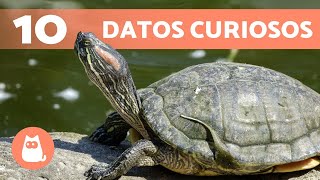
This is a YouTube video titled "10 CURIOSIDADES sobre las TORTUGAS que no conocías 🐢" created on November 21, 2021. The content is an informative monologue explaining ten interesting facts about turtles, covering their anatomy, communication, longevity, and conservation status. The video is educational and aimed at animal enthusiasts, providing detailed biological and ecological insights about turtles.
Do you like learning interesting facts about animals? In this animal expert video, we explain 10 interesting facts about turtles. Let's take a look at them. First, they don't have teeth, but this doesn't limit their ability to feed, since some species, such as the UT turtle, have keratin structures on the palate, around the jaw and even towards the esophagus, which help them retain and process food. Other species, such as the green turtle, rely on the serrated shape of their jaw to hold food. Second, they don't have vocal cords, but this doesn't stop them from making different types of sounds to communicate. Although we can't clearly hear the sounds made by these animals, they do make them in fact of different types and frequencies. For example, tortoises make certain sounds mainly during mating. 3. Turtles don't have ears. They don't have external ears. That is, they don't have ears, but they do have an auditory system made up of a middle and inner ear which allows them to hear. 4. The shell is part of the spine. The shell provides some protection against predators and blows. Although its hardness varies from species to species, this structure is not an exoskeleton. It is a modification of the animal's rib cage that also forms part of its spine and ribs. Discover the story of a sea turtle that was rescued with a fractured shell in the video we have provided above. 5. Not all turtles have the same type of neck all turtles are grouped in the order Testudines, but they are divided into two suborders. On the one hand, there is the suborder Ploridera, which includes turtles that can move their heads to the sides since the vertebrae of the neck flex laterally. On the other hand, there are those of the suborder Cryptodera. This group includes those that are capable of retracting their heads into the shell because in this case, the vertebrae of the neck can flex vertically. 6. There are giant species within land turtles there is a group of 12 living species known as giant Galapagos tortoises, which are the largest turtles currently in existence. Some of these can weigh around 400 kilograms and measure 1.8 meters. 7. They communicate before hatching. Sea turtles, while still in the egg and about to hatch, are able to hear the sounds emitted by the females grouped together in the water, which they do to guide the young. The young also make certain sounds to communicate with the rest of the young that are about to be born and in this way synchronize themselves for hatching. Here above, we leave you a video about the rescue and birth of sea turtles in Barcelona. 8. Temperature determines sex. Thus, in several species of turtles, the temperature of the environment where the eggs develop determines the sex of the embryos. However, there is no single process. In some cases, high temperatures cause more females and fewer males to form. In other cases, males are formed if there are intermediate thermal conditions, while females and the temperature are located at one of the extremes. 9. They are very long lived. They are animals that grow quickly, which allows them to develop to protect themselves, mainly with their shell. Once they have matured, their development slows down and they age slowly. This gives them a significant longevity of more than 100 years, as is the case of the giant tortoise of Santiago, among others. The Guinness Book of Records lists one of the longest living turtles we know, Tui Malila, who died at 188 years old. Likewise, in 2006, Adata, a giant tortoise from Aldraba who lived in a zoo in India and is suspected to have been over 250 years old, died. 10. Many species are in danger of extinction. We end with one of the most devastating facts. There are many species of turtles that are threatened for various reasons. For example, in the case of marinas, aspects such as climate change, pollution, hunting, bycatch and excessive boating have had a significant impact on these animals. If you want to continue learning interesting facts about animals, don't miss the playlist we've left for you here. Tell us which of these surprised you the most. Until next time, experts.