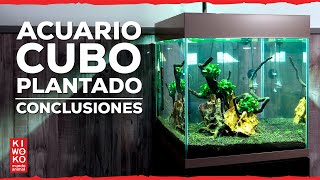
This is a YouTube video titled "ACUARIO CUBO: Características y Curiosidades | ¿Por Qué Elegir un Acuario Cubo? | KIWOKO" created in March 2025. The content is a detailed monologue by a single speaker explaining the setup, maintenance, and equipment of a medium-sized tropical planted aquarium cube. The speaker discusses water parameters, filtration, lighting, CO2 supply, and plans for adding fish, providing practical advice and promoting related products. The video is instructional and focused on aquarium hobbyists.
Foreign Hi everyone. In the previous video I brought you the planting of this wonderful cube that is going to be a planted community tropical aquarium. We are going to have super cool plants. It is going to be a medium sized aquarium. Today I am basically going to reveal the characteristics of the aquarium and what makes it different. I will also tell you about the devices that I am using and also some of the interesting facts about this beautiful setup. As you can see, the biotope is doing great. It has been more than seven days since I first set it up. When I filled it, I have been doing water changes every 48 hours. These are water changes of approximately 30 to 35%. I have to say that when you want to set up a medium sized or high requirement planted aquarium, if you are using a nutritious substrate, you are going to have to do a lot of water changes in the first few weeks because otherwise you are going to have problems with algae. One thing I would like to highlight is that I have analyzed the water every day since I started this project. Right now the PH is still a little low and my nitrites are high. But it's in an area that's not yet toxic. Which is why I've dared to add some first shrimp. They're hand caught shrimp. They're also multi toothed. They're going to help us mechanically by eating any little algae. And I've also added some rainbow guvios which are also very good algae eaters. Having made this aside, I'd like to point out that when you want to create a medium sized planted aquarium like this one, and you really want plants like these ellacharis to start growing vigorously, it's important to add, in addition to a nutritious substrate, an extra supply of CO2. As you can see, we already have a supply of CO2 in the aquarium. We have good lighting. I've made some videos about CO2 systems. Don't worry, I'll also make a video about this aquarium. I'd also like to highlight how well the glue has worked. It's been a real wonder. As you can see in previous videos I used cable ties. But this is a great solution, especially because I was able to glue the plants well. I'm using some Anubias, Nana bonsai against the roots and trunks. In other words, I'm very, very grateful for this glue. Highly recommended. As for the devices, I haven't made a very long video putting in all the pipes and absolutely all the points. Don't worry, I'll make specific videos about the lighting system. Filtration, etc. Etc. Etc. But I would like to go over them with you. We have a wonderful lighting system up here. It's a kill sound, ideal for a planted aquarium. It's very powerful. It's one of the small ones from Kessel and works great for this type of aquarium that is lined underneath, which needs a lot of light. Then I opted for a classic version, the smallest from heim, as an external filter. And you may be wondering, hey, why an external filter? And why not a waterfall? I was looking forward to installing an external filter in this type of small setup because in the end they are less noisy. And as you can imagine, here at home I have a lot of aquarium and what I want is to reduce. It can be done with either of the two filters I have preferred. I insist the 2211. It is a wonderful filter, silent and above all it saves a lot on the electrical part. I have also opted for the thermo heater system. From him I have chosen the preset Thermo heater, the 50. One of the advantages of this is that you put it in the water, connect it and it has a thermometer inside that turns on when it needs to reach 25. If it exceeds 25, it turns off the continuous temperature of this Thermo heater is 25. Ideal for a planted aquarium. You don't have to do anything else. I don't know if you can see at the end there is a small device that is basically giving me the reading of the CO2 dissolved in water. It is very easy to use. It works with a reagent. In this case I had one from Aquamedic. Something that is quite helpful for knowing, as you know, the dissolved CO2 levels in water. Having said all that, I insist once again that I will make specific videos where I will explain each of the devices. I have stored all the devices here, both the filtration system and the entire lighting section and the CO2 bottle. To to finish this video, I am going to start siphoning. I am going to siphon very carefully the top layer of the substrate and remove all the dead leaves to basically reduce possible problems with algae. As I always say, the intention here is for the water to be fine before adding the next fish. My intention is to add the first fish in the coming weeks as long as the water conditions are excellent. I have a small internal debate about which species I am going to add first and which ones I am going to take care of. So follow our videos. We are going to continue making very interesting content about setting up a medium level tropical planted aquarium. And if you're interested in purchasing any of the products we have, visit our Kiboko stores. I'm still here. Oh, and don't forget, hit the bell. Send me a comment if there's anything you need to know. And thank you very much.