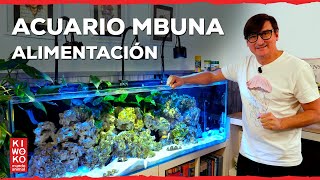
This is a YouTube video titled "ALIMENTACIÓN para un Acuario Mbuna 🐟: 【Serie: Parte 7】" created in January 2025. The content is a detailed monologue by a single speaker explaining the feeding regimen, dietary needs, and care tips for African Mbuna cichlids in an aquarium. The speaker discusses fish species, feeding schedules, types of food, and aquarium maintenance to ensure fish health and reduce aggression. The video is educational and focused on aquarium fish care.
Foreign. Look how the fish are doing. They have adapted wonderfully. We now have 12 species of African Mabuna Cyclia. Yes, these come from Lake Malawi in Africa. As you can see, each species has found its space. They are making some holes for me in the sand. I can really see them and I see them swimming perfectly. There is great harmony. As I have already told you in other videos, what makes these aquariums different is that the water conditions are going to change. They are animals that need a high PH and K. It is also important that they are very territorial and need lots of spaces to hide. But today it is time to talk about feeding and how it influences both the animals more or less aggressiveness as well as the care and maintenance of your aquarium. It is important that you know about the diet of these fish. Most Mabuna fish are usually herbivores. Note that there are also some omnivores, but most like to eat algae. There is a topic here that I would like to dwell on. These animals need to have a full belly. What does this mean? They need to eat several times a day to reduce stress levels. If you're not feeding the animal properly, it will eventually get stressed and go for another one. And you'll stop having real harmony in your aquarium. And all you'll have to do is have a constant struggle. It's important for you to know this. Why? Because since you're going to have to feed your fish several times, I recommend that you have a feeder and that you can program the feeder to feed them at least three times a day. Of course, small amounts. Remember that in this aquarium, unlike other aquariums, we don't have enough plants. So nitrogen complexes like nitrate will increase. And this can cause algae to appear in your aquarium. Here are two tips. Make a 10 to 15% change once a week. Second, and very important, the fish must eat the entire amount of food. Any excess food must be removed from your aquarium because otherwise more algae will be generated. And finally, lastly, the filter media. Remember that in previous videos I have shown you products that help us, such as phosphware, to eliminate excess phosphates, silicates and nitrates. This will be a continuation of the filtration system. Don't stop using these products so that you can have an algae free aquarium. This is the proposal for feeding my fish. I have chosen these three formulas. One from Ocean Nutrition, one from Wax and another from jbl. Here I will explain why. Remember that my fish are juveniles. They have entered the aquarium. The aquarium is less than six weeks old. It is still growing and the Animals are still quite small, so I have chosen eston nutrition, which works very well. It is a diet high in plant products, but it is also suitable for some omnivores. In other words, the protein they will have here is mainly from shrimp and this comes very well from krill. I have it inside the feeder and it automatically falls twice a day. This formula also has a pellet that is a semi moist pellet. It is a soft, small pellet. I repeat, my fish's mouths are small now and this diet will be very good for them. I also like to give them this wax food once a day. A food that works very well. The concentration of green protein is higher. It has 10% spirulina. It is a food that unlike diacetynutrition which descends the this one stays more in the upper area where the fish can eat. And it is also important to play around with that so that the fish can eat at different heights. I am going to use this food once a day. The grain is true that it is a little larger, it is a dry grain, but they devour it, they love it. It has a very, very good flavor. And finally, I am using this flake formula from jbl. As I've told you in previous videos, flakes are an option for me. They're not what I usually use. But it's true that for Mabuna cichlids, from what I've read, it's important to give them flakes. Why? Because of the animals physiognomy. These animals usually eat algae from the rocks, so it's very good for them. And what I usually do with this food is not to keep it inside the feeder, but to give it fresh myself. And this allows the animals to go to different hiding places to look for it. It's a food that has, pay attention. 20% spirulina. This is wonderful. Spirulina will help your fish have better color and above all its immune system will be super strong. So this is my suggested diet for my fish. What I'm looking for is for the animals to gain attention, strength, to be really fat and to stay healthy. On the other hand, we must comply with the nutritional aspect that they have a lot of green food. And finally, as I was saying, we can also gradually add products that with their carotenes can help the animals to gain color, which is one of the most beautiful things about Mabuna fish, those vibrant colors, you will gain those colors. When the diet is an optimal diet, it is a good diet. It is true that outside of the diet you can give them some peas from time to time. You can give them some endive, or you can give them some lamb's lettuce. I am going to stick directly to the diet this formula that I have mentioned, because I want to do a test and see how my fish evolve over the next few months. And finally, as I have done in previous videos, we are going to talk about how important the feeder is. Hein has a feeder that is a magnificent solution. But now you can also buy this, which is a base for the feeder. Look, a feeder is very easy to program. It's like one of those old wristwatches. I put a base here so that I can take it off and stick it back on, fill the feeder and make the adjustments. It's very simple. Right now, it's programmed. It's 11:52 in the morning. It's programmed for a double feed. One at nine in the morning, one at two in the afternoon. And to fill what would be this, the chamber, the container. It's very simple. We're going to leave this small opening. Now I'll explain why. Let's put the food in. I recommend that you put it on the lid. Don't pick it up with your hand, because sometimes the moisture from your hand can spoil the food. We cover it here, and this is the amount that I'm going to use. Another thing, if you are not going to be there for very long periods, do not fill the feeder to the brim. Because sometimes the feeder, after several weeks can get damp and can lose a lot of the vitamins and nutrients which can be affected. So we put a little bit of food in the feeder, close it, and put it back on the platform. The first few times, we are going to leave a very small opening and we are going to see how much food falls and how long it takes them to eat. These fish should eat the entire portion in less than a minute. One of the interesting things about the platform is that, as you can see, it has this funnel pointing inwards. This allows us to ensure that the food always falls into the same spot so that the fish always come to eat here. And we do not have food all over the aquarium. With this food, we are going to be feeding it twice a day. This solution is ideal. Well, let's do a test. As you can see, it is not very open and perfect. As you can see, the food has been consumed in less than a minute. This was what we were looking for. Now I'm going to use the wax food so that you can see it a little. As I said, this food is going to try to cover the entire middle area of the aquarium. As I said before, it's always good to use the food in the cap and from the cap to the aquarium, very small amounts. As you can see, everything that can be consumed in less than a minute. And finally, I'm going to use the one that comes in flakes, and I'm going to take advantage of the filter current so that I can completely take it to all parts of the aquarium. Well, if you have any questions about feeding the fish in the aquarium, Maguna, don't hesitate to write to me. I'll be here to answer you. Remember that all these specific foods, both the feeder and the platform, are also available in our stores and at kiwoko. Com. And finally, subscribe, because we're going to continue making wonderful content for the care of your aquarium.