ALIMENTOS CASEROS SALUDABLES 🍳🐟 para GATOS 😻
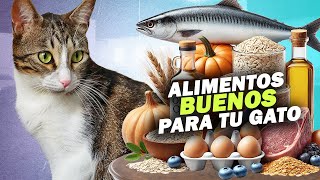
Veterinarian Carlos shows which homemade foods are safe for cats: eggs, fish, meat, vegetables, and fruits. He covers nutritional benefits and food safety rules for feline diets.
Foreign Hi, I'm Carlos and I'm a veterinarian. Welcome to the Happy Pets and Families Channel. What are you watching? You're probably tired of always hearing me tell you about the things you shouldn't do with your cat, but today I'm going to talk to you about a series of foods that your feline companion can eat and that can be part of a complete, safe and balanced diet, always within certain limits, of course. These are a series of foods that we all have at home or that are very easy to find and that you probably didn't know that cats can eat. Well, some of them you do. First of all, I have to tell you that all the scientific articles that I've used to bring you this information, as always, are in the description box, so you can take a look if you're even a little curious. And with this video, I'm not telling you that you have to give them all these foods in addition to their dry food. If you want to give your cat a homemade diet that you prepare yourself at home, what you need to do is consult a veterinary nutritionist, a professional who will formulate a specific diet for your cat so that you don't fall short or go overboard with the nutrients it needs. Eggs. Well, what can I tell you? Well, they are a great source of protein and also have most of the essential amino acids that your cat needs. However, there is an amino acid in which they are especially low and that is essential, very essential for your cat. In other words, vital. I am referring to taurine. As you know, taurine is related to your cat's health because it affects the development of, for example, their eyes or their heart. Therefore, if we give our cats diets low in taurine, they may develop diseases in these organs. Eggs, on the other hand, can prevent some diseases or improve the health of some parts of your cat's body, such as their joints or even their skin. And their consumption can also be beneficial for solving some problems, such as gastrointestinal problems or, for example, when there is obesity. Of course, you should only offer them to your feline companion, cooked, boiled or grilled, never fried, okay? Because otherwise we would also be providing a large amount of fat and of course, never with salt. And you should never give them raw to your feline companion companion. On the one hand, because eggs can have the bacteria called salmonella, which can cause gastrointestinal problems, diarrhea, infections, food poisoning. And on the other hand, if we leave them outdoors for a long time, they can also become contaminated with other bacteria and cause them to grow, also causing an infection in our cat when it eats them. Well, but apart from eggs, there are some foods that we all have at home that we can give our cats so, such as olive oil. Cats can eat olive oil without any problem, always in the right amount, because after all, it is fat. Olive oil provides polyunsaturated fatty acids that are healthy because they have anti inflammatory and antioxidant effects. And it also provides high amounts of vitamins A and E. It can be indicated, for example, when our feline companion has skin problems. These fatty acids act in a beneficial way to improve the health of the external part of the body, such as the skin and coat. However, if we abuse fats well, we already know what happens to us. We end up gaining weight. And exactly the same can happen to your feline companion. And if we ingest a high amount of fat, we also cause some organs in our body to work excessively, such as the pancreas or the liver, which are the organs that are responsible for digesting or metabolizing this fat. An excess of these fatty acids can cause your cat to suffer from pancreatitis or fatty liver. So don't come and say, oh, olive oil is very good. Carlos told me, come on. A drizzle of olive oil in my cat's food. You should always feed it to them as part of a diet that has been formulated by a specialist. Cereals. But be careful, I'm only referring to whole grains. For example, rice, wheat or whole oats. Oh, my goodness, I just saw wigs flying in the house. Because everyone is always saying that cats are strict carnivores. How is it that a cat can eat cereals? Well, it has been shown that our feline companions are highly efficient at digesting cereals. But cereals provide a high amount of carbohydrates. Our feline companions do not have to base their diet on these carbohydrates, but on proteins. When given in the right amount, they can have beneficial effects for them. For example, they can provide them with fiber. And we all know that cats, for example, swallow a lot of hair when grooming themselves. So fiber can help them expel hairballs from their intestines. But if we overdo it, it can have a negative effect on our cat's digestion, causing diarrhea or gas. Of course, the way to give them food is always to be cooked. But you shouldn't add spices, salt or fats, because that can only make it difficult for our cat to digest. Or some spices can even be harmful to their health. And now let's move on to a classic. Among the classics of foods that our cats like and can eat. I'm referring to fish, but of course, you already knew that. What I'm trying to tell you here is that there are some fish that are more beneficial than others for our feline companions. As you know, fish is generally divided into white fish and oily or fatty fish. Oily or fatty fish are the ones that can provide the most benefits to our cat's diet. It is true that they have a lower amount of protein compared to white fish, but in return, they provide fatty acids that are beneficial for our feline companions. It's a bit like what I told you about the oil. The omega 3 fatty acids that oily fish have have beneficial effects on your cat's skin, but also on improving the health of their joints and kidneys. They have a pro anti inflammatory effect, reducing inflammation. And in the same way that I told you when I talked about eggs, you also have to give them fish. Cooked but oily or fatty fish can be divided into large fish, such as tuna or small fish, mackerel, sardines or herring. The most beneficial for our feline companions are small fish because they accumulate fewer pollutants and heavy metals that can be harmful when consumed in large quantities. And so this is where your question comes in. Can I give them tuna? Well, of the blue ones, it would be one of the least recommended because it is larger. But also, you probably don't give your cat fresh tuna, but rather canned tuna. Regarding canned tuna, I have to make a very big clarification. They are not beneficial for our cats. Why? Either because they come in olive oil or sunflower oil in natural water, but salted water cans always provide a very high amount of salt to our cats. In fact, if you give your cat a can of tuna a day, even if it is natural, you will be providing them with almost half of the total amount of salt that your cat needs per day just with that can, which is outrageous. So sardines, herring, anchovies, all of these are fine for our cats. But there is also another small warning that needs to be made. If you give them to your feline companion, I would at least try to remove the bones because that way we can prevent our cat from gluttonous eaters. It's true that some people will tell me, well, cats have eaten fish all their lives and they've never had any problems. Of course they can chew the bones and break them, but if we can avoid any kind of inconvenience for our feline companion. Why wouldn't we do it? And speaking of animals and fish, we also have to talk about meat. I've already told you that cats are strict carnivores and that their diet must be based on meat or animal products, to be more exact. Cats have one very, very good thing, which is that they can obtain energy from the metabolism of proteins. And meat in general provides a high amount of protein, approximately 20 grams for every 100 grams of meat that we give them. That's why, as I said before, they have to be the basis of your feline companion's diet. But you also have to give your cats other things, because meat in general is poor in some very important vitamins, such as vitamin A or vitamin D. Vitamin D is also closely related to the absorption of calcium in the intestine. So if we or our cats lack vitamin D, we may absorb less calcium, and that affects the health of our bones. The bones demineralize and become much more fragile. That's why our cats diets can be based on meat. Yes, but always complemented with other foods. And of course, always cooked and never raw, boiled in water without salt or anything, or grilled, never fried or stewed or parboiled, as they say in some places. Because that's where we've added more ingredients that may not be beneficial for your cat. Meat contains a lot of bacteria that can cause problems for your cat, for example, diarrhea. It could also be that the meat has salmonella, as I mentioned before with the egg, or Campylobacter, which is a bacteria that is very present, for example, in chicken meat. But meat can also contain parasites such as trichina or Trichinella. Or if you give your cats offal, such as liver, it can also include parasites such as dog tapeworms that also affect cats and can also affect you. That is why you should always give your cat cooked meat. And I will never tire of repeating it. Before we stop talking about meat, I have to warn you about bones. You should never give your cat bones. I don't care if they are cooked or raw. Well, if they are raw, much less so because of the bacteria issue. But if they are cooked, they also splinter easily and can also cause intestinal obstructions. The bone gets stuck in the intestine. It doesn't go back or forth. And that is a very dangerous situation. And the barber can tell me that. Let him tell me. I don't care if they come here in a line, because I've seen many cases in the clinic of dogs and cats that have had problems eating bones. That's why it's better not to give them to them. And in terms of vegetables, one that is good for our cats and that they can eat is pumpkin. It's possible that if you are feeding your cat a commercial diet with dry food, with dry kibble, one of the vegetables it includes may be precisely pumpkin. And this is because pumpkin really provides a huge amount of fiber that, as I've said, can be beneficial for our cats to help them with those constipation problems that they may have due to hairballs. Of course, your feline companion may not like pumpkin on its own. That's why it is usually mixed with other foods that appeal to them more, such as meat or fish. While we're talking about vegetables, I can't forget about fruits. Well, they don't have to be your cat's dessert. They can also be incorporated into their normal diet. It's true that our feline companions may not be too interested in sweet flavors, because, as you know, cats perceive sweetness a little less than other animals, or at least we do. But there are some fruits that are very interesting to our feline companions. I'm referring to blueberries. So if you ever want to give them as a reward so that they play with them for a while and even eat them, you can do so. But I doubt that they'll like them. However, the interesting thing about blueberries is because they provide a high amount of fiber and which is always good, but also vitamin C, which has a very important antioxidant effect. And they can also help us prevent some problems that our cats often suffer from, such as urinary problems. They improve the health of the urinary tract and prevent, for example, the appearance of urinary tract infections. Therefore, they can be more than beneficial for our feline companions. And precisely because of all this, it it is one of the foods that you can find in many commercial cat food formulations. In fact, for some time, we gave our cat cans of this wet food that contained blueberries, and you could see the blueberries whole. And with this video, you can get an idea of some foods that are beneficial for our cats, which may have led you to read the label of the food you give your feline companion and say, hey, why do I think my cat's diet has pumpkin? Well, here you will find the answer, probably because it increases the amount of fiber. And it can also be useful if you have ever decided to cook for your feline companion and have been given a specific diet. So that you know. Hey, look. That's why my cat's diet includes eggs. And since there are many more good cat foods that I haven't been able to talk about in the video, let me know in the comments if you were interested because we can make more videos or if there is one in particular that really caught your attention. I don't know if you knew that you could give your cat Pumpkin. If you also liked the video, give it a like. And remember to subscribe to the channel if you haven't already. You can also support us a lot if you give us a super thank you. Remember that we have a secondary channel here on YouTube called Questions and Answers from a Veterinarian. And before we go, as always, we have to meet this large canine and feline family. On the one hand we have Bowie, who is a dog that lives with all of them. Al Capone is the black and white cat. On the other hand we have Don Vito, the blonde and white one, Rita, the kitten, Carrie and Nilo, who are siblings. They all live with their humans, Laura and Jose Luis. Greetings to everyone from San Luis del Potosi in Mexico. We are greeted by a family made up of Vero, Ulysses and Tasuki, who. Tell me what the moon means in Japanese. I didn't know. And finally we have Stephanie Rodriguez, who is Severus, human companion. They both greet us from Chian in Chile. Thank you very much for following the channel. Happy pets and families and here with Alchofo and this bad life he leads. We'll see you in the next video. Not there, not here. That's the computer there. It starts with the eggs. Does that sound okay to you? I'm playing. With none of the nutrients that he needs. None of the nutrients that he needs. The nutrients with the nutrients that he needs. With the nutrients of the nutrients of the nutrients that he needs. I mean, to start with, raw eggs can have salmonella. And to continue. Okay, come on. I'm going, I'm going, I'm going. First, salmonella that only eggs have, and second, making bacteria grow. No, it's always going to be positive because the video is positive. No, I don't want to do that. Okay. Oh, kitty. What's wrong, cat? Yeah, now you're even rewarding him. I'm the only one educating you here. How am I going to help you with your education? Your father spoils you. Oh, my kitty. Let's see, let's see, let's see. I mean, wait.
More from Javier

Cuando nadie reconoce tu dolor por la pérdida de una mascota: así es el duelo desautorizado 💔




¿Tu perro hace suficiente ejercicio? Mantenerlo activo es clave para que viva mejor 🐶💪

GATIFICANDO UNA PARED PARA MI GATO 😻🧗♂️ Ideas para aprovechar el espacio vertical en casas pequeñas



Por qué duele tanto perder a un perro o un gato: el vínculo que explica nuestro duelo 💔🐾

