BARF🥩 comida FRESCA🍲 y alimento seco A BASE DE INSECTOS🐛 para GATOS 😼 | Nuevos tipos de alimentación
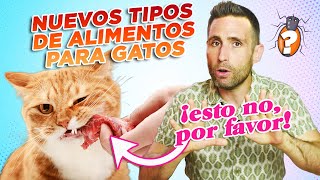
Veterinarian Carlos explores three modern cat diets: insect-based kibble, commercial BARF, and fresh commercial food. He weighs the pros and cons of each approach and explains what cat owners should consider when choosing what to feed their pets.
Do you think your cat is getting bored of always eating the same thing? Well, today I bring you the latest trends in feline nutrition so that you can get some ideas. Hi, I'm Carlos and I'm a veterinarian. Welcome to the Happy Pets and Families channel. One of the biggest fears of any family living with a cat is that their feline companion will end up getting bored of their food. We're tired of hearing about natural foods, ancestral foods and instinctive foods in advertising. Well, there are a lot of things that may sound like commercial claims and we don't know if they're right for our cat or if we can use these foods to motivate our feline companion to eat what they're supposed to. Natural foods don't have artificial preservatives. That's the basic concept. On the other hand, instinctive foods are the ones that our cat would eat naturally. If you put a piece of meat in front of your cat and for example, a watermelon next to it, the cat will normally gravitate towards the meat. Therefore, meat would be an instinctive food and ancestral food would be food that our cat would eat in its natural wild state. For example, an animal that it has just hunted. Well, with this clear, we are going to talk about three innovative ways of feeding our feline companions. Insect based diets, commercial BF type diets, and fresh commercial diets. I will tell you the pros and cons of each of them and if any of them seem like a good alternative to me. Insect based diets. Although it may seem strange to feed your cat insects, the truth is that we could say that these types of diets are instinctive for our cats. Of the total diet of a cat living in the wild, insects account for up to 6%. And if not, tell me if your cat has ever eaten an insect. I don't know. It doesn't have to be a cockroach, it, it could be a fly, for example. This type of food has quite a few advantages. One of them, for the more eco friendly among us, is that insects have a smaller impact on the environment. Producing insect based food for our cats has a smaller carbon footprint and uses fewer resources. And for those who say, well, but an insect feeds him the same as a piece of meat. Yes, the nutritional value of insects is very high. They have a very high amount of proteins and also a large amount of energy. In addition, certain larvae also have a high amount of fat and insect proteins are quite similar to those of other animals. Therefore, the amino acids that make up these proteins will adequately nourish our feline companion. All this if we also consider that they have a high or moderate digestibility. That is, our cat can take advantage of them quite well when eating this type of protein. On the other hand, they are foods that are quite well tolerated by cats because the flavor can catch their attention. And also the external shells of insects provide a large amount of fiber. And as a final advantage, I have to tell you that cats need to eat less insects, less weight of insects than food, for example, chicken meat, to meet their daily needs. If a cat requires 130 grams of chicken thigh meat to meet its daily protein needs, its equivalent in crickets, for example, would only be 43 grams. And this also happens with other nutrients such as fat. And it doesn't only happen with crickets, as you can see in this table. And if you're wondering how you could feed your cat insects, I have good news. You don't have to eat them or raise them at home. There are already commercial insect based diets sold in some countries. In fact, I think there are some in Spain and in Latin America. I think there are some in Chile and Mexico too, and in the rest of the countries. Leave me a comment if you've been able to find them in the store. But don't rush too much, because these diets also have some drawbacks. The main drawback, especially when it comes to making them, is that there are many differences in terms of the composition of the different types of insects and the phase they are in. The composition of a cricket in its adult stage of proteins and fats is not the same as in its larval stage. Generally, the larva are much richer and that's why they are the ones that are fed used to make commercial foods. On the other hand, insects are a very poor source of some amino acids that our cats need to live, such as methionine. Of course, these two drawbacks will affect you very little, because when you give your cat a commercial diet made from insects, it will already be correctly formulated and will have been supplemented with the amount of methionine. And the manufacturers will have made sure that the nutrients given to your cat with that food are balanced and respond to the needs that it has. But as always, it will be up to us to read the label and make sure that it meets what our cat needs. And to know how to read a label correctly, you have to watch this video on the channel where I explain absolutely everything. There, I do not talk about insect proteins. I am constantly talking about other animal proteins. But it is 100% applicable to these cases because the rules with which the labels are made are the same for insects, beef, chicken or whatever. But the two most important drawbacks for our cats are that on the one hand, there are very few long term studies done on cats on how these types of diets affect them. There is a study that tells us that 3 out of 10 cats decide to eat less of this type of food because it does not appeal to them as much. And in fact, one in that study also vomited after eating it and began to eat less food as a result of having vomited. And the other major drawback is that there are no studies that have evaluated the risks that insects can transmit to our cats. It is true that commercial insect based diets are heat treated, they are heated and therefore the bacteria have died in that process. But it is also true that insects can transmit a series of other things, such as contaminants, because the substrate where insects are raised generally comes from, for example, agriculture which is not used. So some pesticides or contaminants in the plants on which the insects are raised could end up in your cat's food. As I say, this is not currently proven, but there are few studies in this regard. And that is why I would like you to know more. In the future, more studies will be conducted to ensure 100% that this food is safe for our feline companions. But this is the same as what happens with a chicken that is eaten from soil that has a stink.
Yes, but chicken. Chicken food has been analyzed for a very long time and there is still very little scientific data on insects. It is true that what we have is safe. Yes, but I would like them to be more analyzed. And since they want to make some progress in feeding cats, we should also have more scientific data to be able to ensure that our cats can eat this type of food food in the long term without problems. And my general opinion is that it seems like an interesting source of food for cats. As I said, I want the study that I had with my Liu and it is true that my Lou did not like it very much and did not eat it as happily as the food she normally eats. But anyway, there we have it. It is another option that we can take into account. In any case, as new data comes out, and if you are interested, I can all continue talking a little bit about insect based diets on the channel. If you want, please tell me in the comments. And maybe later on the channel, we'll have a specific video about this type of food. Commercial Barf type diets. And I'm making this exception about commercial diets, okay? Because I'm not going to evaluate the barf diet that you can make for your cat at home, because I already talked about that on the channel sometimes time ago. So there are some barf type diets that are currently starting to be marketed and that tell you, well, they're perfectly formulated with your cat's needs. You don't have to worry about anything else. You don't have to buy anything more than this little tray or this little package. And with that, your cat will be well fed. What do I think of these diets? What are their pros and cons? Let's go with the advantages. The first of these is that it is an instinctive diet, or we could even consider it ancestral for our cats, depending on what the protein is made of, because obviously cats would not consume much beef protein in the wild. That is why these diets are highly palatable. Our cat will choose them and will probably eat them very, very happily because they will like them. It is also a diet with very high digestibility. The cat will also have much more compact and less voluminous poop. And since it is a diet with a very large amount of water, because meat is mainly made up of that water, our cat will be well hydrated. On the other hand, they are made up of natural ingredients, they are not processed, and they do not have artificial preservatives. That's all for the pros. Now let's talk about the cons, which I can tell you are quite a few. As I've been telling you in this video, I'm giving you a bit of my opinion. But the information I'm giving you is based on scientific studies. So it's not something I say, it's something that's been proven by science. And I want to make it very clear about the bar type diet because it has some very staunch followers who often ask me where I get my information. All the studies are linked in the description box available to anyone who wants them. I don't care what you give your cat. I'm giving you information so that you can form an opinion. Don't come to me with your nonsense because in the end you have to make the decisions. I'm not making a decision for you. The main drawback of these types of diets is that they are raw. And the fact that a food is raw, regardless of whether it's frozen or just refrigerated, means that it can carry bacteria. In fact, there are many Studies that show that commercial barf type diets are contaminated with certain bacteria such as salmonella, and that these bacteria not only pose a risk to your feline companion, but they can also pose a risk to. There are some studies that have shown that raw barf type treats are the source of a salmonella infection within the human family. And that is very, very dangerous. This is transmitted because you contaminate the surfaces in your home, for example, the kitchen, or where you have prepared the cat's food, or even because you do not have sufficient hygiene. And after giving your feline companion the treat, the raw treat, you put your hands in your mouth and you can become infected with salmonella. So if you are going to follow this diet, hygiene is essential. Always wash your hands thoroughly after handling food and clean all surfaces. Use a good disinfectant, please. But it is not only salmonella that we have to worry about. Listeria monocytogenes, which is a fairly dangerous bacterium because it can cause miscarriages in pregnant women, diarrhea, vomiting, chills and high fevers in other people who may contract. The infection, is present in many commercial barf type diets. And if you're thinking, well, I don't care because I'm going to freeze my cat's barf diet and that way we'll kill all the bacteria, well, no, because many of these bacteria survive freezing. I have the data I want to give you here. 54% of frozen commercial barf type diets sold in the Netherlands were contaminated with hysteria. And up to 16% of frozen diets sold in the United States also had it. But this is due to poor food handling, right? That's because listeria is present in meat. And since you give it to your cat or dog without cooking it, in the end it's around and it reproduces. That's just how it is. On the other hand, barf type diets have to be very, very well formulated, even though sold commercially, because it is very easy for them to deviate a little and that could lead to malnutrition for our cats. There are studies that say that commercial barf type diets have deficiencies in vitamins A, D and E. And another very interesting study discovered that a commercial barf type diet made with rabbit provided very little taurine for cats. And as you know, the amino acid taurine is essential for our feline companions. It is vital. And cats that consumed this type of diet ended up developing heart disease, a heart disease due to taurine deficiency. And I can tell you this from an empirical point of view, because I have experienced it in the clinic and it was the day I stopped believing in the barf diet. It can also pose risks to our animals due to problems with other bacteria such as Campylobacter. Suddenly, dogs that were consuming barf type diets with leg paralysis began arriving at the clinic. Eventually, after investigating, we were able to conclude that there is a disease caused by a bacteria called Campylobacter, which is very common in Chicken, which causes polyradicule 1, neuritis and paralysis of the extremities. Over time, the dogs recovered, in case you're interested in the end of the story, but of course, it's not something that I would recommend your feline companion go through. For all of these reasons, I do not recommend barf type diets, neither the ones you make at home, nor commercial barf diets. Furthermore, for all the followers of raw food, for our animal companions who say that it has a lot of advantages, that it means that our cat is healthier and that it will live longer, I have to say that there are no very solid studies in this regard. There is a huge lack of scientific evidence, and that is why we cannot say that all of these supposedly beneficial effects will occur in all animals. And since I know that every time I talk about the barf diet, I end up causing a stir, and there are a lot of people who start to make comments that aren't exactly very nice, I have to say that I'm just providing information here. I'm giving you the information so that you can do with it what you think is right. The scientific studies, I repeat, are all in the description box if you want to look at them. If you want to do some more research on the subject, feel free. And of course, you're also free to give your cat what you think is right with this video. I want to provide you with the information so that you can choose freely. And now let's move on to the latest big trend in feline nutrition, fresh commercial diets. Well, here I'm also going to include diets that you can make for your cat at home, that you can cook specifically for your feline companion. Foreign we're referring to diets that are made with natural ingredients, that generally have no additives or preservatives, and that have been cooked especially for our cats according to their nutritional needs, but that are fresh, that are not sold dry, like the carrot, the kibble, the balanced food, the feed that we call here in Spain, they are generally sold in small containers. And with that, we Have a complete food for our feline companion. And the key to these diets, unlike the barf diet, is that these foods are cooked and you have to heat them up at home.
Or you can heat them up if you want the cat to like them more. The main advantage of commercial diets that are sold like this is that they have been cooked or sterilized inside the tray or pouch packaging. And therefore, all the problematic bacteria that precisely made the barf diet a not very recommendable altar alternative have been eliminated. They also have the palatability that I was telling you about. The barf type diets having cats will like them quite a bit. The digestibility of this type of diet is also quite high, a little lower than that of the barf diet, which it must also be said, but higher than that of dry food. Our cat's poop will also be more compact and less bulky, exactly the same as what happened with the barf diet. And they also have a high capacity for customization. If your cat has specific needs or likes one type of ingredient more than another, it can be substituted or changed. If you only cook at home, you just have to change the recipe. But if you buy it yourself, there are many options available, depending on your cat's taste. As for the drawbacks, we have to say that it is a diet that is much more expensive than feeding based on dry food or a commercial dry diet. And for me, this type of diet would not be an alternative if our feline companion has a specific health problem, for example, kidney problems or heart problems. Because in this case, we need the food to be formulated in a very strict way so that there are no problems or their illness does not worsen. And although the diet does not have bacteria, because it is sterilized inside its packaging, it can be contaminated more easily if you leave it in the dish for a long time. You can't just leave your cat a portion of food ready for you when you go to work and forget about it, because that diet can't be left out at room temperature for a long time. Therefore, it's a diet that you can open, serve, and eat right away. If there's anything left on the plate, it's better to throw it away. And what happens if you decide to cook it at home? You should always consult a veterinary nutritionist, a specialist who has formulated the diet for your feline companion with everything your cat needs and the exact amount of ingredients. With diets that are made at home, we usually have a big problem, which is that, well, to make things lighter or because we don't have an ingredient on a particular day, we decide to skip steps or add less meat because we've run out. In that case, we're malnourishing our cats. And it might not be a big deal if you do it one day, but if you do it systematically, your cat probably isn't getting all the nutrients it needs. And this may seem obvious to you and you might think, well, that's not going to happen to me, but it happens a lot. In fact, there is a scientific study that has shown that diets prepared at home, even if they are formulated by a veterinary nutritionist, even if they have told you all the steps you have to follow, generally end up malnourishing our cats because we fail to prepare them. And if I am constantly harping on about the nutritionist, then all those generic diets that you can find already formulated on the Internet are not going to work for you either, right? Your cat needs two egg whites or 150 grams of meat, right? Because you do not know exactly if you are meeting all its requirements. So never make your cat home cooked food by choosing a generic diet.
But the ones sold in supermarkets are generic for Cat X, yes, but it is not the same. You do not know who is telling you that on the Internet. But what do you know about this that you find on a blog out of nowhere? If it is commercially available, it is understood that there is a quality department behind it and they have done an analytical analysis. And you look at the needs of your cat and you look at the label, hey, this gives it so much protein, 35% perfect because it is above. But you know, bye. How much protein do you know you are giving your cat? For me, this type of diet is a good option, especially those that are already commercially prepared, because you know that you are not going to go over or fall short with the ingredients that your cat needs. I know that there are some sites online where you send them your cat's measurements, weight, breed and they will adjust it to the needs that your cat supposedly should have. However, you should keep a little more thorough check on your feline companion's health at the vet if you opt for these diets. Because as I say, there may be variations that end up being noticeable and end up affecting your cat's health. That's why if your vet is informed, they'll do the pertinent check ups so that if there's any kind of imbalance, we'll notice it as soon as possible. And regarding the diets that you cook at home, I don't see them as ideal, but not because the diet itself is bad, but because it's very easy to fall short or go overboard or not adjust it exactly to what your cat needs. It's something that I usually recommend right away, unless you're a super methodical person who does everything carefully and in a measured way and is always well advised. But even in these cases I have some reservations, especially considering the well being of our cats because of everything I've just told you. But anyway, in any case, it's an option that can be interesting and that you have there if you want to feed your cat a natural diet. And well, with this video I hope to have clarified your ideas a little. Tell me in the comments which one you find most interesting, which one you like the most, which one you like the least. Did you know the drawbacks of these alternatives? Did you know that cats can only eat insects? Okay, well tell me all that below in the box so I can read it to you. And if you liked the video, by the way, give me a like and subscribe to the channel. Okay. Also, if you Click the bell, YouTube might notify you of our next video. And I also remind you that we have a secondary channel here on YouTube called Questions and Answers from a Veterinarian. Come on over and take a look. And don't leave yet because we're going to meet these followers of the channel Blue and Red, or as they're known at home, Baby and Fatty, who live in Alicante with their human companion, Eva Rios, and their canine companion, a beautiful elderly cockerel named Luna. These images that transmit so much peace are from Alvin too, who lives in Asturias with Vanessa and Steel. It's named after Alvin Priero, who is no longer with us. And we say goodbye with the kitten Yuka, who greets us from Mexico with her human companion Sam, who tells me that she wants to be a veterinarian like me. Well, lots of encouragement. Thank you very much for following the channel, happy pets and families, and I'll see you in the next video. So that's good. Well, that's what I'm bringing you today for. That's not what I told you about the video for. Oh, but then it's going to seem like I'm recommending that they give them one of those that I can't watch. I just don't see it because that's already your job. My job is to bring you the headaches of feline nutrition here to all this audience. Hey, here in the first part of the video. I'm telling you, in case it sounds a bit boring. And if you want, we can remove it. We can help give it a little bit of spark. There are three ideas that are Clickbait, because clickbait. My goodness. The obsession. Please. And the ingredients it's made of are. Or not. And the ingredients it's made of the. And the ingredients it's made of form. And the ingredients it's made of the diet the external shells of the insects make. Uh, was that what I was going to say? Because if a cat like that has been made clear. Right. You don't have to convince me of anything because I already have everything. Very clear. And much less if it's insulting, because I have the easy button to block the finger. The finger. Is that Kittylin, Kitlin or I don't know what. My goodness. This is filling up with mosquitoes. If Totoro had a basic diet of insects, we would have already had him for dinner. Well, didn't you like it? Tell me here below.
More from Javier

Cuando nadie reconoce tu dolor por la pérdida de una mascota: así es el duelo desautorizado 💔




¿Tu perro hace suficiente ejercicio? Mantenerlo activo es clave para que viva mejor 🐶💪

GATIFICANDO UNA PARED PARA MI GATO 😻🧗♂️ Ideas para aprovechar el espacio vertical en casas pequeñas



Por qué duele tanto perder a un perro o un gato: el vínculo que explica nuestro duelo 💔🐾

