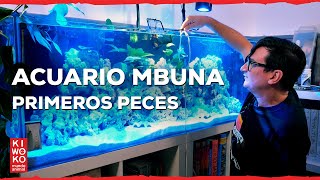
This is a YouTube video titled "Cíclicos Africanos del Acuario Mbuna 🐟: 【Serie: Parte 4】" created in December 2024. The content features a single speaker providing a detailed explanation and demonstration of introducing various juvenile African cichlid fish species into a Mabuna aquarium. The speaker discusses acclimation techniques, fish behavior, and species characteristics, aiming to educate viewers interested in aquarium care and fishkeeping.
Foreign? Yes, they are here. The first batch of African cyclamen that we are going to put in this aquarium. We are building a Mabuna aquarium and these are going to be our first fish. They are all juveniles. They are super cute, small, ideal when you are going to build an aquarium like this because they are less territorial. If you get them as adults, they can be a bit more aggressive. Another issue we have is when we get them as young ones, we can then see if they for pairs and know if we are going to need to add more males or more females Also. Why is everything off? We are in the acclimation process with the lights off. We avoid what is called photophobia, which is that fear of light. On the other hand, to speed up the acclimation process, the fish have already been here for about 10 minutes. We have stabilized the water temperature, but we are going to use a drip acclimation system. This allows us to do all the fish at once and thus reduce stress. Do you want to know more about cyst drip and acclimation topics? We have a bunch of videos where we explain it in depth. Now I'm going to start opening the bags to separate the fish. With almost all the bags already inside the bucket. Look how beautiful. A lemon cycle. A beautiful light cycle. We're going to leave the drip, as you can see, for about 40 minutes. This is the safest system there is for acclimating fish and other aquatic creatures. Hey, I'm going to turn off all the lights now. I insist. They're going to be there for about 40 minutes. And once I've released them all, I'll start giving you brief descriptions of each of the species. Remember, five species of cichlid fish enter the Mabuna tank. Well, after more than 40 minutes and pulling on the glasses, we're going to start introducing the first species. We're going to start with the lemon cichlid, or the Videochromis carass, I think it is. Hey, we have four specimens here. It's worth noting that there's no major sexual dimorphism. They're very, very similar. They're in the juvenile phase and I hope you like them. Now let's move on to the ugly zebra Pseudotrophes. These are the red phase. Pay attention. And they're beautiful because I was wrong. They're not orange, they're red. These animals usually grow to about 12 to 15 centimeters. They tend to be the most aggressive. But we're going to add them now because I've been told that these alset colors aren't usually that aggressive. Here we go with two other Pseudotrophes. But in this case we're going with the Lombardi. One of the really funny things here is that they're usually all born blue. And then when they become the dominant fish, the male usually changes to yellow. And I'm going to introduce a male and a female for the first time. Later on I'll have to introduce two or three females. I don't know if you can see it, but they've disappeared. Yes, they're hiding, but perfectly. You can only see their heads peeking out between the caves. They're loving this place. Now I'm going to move on to these fish which are the bumblebee cichlids. They're a friendly fish. I really like them. This is the goat cichlid. Here we have a surprise. These are some Libidochromis ongoi. They're beautiful. One of the prettiest fish of the Malawi cichlids. Of course, they also have quite a character. And sixth and last in this batch, four beautiful Missoni Pseudotrophes, One of the best known Malawi cichlids. Blue with black bars. Very pretty little animals. They don't grow very big, but they're also very cool. I've already put the first batch in. In the end, six species are all hidden. They really liked all these caves a lot. We can only see the little heads. It's important to discard this water, which is the water the fish came with. It's also important to analyze the water. Don't feed them for the first 24 hours. I'm going to turn off the lights. Leave everything very, very still and very calm so that they can get used to their new habitat. It's been a great pleasure for me to show you the introduction of the first fish, which won't be the last in this Mabuna aquarium that we're building. Remember, if you have any questions, send us a comment. And please subscribe if you like this content because we're going to continue making lots of very interesting videos for Mabuna aquariums. M.