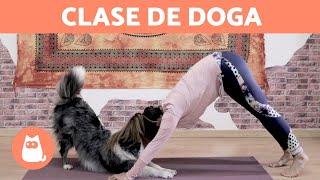
This is a YouTube video titled "CLASE DE YOGA CON PERROS (DOGA)" created on May 19, 2019. It features Patricia Guerrero, also known as Pat the dog trainer, leading a doga session, which is yoga practiced with dogs. The content is an instructional and relaxing yoga session adapted for both humans and their dogs, emphasizing gentle movements, mutual respect, and connection. The video includes detailed guidance on poses, massages, and stretches to perform safely with dogs, aiming to promote relaxation and bonding.
Hi, everyone. I'm Patricia Guerrero, better known as Pat the dog trainer. And today we're going to do a doga session, which is yoga for our dogs. If you want to know what this is, you can watch a video here. First you can see what doga really is and practice it with knowledge. First of all, I want to tell you that you are responsible for your body and that of your dog. Each one of us has our own handicaps and injuries, so you have to adapt the practice to you and your dog. In this practice, you'll see that I do it with Vespa. Vespa is very used to it. We've been practicing for a long time. The important thing is that you adapt it completely to your dog. In other words, don't rush, don't do the poses exactly as we're going to do them, but gradually get closer so that your dog enjoys the practice. Just as you're going to see how you can enjoy it, so let's do it here. As you can see, I'm playing from head to tail. I'll start behind the ears and begin to massage gently. We must never hurt anyone, and above all, we must allow our dog to leave at any time. If you notice, I've let go of my hands here so that Vespa could leave if she wanted to. Now we're going to move on to the paws. We're always going to stroke from bottom to top in a gentle way, as if we were kneading bread, and that's what we're looking for. It's as if we were combing the paws from bottom to top. It's important that this be the direction from bottom to top, the direction of the heart. Let's keep to what I was telling you is very important that you always allow your dog to leave at any time. Now we're going to warm up our muscles. We're going to move our shoulders gently. We're going to sit comfortably and we're going to activate our legs. Now we're going to kneel down and stroke our dog from head to tail. We're going to continue warming up the muscles. And here we're going to do another type of massage. Notice that my hands are open and I'm making small circles towards the tail. Next, we can do what's called Adamukha's Bananasana, or Downward facing dog. This is a pose where we have to try to align our arms with our back and legs. It also so happens that Vespa wanted to do it with me, and it's a way to stretch the back. And here what we do is what's called cat cow. I've also done it to warm up the muscles, also known as marjariasana in Sanskrit. This way we warm up the muscles and then from there we go down and go to the child's pose or Atita Balasana. Here, for example, when we get up on our knees, Vespa is strengthening her hind legs as she goes up. It's important that your dog feels comfortable, especially because here there will be face to face contact. And notice how I look down so as not to look at her directly. Here Vespa already knows the pose and she's already going up herself. Same here you are stretching your back and strengthening your hind legs. Now from Tadasana, that is from a standing position where your feet are firmly planted on the floor. We are going to stretch upwards to the sides and backwards so that we can also stretch correctly. We are going to open our legs, support our feet on the floor and reach all the way down. In this pose it it is also important to activate the legs, keep our stomach strong, that is for the whole body to be aware of what we are doing. We can bend our knees and thus be able to stretch our dog's legs. It is very important that we accompany the movement. We should never grab the leg or force our dog to stretch. When we go to the hind legs, it is very important that we warn our dog that we are going to touch them. In other words, we are going to touch the back in that part first. And these are going to be extensions for a few seconds. And as always, we are going to give our dog all the freedom to go whenever he wants. Here we are going to take advantage of bending our knees a little. We are never going to step over and we are going to keep our legs very strong. Right now we are going to turn the foot to the right and notice how the other foot also turns a little. You can't see it in the video, but you have to turn that foot a little. We would be in Warrior 2 or what is called in Sanskrit, Virapadrasana II. Here what we are going to do is bend one of the legs, trying to make a 90 degree angle with the floor. We are going to keep the hips facing forward very strong. And we are also going to help our dog climb on our leg so that we have to use more force and they strengthen their hind legs. From here we are going to turn and go to Warrior 3, Virabhadrasana 3. If we want to make the pose a little more complicated. We can have our dog climb on top of us and help him strengthen his hind legs and back. We are also going to maintain a straight line between our back and our leg is very important. I prefer it to be a very slight angle, but that the alignment is really maintained. In yoga, you always have to look for that alignment in the poses. From there we go to Domo Caspanana, Downward facing Dog. And also look, Vespa wants to do it too. Once we are down, we can do what is called a twist. Or in the pose, that would be Arda Martin Gana. I apologize for my pronunciation because I am very bad with languages, even though I know them. What we do is put one leg and turn to the other side. The back should be straight. Here I have twisted a little, but it does not matter. Okay. What we are looking for is that small twist. And our dog can twist with us like Vespa has done. Or we could also simply accompany us. Now we are going to stretch our legs here. We are going to touch it. We are going to stretch its little legs in the same. We have to accompany the movement. At no time are we going to force it. For example, if you notice here, I make a slight gesture with the little leg in the back. And at that moment it doesn't feel like stretching its leg. Well, that's okay. We are going to move forward and we are going to keep our backs straight, our legs strong. And when we move forward, what I want is for you to keep your chest forward, Sam. And now now comes the part that you like the most, which is total relaxation. And we are going to get into the corpse pose, or so called sabasana. Here it is important that you put your hands facing upwards. It may seem silly, but it changes the whole sensation. And here you are going to let your dog accompany you too. If it wants, you can relax with it. Put on some music that you like the most that relaxes you, and you are going to stay in this position. Breathing. Always remember to breathe throughout the practice. Inhale and exhale. In fact, this practice, the postures, are the least important thing. What we are looking for is a connection to breathe correctly and also to take the practice as something relaxing and to share and respect each other. I hope you have enjoyed the practice, that you have relaxed, that you have enjoyed each other, and above all, that you have shared a moment of mutual relaxation. So I encourage you to dedicate a little time each day to doing this practice. And if you want to know more on the page patadoukodoricinia.com you have a very complete course where we will explain not only these sessions, but also the muscles, the stretches and everything you want to know. So thank you very much and see you next time.