Cómo ALIMENTAR a tu GATO 🥣🐈 ¿RACIONAR o Libre disposición?
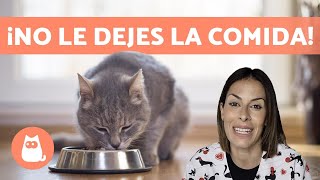
Alba Perez, a veterinarian and CEO of Vetropia Space, explains why rationed feeding works better than free choice for cats. Free feeding leads to obesity, diabetes, and makes it harder to monitor your cat's health. Portion control gives you better command over their diet.
Hello, Plovers family. Welcome to the Experto Animal Channel. For those of you who don't know me, I'm Alba Perez. I'm a veterinarian and I'm the medical director and CEO of the Vetropia Space. You can visit my YouTube channel or my social networks as well as my website to learn a little more about me and also to find out a lot more information, tips, advice and lots of things about nutrition a especially for your dogs and cats. But the point is that today we're here on the Experto Animal Channel because we want to talk to you about a very important topic. Feeding cats. Many of us wonder whether the best way to feed them is through free choice feeding or through rationing. So if you want to know the answer, don't move because we're already starting. The truth is that the vast majority of cats we have at home live with free choice food. We usually have it on display 24 hours a day. Why does this happen? Because cats have slightly different personalities. They are a little more particular about their food. Sometimes we worry a little more about them not eating since they are not such gluttons or they do not throw themselves on the food when we put the bowl out for them. And we have thought that in the end, the best way to make sure that they are well fed and for us not to have to worry so much is to leave them the supposed good food all day. And something that started out as something to help them and promote their diet has ended up being a cause of quite a few feline pathologies. Look at this data. More than 70% of the cats that live with us suffer from obesity. It is a disease that is becoming an epidemic, a real epidemic among domestic cats, among the cats that live with us at home. And the problem we encounter with the free choice type of feeding is that we have no control over what our cat is actually eating. What happens is that in the end, we have a cat that is eating a little bit without control. There may be some cats that know how to ration themselves, but there are other cats that will eat too many times. Furthermore, they eat too consistently throughout the day. What does this end up having as a consequence? Well, we find cats that live a sedentary lifestyle because they are usually locked up at home. They do not go out, they do not exercise. If on top of that, they are cats that do not live with other animals, they do not play enough hours a day. Therefore, they do not have a very high caloric expenditure. But in addition, the vast majority, more than 97% of domestic cats are castrated or the females are sterilized. This means that their caloric expenditure is even lower. Therefore, an excess of calories that is entering us orally due to free feeding, plus the low caloric expenditure due to the living conditions and the physiological state of the animals causes them to accumulate fat and excessive calories. That therefore favors the disease of obesity, which we must remember is that obesity is in reality a pathology and a serious pathology. Another contributing cause of obesity is eating so many times a day. What happens is that every two xtr there are spikes in glucose. These spikes in glucose, these spikes in sugar, cause the feline pancreas to be greatly stimulated and also spikes in insulin. So we are going to have constant increases and decreases in sugar and insulin. All this that the excess fat accumulated in our cats little bodies will do, plus the spikes, increases, decreases and overstimulation of the pancreas makes them very prone to suffering from diabetes. Because yes, feline diabetes works the same as human diabetes. So being overweight and a poor diet are directly related to this pathology. So this is the first drawback of feeding our cats with free flowing food. But this is not the only problem. Another problem I encounter in my daily clinical practice, in addition to the issue of obesity, especially in multi cat households with more than one cat living at home, is that they don't realize if one of their cats is feeling unwell and stops eating. The fact is that our felines, our cats, are animals that don't show it in a particularly noticeable way when they're feeling unwell. What they do is become a little more apathetic and stop eating first. When we have free feed and we don't pay attention to how often our cat is going to eat, whether one cat is going or the other is going to, what happens is that when three or four days have gone by and we haven't had to put in as much feed as usual, we say oh, what's wrong? But we don't realize it before. Therefore, another serious drawback that I see in this way of feeding is that we won't be able to detect if something is happening to our cat or if our cat has lost its appetite due to some pathology. Not only that they have stopped eating altogether, but that they are actually in a cycle in which they are eating less. So we are going to be ignoring any type of illness. Another problem that can arise when we have our cats food freely available every day and on top of that we have more than one cat at home, is that if one of them acquires a physical condition that requires a special diet, it will be impossible for us to separate the rations. That is to say, if, for example, we have a cat that is an adult is completely healthy, and on the other hand, we have another kitten that is older, that is a senior, and needs food, for example renal or hepatic, it will be completely impossible for us to separate and react those foods, because where one cat has access, the other will have access. Therefore, this would be another drawback, the inability to adapt the diets to different cats according to their needs. In addition, another drawback is that if your cat gets diabetes, you will have to ration the food. Yes or yes? Because on the one hand, it is most likely that this animal will become overweight and we will have to put it on a diet. Because one of the advantages of feline diabetes is that if we manage to control the excess weight and sugar levels in the first two months, once the disease has been diagnosed, we will have a high chance of success and we will be able to reverse the diabetes and return to the previous state. But for that, it is very important to ration the food. First, to reduce the daily kilocalories, and secondly, to ensure that the insulin dose actually coincides with the cat's mealtime. This is vital because otherwise the treatment will not work, no matter how well we are doing it. Another problem related to obesity that I have not mentioned before is the issue of heart disease. Whenever we find an overweight cat, we will have a greater risk of it developing thrombosis or developing cardiovascular problems. And if it is unwell, in addition to the fact that we are overfeeding it because the animal is not able to ration its kilocalories, we will also not be able to detect if it is unwell due to overeating, and therefore a heart disease is stopping it from eating. Therefore, leaving food out all day doesn't really give us any advantage, except for the convenience of not having to worry about feeding it several times a day. But my advice is that you definitely get your cat used to eating several portions throughout the day. For example, if your cat is getting 100 grams per day, I recommend that you give it at least three portions of 33 grams per day. For example, you can also divide it into four portions. For example, if it's a cat that suffers from anxiety and needs fewer hours between meals, you can divide the daily dose into four equal portions. Even when you can feed it in portion form, you can play around by mixing dry food with wet food. For example, at 10 in the morning and 9 at night we can give it dry food and at 1 in the afternoon and 4 in the afternoon we can give it wet food. This way we ensure that we provide extra water and we won't be going over the kilo calories because we will have control at all times over how much food our cat is eating. The advantages of managing to feed your cat in a rationed way are that on the one hand we will be preventing obesity, diabetes and cardiovascular problems, and on the other hand, you will be able to control what your cat is actually eating. So if there is a problem in which your animal stops eating, is eating less, or suddenly demands more food, you will be able to suspect that there has been a health problem in your animal and you will be able to go to the vet earlier and detect this disease earlier. So without a doubt, the correct way of feeding our cats and the one with the most advantages, is feeding them through rationing. Well, that's it for today's video, guys. I hope you found it really useful and if you still have any questions or have any comments, don't hesitate to write them down below. On the other hand, I encourage you to continue learning many more things for your cats or dogs by watching more videos on this channel. And if you specifically need more advice or help with nutrition, you can visit my channel, which is vetropeas, and we can get to know each other a little better. Thank you very much for spending this time with us at Expert O Animal and I'll see you in the next video. No.
More from Javier

Cuando nadie reconoce tu dolor por la pérdida de una mascota: así es el duelo desautorizado 💔




¿Tu perro hace suficiente ejercicio? Mantenerlo activo es clave para que viva mejor 🐶💪

GATIFICANDO UNA PARED PARA MI GATO 😻🧗♂️ Ideas para aprovechar el espacio vertical en casas pequeñas



Por qué duele tanto perder a un perro o un gato: el vínculo que explica nuestro duelo 💔🐾

