¿Cómo analizar el AGUA de tu ACUARIO?💧 TODO lo que NECESITAS SABER | KIWOKO
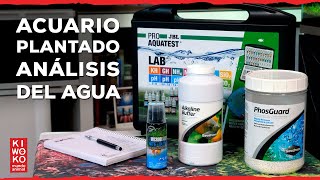
Learn how to test your aquarium water using a JBL kit. The video covers pH, KH, GH, ammonia, nitrites, nitrates, iron, phosphates, and silicates, with advice on maintaining optimal conditions for a planted tropical tank.
Foreign Today we're going to talk about the physical and chemical quality of water. We're working with an aquarium that is a medium sized planted tropical community aquarium. It's important to keep in mind that the water conditions in an aquarium like this have to be optimal. And for that I have a great kit. I have this JBL case which I replaced with the one I had. And it's absolutely amazing because it has everything you need to measure your aquarium and know what's happening at all times. This case contains everything you need. But before you start analyzing the water, you're definitely going to have to read the instruction manual. The information contained here is important. One tip. There's a way to read it in a summarized way on each of the sheets with the values we're going to analyze. But that doesn't mean you won't have to read it. This case also includes something that helps you keep track of the measurements you're taking from your aquarium. And finally, it comes with this label that will tell you the level of dissolved CO2 in the water. We will discuss all of this in the video. Importantly, when you start working with a case, I recommend that you have a pen on hand so that you can write down your values and some absorbent paper that will come in handy for taking out and drying the test jars. Another thing that you will also need, obviously, is a syringe that also comes in the kit so that you can fill each of the jars. I insist, we are going to try to summarize everything in the values that interest you and find out which is really the best value for your aquarium. Well, the values that I recommend for a medium sized tropical planted aquarium are the following, in this order. First, we are going to analyze the PH kh. These three directly influence the water conditions. We have videos where we explain each of these values. On the other hand, we have those that are related to nitrogen complexes. Boom. Your head explodes. Don't worry, they're simple. It's ammonium nitrite and nitrate. And basically what they give you are the results of how the bacteria that are helping us in the nitrogen cycle are breaking down all the waste from the fish. For the third batch, we're going to look at these that are not usually analyzed. Iron, which would be the contribution of the plants, which the plants need. We're also going to analyze silicates and phosphates. These planted aquariums usually get out of control the first few months. And that's because there's a very high concentration of phosphates in the water and silicates that's why it's interesting to analyze them too. Well, let's go over some basic concepts that you have to keep in mind when you're going to analyze the water with a case like this one, the one from jbl. First you have the summarized information on how many milliliters of water you need to add to each of these little bottles. Another thing, depending on where you are, you're going to have different metrics for ph. What does this mean? Look, here we are going with a PH range that goes from 6 to 7.6. For planted aquariums, that is the correct range. It is also important that you know the water in the area where you are. In Madrid, we usually have water that has a ph between 6.5 and 6.7. Note that there are different ones. Here you have a range that goes from 7.4 to 9. This is more for Mabuna aquariums. Do you remember that I have a Mabuna aquarium? Well, this is the one I usually use for the Mabuna aquarium. For a planted aquarium, we are going to stay between 6 and 7.6. IMPORTANT. Find a surface that is completely flat so that you can do your analyses properly. This would be the correct side. It is basically color and meter, and it will give you a range of colors. We place it here. Important. I take this into consideration. You have this thing. Look, it has a V and it. So you can put your little bottles in and analyze the water. This would be the water sample from the aquarium, what we call a virgin sample. This goes up here. And then we have the other little bottle that would go down here, which is where we're going to add our drops. Why? Because usually over time aquariums add tannins. And this way you can have some interference in the colors. What do I recommend that you do it as the manufacturer says, it works wonderfully. The times can vary depending on the analysis you're going to analyze. What does this mean? We have reactions like the pH1, which are almost immediate. And we have others like the ammonium one, which you have to wait up to 15 minutes. Then we have another type of reaction which you have to count drop by drop, which will give you the German degrees. What does this mean? We start with a color and we keep adding drops until it changes color. I would like to remind you again that it is very important to read the instructions and follow the correct steps. There are analyses in which you are going to use a reagent that can be liquid. There are others in which you can use two reagents that can be liquid. There are even some in which you are going to use two liquid reagents and one in powder form. You have to shake all this very well so that you can get the correct result. But let's move on to the analyses of this aquarium. Well, let's move on to the pH. Four drops and let's go. Okay, six with two. Let's move on to the KHS. And we are going to count them in German degrees. As you can see, one drop is one degree. We start with a bluish color. And we are going to have to keep counting drops until we get to yellow. 2, 3. As you can see, it has already turned yellow. Let's move on to the ghs. They are also measured in German degrees. We are going to start with a red color and it will change to green. Look. 1, 2, 3. Let's move on to the ammonia. We place it here. And let's go. First bottle, four drops. Second bottle, four drops. Third bottle, there are five drops. And in this one, we will have to wait 15 minutes. After 15 minutes, the value is 0.05, a value that is safe and almost perfect. Well, let's go with the nitrite. It's quite a toxic compound. With this one, we will have to wait five minutes for the analysis. Reagent number one, let's go with five drops. There we go. And now let's go with reagent number two. Perfect. Look, the nitrite value is already a bit high. This tells me that it's time to clean and maintain the filter. Now, let's go with the nitrate. With this value, we start by adding a teaspoon of this reagent, which is in powder form. It's important to shake it well here so that it's well mixed. The analysis has to be a heaped teaspoon. And now let's go with the reagent in liquid form. This would be six drops. And here we have to wait 10 minutes. Let's shake it. Well, pay attention to what I'm telling you because we waited 10 minutes and the results are 3 milligrams per liter, completely safe. Okay, now let's move on to iron. In this case, it's just one reagent. Five drops are added to the bottle, and you have to wait 10 minutes. Ten minutes have passed, and from what I can see, look, it's very, very low for a planted aquarium here. We're going to have to take action. Okay, now. Now we're going to analyze the phosphate. We've gone to the sensitive Phosphate test. We're going to use this side of the spoon. We're going to start with a heaping spoon of powdered reagent one, 10 drops of reagent two. And we'll have to wait 10 minutes. And as you can see, we're above 1.5, almost 12 here. We have to say, as always, houston, we have a problem. Okay, I've left the silicate test for last. As you can see, this one is a little more complex than the rest. With these, we're going to have to add about reagent one. It's going to be 10 drops. We have to wait three minutes. Then we have to add another 10 drops. We have to wait another three minutes. And finally, we have to add a powdered reagent and wait another three minutes. After three minutes, reagent two, 10 drops and wait three minutes. Okay, let's go to the third step. We're going to add a heaping spoonful of these into the reagent. We cover it, shake it well, and we'll have to wait three minutes. And after three minutes, we have another problem. The silicates are also out of control. They're at 1.2 milligrams per liter. This is high. After analyzing the water, we have three problems, and we have to address them. They're not very serious problems, but they have to be addressed as soon as possible. First, we're going to work on raising the ph from 6.2 to at least 6.8 or 7. In addition to raising the kh and gh, we're going to do this by adding a product like this. The alkaline buffer will help us raise these values and stabilize them. The second issue to address is the nitrites. They're a little high. It's not serious, but it's easy to fix. Let's add a biological complex which will help restore the bacterial population, both Nitrosoma and Nitrobacter, so that they can close the nitrogen cycle. And finally, the one that worries me the most is having high levels of silicate and phosphate in the water. This can be due to different reasons, such as the quality of the water at the inlet, the nutrient substrates, the introduction of fish, blah, blah, blah, blah, blah, blah. This has an easy solution. Of course, we are going to have to clean the filter. We are going to have to use this wonderful product called Fosware. I have talked about it in many of my videos. It is a product that absorbs the phosphates and silicates that we do not want in the aquarium. They are collected inside what would be this filter material and then we remove them. Another issue that must be addressed is the filtration system. For all this. It is good to have a filtration system that is clean and I am already thinking of making a new video about the filtration system and especially the filter charges that help us keep the aquarium in perfect condition. Don't forget to subscribe and leave me a comment if you need help taking care of your aquarium. I remind you that we have all these products in our Kiwoko stores and@kyouko.com See you later.
More from Javier

Cuando nadie reconoce tu dolor por la pérdida de una mascota: así es el duelo desautorizado 💔




¿Tu perro hace suficiente ejercicio? Mantenerlo activo es clave para que viva mejor 🐶💪

GATIFICANDO UNA PARED PARA MI GATO 😻🧗♂️ Ideas para aprovechar el espacio vertical en casas pequeñas



Por qué duele tanto perder a un perro o un gato: el vínculo que explica nuestro duelo 💔🐾

