¿Cómo ENSEÑAR a tu PERRO a VENIR CUANDO LO LLAMAS? 🐶 Adiestramiento canino básico
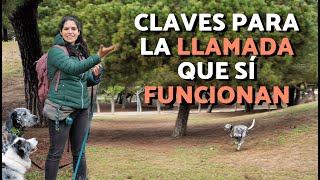
This is a YouTube video titled "¿Cómo ENSEÑAR a tu PERRO a VENIR CUANDO LO LLAMAS? 🐶 Adiestramiento canino básico" created in February 2025. It features Patricia Guerrero explaining her philosophy and approach to teaching dogs to come when called, emphasizing trust, communication, and living together rather than just training commands. The video includes her family dogs and discusses practical and emotional aspects of dog training and coexistence.
Hello. Welcome to this video. My name is Patricia Guerrero and I'm going to be joined by my entire family. Here are the Vespa, Domi, Abel and Jambo. And together we're going to explain how to teach the recall. You'll also find this and much more in our book, the book your dog wants you to read, where, as you can see, they are the main characters and the ones who guide you on a journey through the Parakan archipelago, where dogs are pirates. If you've come to this video, you're probably thinking that I'm going to give you the steps to teach the recall, right? Step one, call your dog and give him a treat. Step two, uh, ta, ta, ta. Well, that's not the case. I'm not going to give you formulas. Instead, I'm going to make you reflect on what it really means to live with a dog and why you want to teach him to come when you call him. For me, the basis of everything is trust. Dogs are our life companions. We live many adventures together. The hardest part is living together. That is being at home in an apartment, traveling, walking around cities, living lives that are sometimes a bit frenetic. That is the great challenge that we face. Well, the one we are facing, how should we say it? Every day we have fewer and fewer places, more restrictions, and even in nature. For me, calling is a form of long distance communication. As I was saying, right now I am communicating with them on a leash, for better or worse, right? Because there are also many of them and the ideal is also to have full attention to each one. Right now, as you can see, we are communicating while on a leash, which is quite challenging, especially if you live with many people and also like us. You have just arrived from the village and this is like an amusement park full of all kinds of smells. Part of it has just rained and that is, well, what it is, right? Being on a leash or off a leash is quite different. The leash is ultimately a safety tool that also gives us information about how the other dog is feeling, right? For example, if I pull on the leash now, I am giving it information to be alert. On the other hand, when we are without a leash, which is why you have come to this video, we are communicating from a distance. And here there is something super important that is the key to everything. And I am going to make it a little interesting so that you can think about what it is. I ask you right now, what do you think it is? Come on, think about it for a few seconds. Well, the key is trust. The trust that you have in your dog, letting him off the leash in a safe place where you feel that trust at all levels also be realistic, right? If there is a highway next door, well, it is complicated. That trust is not built overnight and is not trained with a treat or a toy without more. That is one of the small things we do to improve our communication from a distance. Trust is built day by day one in living together. As I was saying before, living together in our homes, in our flats, in our houses or wherever we are is one of the most challenging things there is. Why? Because there are a lot of conflictive situations that arise in everyday life, right? Like when someone steals a piece of cheese from the counter, or when they have taken a sock, or when someone comes over and jumps on them. There are a thousand situations that cause conflicts to rise. And when I say conflicts, I don't mean violence because violence really isn't necessary in our lives. The only thing is that we have confused boundaries and not understanding each other with that violence. As I was saying, for me it's communicating from a distance. And I can tell you in advance that for me all learning is playful. That is, it's fun and it's a game. For it to be a game, anything we propose to our dog has to be voluntary, creative, where they can really stop at any time. So if you really want long distance communication, a call that is a game for your dog, or the game of calling, it is important that he decides to be with you and when you decide to be with someone, when you trust them and when you like being with them. In short, what I am proposing is a change of perspective, a change of paradigm. Until now, when we thought about teaching the call, we only focused on conditioning a signal with the call, right? A ben, a vin here, calm, however you would like to call it. In fact, dogs do not understand words in any language. But what we do is domi. Very good boy. It is conditioning them. That is why we use rewards, we use toys, and it makes the dog understand that signal. I want you to go further. I want to change the perspective, right, for you to see that it is communication without a leash. But it is still a communication where trust and knowing what language we are speaking is important. Our dogs understand everything we tell them with all their senses. Right now I'm not only communicating through the leash, but but also my smell, my voice, my movements, everything. Besides, they know us very well. They watch us all day long. And that means that when we call them to blackmail them, because we humans use this a lot, right? We blackmail Them a lot like, come here, come here, look what I have. And then when they arrive, it's really because we want to put the leash on them, leave, or even scold them. We don't fool them with that blackmail. And that's what causes their trust to plummet. The more trust our dog has in us, and not just in us, but also in themselves, in the environment, in other dogs, in everything around them, the easier it will be for them to be able to communicate with us from a distance. That doesn't mean that from time to time we can train, right? With what we call conditioning, right? Being able to reward a. Well, a signal. What would that be? Well, I say the signal in this case, Ben, or whatever you want to call it. I'm telling you, like if you were saying French fries, I want to make it clear, because for years keywords have been used especially in German, right? They had been taken. And everyone thinks that they have to say those words, but not because anything can be conditioned. For example, Vespa is looking at some dogs that are there, right? Well, what I would do is the following. Vespa, very good girl. And here I could give a reward or give that. Now I don't know if I have any left. Okay, now I do have any left. Look how good. What did I do? I said the word, the signal. In this case, I don't remember if I said Bonovo, Vespa, it doesn't matter. He turned his head, made a marker. I said, very well, because what I want to teach him is that head turn, that attention. And then when he came, I gave him the reinforcement. In this case, I gave him food. But it could have been a game, it could have been a caress, it could have been anything. And this would always be the order that I propose to teach any signal. In this case, we are teaching the call signal, but this signal without trust, without letting the dog decide, without the dog feeling free to screw up. Okay, and this sounds very much like that. But what is free to screw up? For example, if my dog is afraid to do something that he doesn't think I'm going to like, he's not really being free. He's being inhibited and conditioned by what we want. And we do this a lot, right? There are dogs that don't dare to go and explore a tree for fear of reprisal. And for me, this is not the basis of everything. If I say, for me, it's because I want you to see that it's my perspective, and I'm sharing this with you. But I want you to take your own perspective, to be able to take what connects you from what I'm explaining, and do it your own way. Because there's no single way to live with dogs, humans or anything. So that I don't forget anything, I'm going to grab my cheat sheet to give you a summary of everything I wanted to share in this video. The title of the video is How I Teach my Dog to Come Right. And one nuance is teaching. I don't think you have to teach him to come first, but rather teach him to return. Because that, as I was saying, is. Is a team effort and it's about wanting to be together for it. So first you have to see the call as a game, that it's voluntary, creative, that anything can happen, and that the dog feels free not to come at any time. And this may seem a bit like that, but this will give him freedom. Tomi. Tomi. Alright, kid. The rest of the family is there. It's going to give him a way of living with you, that he's going to be with you because he wants to. And this nuance of trust that pervades everything. And trust isn't built just with rewards or games. It's built day to day in coexistence, in respect, in truly living together. Because having a dog locked up in a garden isn't living together. That's something else. So when I say living together, it. It's this. And there are challenging moments when you're going to get overwhelmed because they're very intense. Especially if you live with a Domi. He's Domi. Uh, There's a lot to do, so try to avoid conflicts. Oh, Vespa. What are you doing there? That one. Come on. Alright, girl. Avoiding conflicts and living together will help a lot to build that trust. Living Canine Adventures what we're doing now is a super adventure. We are very used to going for walks. And if you see me, I am dancing with the leashes. There are four leashes, four characters. It is not ideal. The ideal would be to go one by one to relieve themselves. But since we like to go on walks, well, we travel and live together at an extreme level. Yes, honey. Let's talk a little then. When you want to practice the signal that I taught you before with Vespa. Right? Life has given us this opportunity. Do it at times when you are not interrupting communication. In other words, try to wait your turn to talk to your best friend so that Domi doesn't get distracted. Just like you wait your turn when you are going to have a conversation. Domi, come here. Very good. Do you see? Why did now is a show of trust? Look, my first instinct was to go get the leash, right? But then I said, why am I anxious? Let him come calmly. Quote. But this comes from trust is also true that it depends on the dog. If the dog has socialization problems, and we know that if the dog comes by, it will jump on it. It is normal for us to be a little more scared, but trust is going to be vital. As I was saying, trust between us, trust in the dog itself, trust in the environment and so on. And that's it. That's it. For this video. If you have connected with this way of thinking, of doing things, of living with dogs, of going on adventures, then I'll be waiting for you at my house, Patty, which is also your house. And well, the book that your dog wants you to read is in all the bookstores. So there you have this explained in more order and with more points. See you later.
More from Javier

Cuando nadie reconoce tu dolor por la pérdida de una mascota: así es el duelo desautorizado 💔




¿Tu perro hace suficiente ejercicio? Mantenerlo activo es clave para que viva mejor 🐶💪

GATIFICANDO UNA PARED PARA MI GATO 😻🧗♂️ Ideas para aprovechar el espacio vertical en casas pequeñas



Por qué duele tanto perder a un perro o un gato: el vínculo que explica nuestro duelo 💔🐾

