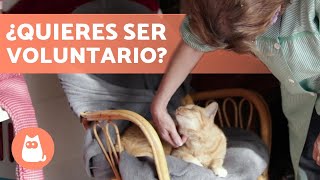
This is a YouTube video titled "¿Cómo es ser VOLUNTARIO en una PROTECTORA de ANIMALES? 🐶🐱" created on January 24, 2021. The content features Henrique, an animal expert from the League for the Protection of Animals and Plants of Barcelona, explaining the daily life and tasks of volunteers at an animal shelter, including dog walking, cleaning, and veterinary care. The video discusses the emotional challenges and rewards of volunteering, the importance of volunteer support, and encourages viewers to get involved once conditions allow. The video is informative and focused on animal welfare and volunteer engagement.
Are you thinking of volunteering at an animal shelter? In this video, animal expert Henrique from the League for the Protection of Animals and Plants of Barcelona will explain what day to day life is like at a shelter and what the volunteers tasks are. Let's start here at the Shel. Apart from the fact that we have a structure of workers that is essential due to the volume of animals, the figure of the volunteer is very important because it reinforces all the work that is done at the worker level and complements things that we cannot do so regularly or even expands the possibilities for us to do work that we workers can do with more limitations. For example, the length of walks. If more volunteers come, the walks and dog walks can be longer and of better quality. In principle, to be a volunteer for this organization, we ask that the person be of legal age, obviously that they like animals. And we ask for a commitment to come at least once every 15 days, at least once a fortnight, basically. Volunteers are usually here for three, four hours, depending on. Depending on their availability. The main work that volunteers do is dog walking. Occasionally they can also help with other tasks, but what they mainly do is reinforce dog walking, which is one of the most important activities because there are many animals, especially in the case of dog walking. There are dogs that come with fears, with signs of abuse and distrust of people. So the issue of walking is super important not only for the workers, but also for these volunteers who can take these animals for walks, show them affection and cuddle them. And so this strengthens them and helps them to socialize a little better. There are other tasks that they can sometimes help with, like cleaning the clothes we use, for example, cleaning facilities. But. But in general, the most important work of the volunteers is dog walking. The day to day running of the shelter is quite intense, to be honest. Let me explain a little bit about how it works. In principle, the first worker comes in at 8am the first job they do is cleaning and taking some initial walks. Because there are animals that for example, don't relieve themselves in their cages, they only do it outside. So as soon as they get here, they have to take them out because they've been waiting for hours. As soon as these initial walks are done, the deep cleaning of all the cages and facilities begins. And around mid morning, starting at 10 o' clock or 10:30am, the walks are intensified so that all the animals can go out. Here the dogs are walked a minimum of twice a day, in the morning and in the afternoon, or sometimes twice in the morning, depending on how organized the day is. But we try to take them out for a minimum of a couple of walks. We also have an area, a fairly large patio, where the animals can be taken out of their cages and climbed up there so that they have more space and can run around a bit. It is even used for socialization purposes, putting several cages or animals that do not live together all the time, so that they can get used to being with other types of dogs. As you can see, in this area where we are, the cats are free, so the issue of walking is solved because they move wherever they want. And here the work is also basically cleaning, because it is a very large area and it has to be cleaned thoroughly every day. Once these walks are done, more or less at 12:30, the dogs are fed, then they are given a little rest to help them digest and calm down. And then in the afternoon they go for their last walks. In addition to this, there is also all the veterinary work, not only giving medications to animals that need it, but also sterilizing animals when they come in after surgery, treating colds, diarrhea, and monitoring the animal's health. Everything that involves veterinary maintenance for the 200 animals we have here. In the case of cats, well, they move freely around wherever they want. And at the veterinary level, the vet comes every day to take a look at the animals and see if any have a problem so they can treat it. Being a volunteer is really rewarding. If you like animals and you integrate and connect well with this world, which is quite tough, you can have a good time and feel very satisfied. It is not easy either, because sometimes you see dogs that come in in very bad conditions, or cats that have been mistreated and are very scared. So, well, obviously this also affects you on an emotional level. And occasionally you also experience cases of dogs, for example, that no one adopts and that spend many, many years in a cage because they can't find an adoptive family. And even some that spend years here end up dying here because they haven't managed to find a family. Luckily, these cases are very rare. They happen very rarely, but, well, sometimes it happens. And of course, the volunteers who have created an important bond with that animal also have a hard time. Apart from this, I think that you always have to look at the positive side of this issue and, well, think about everything you do to help animals. And the negative side, which also exists, well, you have to put it aside for a bit and reinforce this positive assessment of volunteering. Let's see, we would encourage everyone who likes the world of animals and wants to collaborate to try to become a volunteer, at least for a while when this emergency we are currently experiencing with the virus is over, when people's attendance at the shelter is not being greatly restricted, but when everything returns to normal, I would encourage people to at least call and ask how the volunteering process works and how they can help. Another very important thing to highlight is that people are interested in what a shelter does because sometimes it's not so much about physically helping and coming here as a volunteer, which is important, but also the impact that shelters have on people who are completely unaware of the problem of abandonment and animal abuse, which is very important in Spain. It is also very important for people to be aware that this is a very important problem that remains unresolved despite the laws that exist and that there is still a lot of abandonment and abuse in our country. As you can see, volunteering at an animal shelter can be very hard but also very rewarding. Have you ever volunteered at an animal association? Until next time, experiment.