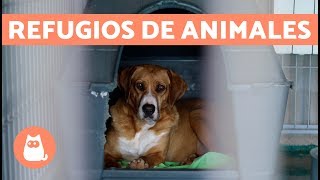
Rick Sway, manager of Barcelona's League for the Protection of Animals and Plants, walks through how the shelter operates, from its history and facilities to daily routines, volunteer work, and where funding comes from.
Every year, hundreds of dogs and cats are abandoned all over the world. Some of them manage to find shelter in animal shelters or animal shelters, patiently waiting for a new family to arrive. But what is life like for them in these shelters? How does an animal shelter really work? What kind of resources does it have and what are its facilities like? To find out, we visited the League for the Protection of Animals and Plants in Barcelona, a shelter for dogs, cats and small anim. Rick Sway, the shelter manager, explains what the league is, what its facilities are like, and describes a day at the center. Don't miss it. This shelter is managed by a private entity, the League for the Protection of Animals and Plants of Barcelona. It was founded in 1944 by Count Desert, and after passing through several hands and various procedures, it has finally been managed since the late 90s by volunteers who organize themselves and create boards of directors that are the ones who manage this entity. Well, we basically take in animals from their owners, that is, animals that the owners can't have due to various problems. And we obviously keep these animals, trying to find them a new family so that they have a new opportunity with other people. Right now we have about 200 animals, more or less, 125 cats and about 75 dogs, although it changes all the time. And obviously all the animals here are up for adoption. Some are easier to adopt due to their personality, behavior or different circumstances. But there are also some that are a little more complicated and have been here at the shelter for a longer time. Yes, and you see, we are a private entity and we are supported by the contributions that people make. Basically, we have members who contribute a fee of €10 per month, and sponsors, which is another way of helping, which is €15 per month. And then, well, what we charge for adoptions, which were 150 and 125 per cat, but this basically covers a little bit of the veterinary costs for the animals, more than being a help. It's recovering a bit of the cost of the animals and then people who want to make donations. There are people who don't want the help, but don't want an obligation that we pay a certain amount each month. So, well, they come here to visit. I don't know what they leave you €50. Well, all this helps. Sometimes we get a call from a store or a vet who has stock there, either that people have left them or that they can't sell due to expiration dates or such. And sometimes they give it to us too. Yes, or many individuals who may have lost their pet and, well, they have Half a cup of food, they have, the leashes, they have. I don't know what. And, well, they also bring that to us. Yes, yes. Another way to help is to become a volunteer. It's good to come here and dedicate a few hours to helping out. Well, cleaning or doing things that need to be done around the shelter. To be a volunteer, you must be of legal age, of course, and commit to coming up at least once every 15 days, because otherwise many people sign up and don't come, or they come three days a week and then go three months without coming. We do ask that people be more or less regular and that they keep coming up. That's true. Okay. There are nine of us working here right now on different shifts, and the number of volunteers varies greatly. But the last time I was told there were 200 or so. There is a veterinary service here Monday through Friday, which is open eight hours a day. Obviously, when there are 200 animals, it is essential that there is a veterinarian who is in charge of all health issues. She is in charge of examining the animals when they come in, and then all the veterinary maintenance and castrations if an animal gets sick, prescribing and giving medications. Well, all the veterinary care for animals. A standard would be to arrive here, clean the cat area where we are now, or the dog cages downstairs. Around 10:30am the dog people have finished cleaning, and then they start walking all the animals around lunchtime, around 1:30 or 2:30am well, she stops for a moment so that the people can eat and such, and then she feeds the dogs. And then in the afternoon they go out again. The vet, well, veterinary issues all day long. And myself, for example, or my colleague who is downstairs. Well, we also do a bit of administrative stuff. Preparing adoptions, answering the phone, which is a lot of hours because it doesn't stop all day. Attending to visits well, managing issues with partners, sponsors. Well, a bit of all the administrative stuff too. Yes. When an animal comes in, it is separated from the remains. If it is a. If it is a dog, well, it has a cage for it. It is there for a few days, two, three days, four days, so that the finish line can see it, it can be seen. Well, its record can be checked. If it comes with a record, if it needs to be vaccinated, it is vaccinated. Well, it does everything it needs to be done. And when we see that the animal is calm, we also analyze the animal's character a bit. Uh, if it is very fearful, if we see that it relates well to other Dogs. Well, all the colleagues of the dog caretakers, well, they look at it those days and then when the vet can join the others and they see that the animal is also receptive to going with another animal, then it is moved to a cage so that it can be with another animal. And then that cage is free to make another entrance. In the case of cats, we also have an area downstairs with cages. And the animals, the cats that enter go to that cage individually. The vet checks them, also does all the veterinary checks. And when they see that they are okay, they go up to. Well, this area that we have here, which is the cat area, we have three levels of dogs. The first is an area for small or medium sized dogs, which is the one right at the entrance. Then going up, there are two levels of cages where the medium sized and large dogs are kept. These are usually in pairs, male and female, all neutered, of course. Then there is also a large walking area, a very large patio where dogs can also be brought up so that they are in an open space and can run around a bit. And then from there up there is this area where we are now, which is the cat area, with three more levels with the cats that we have here. Now that you know how an animal shelter works, if you have the opportunity, volunteer, donate food or offer to help increase their resources. Any help, no matter how small, is always welcome. What did you think of this video? Did you know how these types of centers work? If you liked it, don't forget to like it and subscribe. Until next time experiment.