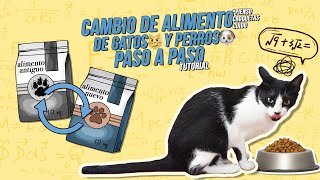
Carlos, a veterinarian, walks through how to switch your dog or cat to a new food brand without triggering diarrhea. The transition takes time: mix increasing amounts of the new food with the old over several days, watch for digestive problems, and adjust the pace if your pet struggles.
You can make sure that your animal companion's diet change doesn't turn into a disaster. Hi, I'm Carlos, a clinical veterinarian at Small Animals. Welcome to the Happy Pets and Families Channel. Changing our animal companions diets is always complicated because they often cause diarrhea. What's more, there are many people who, when they change their dog's or cat's food, may have just taken it from the vet clinic or the store and come back the next day upset because they say, hey, this food isn't good for my dog or cat. It's causing diarrhea. This is no good for me at all. And then, of course, that's when we have to say, let's see, how did you do it? And how we make the change in diet is very important because your dog or cat's digestion isn't just done by them, but also by all the bacteria that live in their intestines for that very reason. And so that we don't have any problems at home today, we're going to do a short tutorial so that you know how to change your dog or cat's diet clearly, and so that it doesn't cause any problems or diarrhea. And what's the secret to changing feed? What do you need to do it properly? Well, it's very simple. You probably have it at home. You need a glass jar, a scale, and also the two brands of feed, the one we're abandoning and the new one, which is the one we're going to start introducing at this time. And there's one very important thing. You can't decide to change your dog's or cat's feed when you've already run out of the one you were giving them, because in that case, you won't be able to make the transition little by little, as we're going to see here, many people say, oh, I'm coming for this new feed, because I was already planning to change my dog's kibble and I don't have any at home anymore. Well, that's probably where we're going to have a problem. To make the right change, the first thing you need to know is how much kibble your dog or cat needs. You will get that information on the bag itself because there should be a table on the back or on the side or somewhere on the bag that tells you how much you should give them per day. So you will be able to know exactly how many grams of that type of food they should be feeding them for this. I have assumed that this Is the amount of food your dog or cat needs in a single day. From there, we will start making the change gradually. This is, of course, an assumption. What you will have to do is weigh the amount of food your dog or cat needs, and with a marker, mark the container according to what it needs. From there, we will know how to mix it. We will make the change in approximately one week. So plan ahead, because it will take more or less seven days. On day one and day two, we are going to give him 75% of the old feed and the remaining 25% of the new feed. Since I don't know the amount your dog or cat needs, we are going to use this scale as a reference because I have already given you 25, 50, 75 and 100. That would be the complete amount, so that you can then distribute it throughout the day in the feedings that he needs. I want to tell you that it is much easier to do this than having to mix four kibbles of this and five of that every time you have to give your dog or cat food. No, it is much easier to do everything in a jar, mix it well, and add more from there. And, of course, during these first two days, you are going to have to observe your animal companion's behavior very carefully in case there is any type of change that catches your attention. Okay? And I'm telling you here to give him 75% of one and 25% of the other. And you say, well, how is this? Let me get this straight. Well, it's very easy. It's a very simple trick. Go to the bag of feed and look at the table to see what amount of the old feed he gets. For example, in this case, since we're only giving him 75% of the total old feed, you'll have to multiply that amount per day by 0.75. And the same goes for the new feed. But in this case, you'll multiply it by 0.25. And now you have the grams he gets each day and so on in all the phases. On days three, four, and five, you'll have to give him the same amount of old feed as new feed. Half. This is a very, very important moment. At that moment, diarrhea or slightly softer poops may appear because there's more new feed. Be very careful when you take your dog for a walk or when you clean your cat's litter box. And on days six and seven, you will have to give them 25% of the old food and 75% of the new food. If you have already reached this point and there have been no problems, everything will probably go well from now on. Some people even skip this part. But I recommend that you do not, because after all, it is only two days. And from the eighth day on, the entire ration will have to be the new food. Okay, and what can you see during this whole process? Is there anything that should worry you? It is normal for the poop to be a little softer during these days. Don't worry, that is normal. But what happens if the diarrhea becomes much more liquid or vomiting also begins to appear? In that case, we have to stop the machinery, change the food, and first we have to attend to what is happening to our animal companion. I've already told you in a video on the channel how you can manage diarrhea and vomiting at home. Anyway, I'll leave it up here. But if it doesn't stop, then what you'll have to do is go to the vet. And once the diarrhea and vomiting have disappeared, we'll have to start over if we want to continue with the change of feed like day one. Yes, but now I'll explain how it works a little differently in these cases. I recommend that you start over in a slightly different way so that vomiting and diarrhea don't reappear. If they do reappear, which we don't know about, what I recommend is that you use a very small proportion of the new food, that you use 90% of the old food and only use 10% of the new food, and that you increase it each day. 10% on the first day, 20% on the second day, 30% on the third day, and so on until you complete the transition. As you can see, it's a slightly more gradual and regular transition so that their intestinal flora gets used to the change. If they still don't get used to the change, it's possible that your dog or cat is overreacting to the feed you're giving them. This usually happens, for example, in cases of intolerances or allergies. In that case, changing feed wouldn't be recommended. You'd have to stick with the old one or look for another type of food that might work for them. In addition, probiotics can be very helpful in these types of feeding changes. You may have heard some TV advert for yogurt that said it had probiotics or whatever. Well, these are populations of bacteria that we're going to give your dog or cat so that their intestinal flora is always balanced. And digestion continues to occur. Normally, they're usually sold in the form of powders that you pour on top of the feed, which will help a lot. Anyway, ask your vet because they'll tell you exactly what kind of product I'm referring to. Come on, Totoro. Enjoy. Well, who would have thought that changing your dog or cat's menu would involve so many little things that you have to be aware of? But is that so? What are we going to do? And let me know in the comments if you knew all these tricks or how you've previously changed your canine or feline companion's kibble. Hey, you might have another system. I'm interested, too. And that's it for today's video. If you liked it, give it a like and share it with everyone. Remember to subscribe to our channel if you haven't already. And hit the bell so that YouTube will notify you every time we upload new content. We also have a secondary channel here on YouTube called Q& A from a veterinarian with lots of interesting questions for your animal companions. Check it out and subscribe. And today we say goodbye by getting to know Dudu, who was introduced to us by Foley ESA and who is very entertained with his tablet. And Mr. Spock lives with Ruth and says he has another bed, but he prefers a case of beer. I honestly see him as if he were on the Enterprise. He is the most beautiful cat in the entire world. I'm not the one saying it. His family says it. Natalie Gomez, thank you very much for following the Happy Pets and Families channel. And we'll see you in the next video. And that's it for today's video. And that's it for today's video. Oh, and this is going to the end of the video. Again, what I'm going to say goes at the end. That is following my explanation that I was saying before I cut it off to talk about percentages. It has its intricacies. How versatile, right? Because bacteria aren't him. Bacteria are microorganisms that live inside him. I always think well, but if you mix it well, it will be more or less well distributed. That is, there will be no.