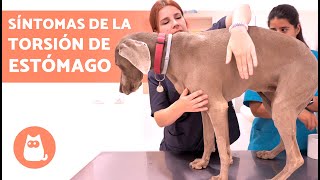
This is a YouTube video titled "Cómo identificar una TORSIÓN GÁSTRICA en PERROS 🐶 (Síntomas y Tratamiento)" created on August 10, 2022. The content features a veterinarian named Miriella from BET24 Veterinary Hospital explaining in detail the symptoms, risks, and treatment of gastric dilatation and volvulus syndrome in large dog breeds. The video is educational, aimed at pet owners to help them recognize early signs and understand the urgency of veterinary intervention for this condition.
Hi, everyone. I'm Miriella, a veterinarian at the BET24 Veterinary Hospital in Gaba. We are a collaborating center with BET Macione, a training school for veterinary assistants. And welcome to this video by Experto Animal. Today we're going to explain how to detect and what gastric dilatation and volvulus syndrome consists of, especially in large dog. This syndrome may sound familiar to us if we have or have had large or giant breed animals or animals with deep chests, such as Mick A. Weimar pointer. In these cases, it basically means that the height of the chest is greater than the width of the chest. Right. In these cases, these breeds would be predisposed. What does this syndrome consist of? Well, it basically consists of an abnormal dilation of the stomach.
Right.
Without the possibility of emptying, which in the end can cause it to twist. How can we know if our animal is suffering from this syndrome? Well, especially at the beginning. Right. We're going to notice that the animal is uncomfortable. We're going to see that it looks at its flanks, that it stands up, crouches down, lies down. We're going to notice that it's uncomfortable.
Okay.
Why? Because it's starting to suffer from abdominal pain and this discomfort due to the swelling. Then we're going to notice that this syndrome is progressing. Ah, what's going to happen is that it's going to try to vomit, but it's not going to be able to. Why? Because being twisted means it can't empty its stomach. So it's going to gag, but without being able to expel the contents as it progresses.
Okay.
It's important to know that this is a fairly rapid progression and requires an equally rapid response. Oh, it's going to continue with these unproductive gagging movements. It's going to start drooling a lot and it's going to be less and less able to move.
Okay.
Finally, it's going to end up lying on the ground.
Okay.
And we're going to start to notice that its stomach is expanding. Okay, let's notice. It's especially easy to notice in thinner animals. For example, in your case, it would be very obvious if we stood her up, we would see a swelling from behind the coastal wall. Right. We would see that abnormally dilated abdomen in dogs like a Saint Bernard, for example, that have much more hair, are more focused on meat in a superior body condition. So sometimes it's a little hard to see until it's not very obvious. So, ah, what happens if I start to see this? We shouldn't Even wait to see the dilation if I start to notice unproductive retching. The animal is a large breed or predisposed, as I was saying, like a brock deer. Like in your case, a Saint Bernard, a Great Dane. But it can also happen in German shepherds and other types of dogs. So the first thing is to notify the vet, say, look, my animal is trying to vomit, but it can't. Above all, we must warn you and start moving. Okay, so what happens if we don't act quickly? Well, in these cases, the greater this dilation is, the more space this stomach full of gas and contents takes up, the worse it's going to be. Why? Because inside the abdomen, when this stomach inflates, it's going to put pressure on the large vessels, okay? Which transport all the blood from the entire systemic circulation and abdomen to the heart. This is going to cause drops in blood pressure, right? And also a poor supply of nutrients and oxygen to all the tissues of the body. On the other hand, the same pressure, by also putting pressure on the diaphragm, it's going to prevent my animal from breathing properly, which is also going to prevent it from oxygenating as it should.
Okay?
And its tissues, especially the kidneys, liver, everything can start to suffer. On the other hand, if my stomach distends abnormally, I can also suffer from a cut in the stomach circulation. And it is also often associated with this syndrome due to its relationship with the stomach. So what will happen? Well, I will lose that supply of oxygen and nutrients to the stomach and spleen. So if time and time and time goes by, in the end, what will happen is that some. Some areas of the stomach will become unhealthy. They will lose that supply of oxygen and nutrients, and they will end up dying. The more time that passes from the onset of clinical symptoms until I resolve it, the worse it will be and the less likely I am to succeed in solving it. Another thing that can also happen is the appearance of arrhythmias, because in the end, all this failure in the supply of oxygen to the tissues will also affect my heart. And in many cases, I will have the appearance of arrhythmias. This is also a factor that worsens my prognosis. On the other hand, we will also have the accumulation of toxins and bacteria in the stomach, which can cause bacterial translocation from the stomach to the bloodstream. And this can lead to a state of septicemia, which obviously does not have a good prognosis either. In the end, the most important thing in These cases is to detect it as soon as possible and act accordingly. As soon as it is known that the animal has a torsion while. What will the veterinarian do? Well, if our animal is suffering from this syndrome, what they will first do is put in IVs and give it fluids to strengthen its vessels, which are currently compromised and suffering. And also in this state of hypotension, as I was saying, many organs will also suffer. We are going to give it oxygen. Since it cannot breathe properly due to this pressure on the diaphragm, it will need an extra supply of oxygen. And also. Well, we are going to finish diagnosing it. Right? We're going to do an X ray, we're going to see what's going on. You're going to be told, and then what we need to do is decompress the stomach.
Okay?
Something that's difficult to do at home, which is why you need urgent veterinary attention.
Okay?
Here I'm telling you, your main role is to detect this as soon as possible and go seek veterinary help as soon as possible.
Okay?
The mortality rate for this problem is around 15%. Obviously, it gets worse the more time goes by, as I mentioned before. So your actions as owners are key here. To see it, to know about it, to detect it, and go to the vets so that they can find a solution.
Okay?
And the solution, apart from this initial stabilization that I mentioned, is surgical.
Okay?
Your animal is going to have to go through surgery. So what we're going to do in the end is distort it and join the stomach to the abdominal wall using a surgery called gastropexy, so that if it ever dilates again, it doesn't happen again.
Okay.
There is the option when you have an animal of a predisposed breed, a large dog with deep throats, to perform a preventive gastropexy, which means joining the stomach to the abdominal wall from the beginning. This is usually done at the time of the ovaryectomy or castration. Right. In any case, whether it is male or female, and in this way, if we already have a predisposed breed, we try to prevent this from happening a little more. Right. So apart from this, what can you do as owners to try to prevent this from happening to our animal? Well, first of all, it has been seen that it tends to happen more to animals that eat only one large meal a day and food that is quite fatty. In other words, the number one recommendation would be to give them moderate amounts of food spread out two or three times a day. And good quality feed that is not excessively fatty. On the other hand, what we can also do is when we go for a walk, always make sure that they walk first and eat afterwards. In other words, when they have eaten, they can rest and not run around, right? Because in this way we are also encouraging this torsion or dilation to happen. On the other hand, as I was saying, preventive gastropexy, right? When they are young or when they are older, there is no problem. So if knowing this, it still happens to you, it does not matter, right? These are problems that can arise in the end. There are stressful situations that can also be a trigger for these situations. Or there are animals that, as they get older, are also more likely to suffer from this disease. So, as I said, if you have done everything possible to prevent it and it has still happened, your work is essential, right? To act as soon as possible to help your animal, your puppy, survive this, right? With the help of everyone, both veterinarians and owners, we can find a solution and that's it. And let them continue with their lives. Okay, that's it. Here are the keys to detecting and understanding a little bit about gastric dilatation and torsion. If you're curious about other topics, you'll find more videos by animal experts in the description. Also, if you're interested and want to turn your vocation into your profession, you can also find more information about BET training here. And if you want to know more about our hospital, you'll also find information there. I hope you enjoyed it and found it helpful. Oh.