Cómo Limpiar el Terrario de tu Serpiente del Maíz 🐍 | Guía de Limpieza Profunda Paso a Paso | KIWOKO
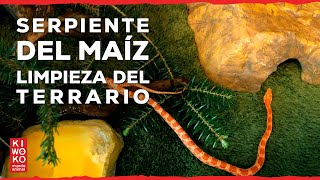
Step-by-step guide to deep cleaning a corn snake's terrarium. Learn how to safely remove your snake, clean the enclosure properly, and maintain a healthy habitat with practical tips from an expert handler.
Foreign Today we're going to do a complete maintenance of this terrarium where we're taking care of a corn snake, an elf edge gutata. As you know, we're doing a pretty interesting series about everything you need to know to properly care for and maintain a snake. We started with a corn snake, which is a very simple snake. And today I want to do some maintenance so you can see how easy it is to keep this type of animal. Animal. And before we start, as promised, thank you very much for all the comments so we can give it a name. In the end, we decided to call it Nagiri. Since I still don't know if it's a boy or a girl, I think it's a name that will suit it perfectly. I mean, really. Thank you very much. Important. When I'm going to do maintenance on a terrarium or an aqua terrarium, such as an aquarium or a pond, we must first disconnect all the devices that are connected to the mains. Why? This way we're going to avoid any electrical shocks or accidents. Well, let's get to it. I'm going to disconnect the lighting and what would be the heating blanket? With this out, we're going to move. I'm going to remove the lid because another thing we have to do when we remove the electrical devices, my recommendation is to always pick up the animal. This will reduce stress because in the end, as it's a complete maintenance, we're going to have to take everything out. In this case, for convenience, I'm going to do it through the lid. We're working with reptiles, and snakes in particular are big sleepers. So if we're going to pick it up, we're going to do any manipulation. We're going to warn it by tapping it gently that we're here so that it wakes up and knows what's going to happen next. What is never recommended for any animal is to wake it up abruptly. Why? Because the animal could either bite you or get a big scare. Good morning, Nagiri. Look at it. It's here. Come here, little one. Right now I'm going to take the opportunity to make a brief observation of how the snake Nakiri is in this. And I'm going to store it in the box it came in. It's a plastic box with holes. It has a sheet of absorbent paper inside. I'm going to put it here. Come here, little one. Come in. Yes. I'm going to clean your house. Come here slowly. Very good. Once I've done that, I'm going To put it in an area where it has little light. There aren't big changes in temperature. It's in a cool place. Because what I want is for it to be calm and for this not to be less or more stressful for what is normal maintenance. Let's get to work. First, we're going to remove all the decoration. This time I'm going to throw away the leaves. We're going to put new leaves. We're going to remove all this. On the other hand, we're going to take out the trunks. We're going to wash them. We're going to take out the drinking fountain. We're going to give it a good cleaning. Remember, the drinking fountains are cleaned every week and fresh clean water is added every week, once or twice or as many times as necessary. Pam, Pam, Pam. Okay, look what we have here. Look what these logs are good for. These logs help the animal look to help shed its body. This is something fantastic. The snake is in perfect condition. It is growing. It hasn't stopped shedding. Look how big it is. I estimate that it has grown by about 6cm since I've had it at home for about three months. In other words, it is growing very well. Let's put this aside. My children always like to keep this. Okay, let's finish picking this up. As you can see, this is taken out and what we are going to do is give it a good wash because I don't know if you can appreciate it, but there are several areas where there is a lot of snake droppings. This needs to be cleaned with a brush with enough water. I'm going to throw this away here. We are going to leave this here and we are going to clean it to remove the dirt and especially the droppings. The best thing is a bucket filled to the top with water. We're going to add a little bit of dishwashing soap. Just a tiny bit. It's completely harmless. Remember that we clean our dishes with this and we don't get poisoned or anything. And then we'll have to use the brush to clean it. I'm going to let it soak so that everything softens up and then you'll see how great it's going to be. Remember the drinking fountain? I do this every week. A deep cleaning of the drinking fountain. It only needs water. Okay. It cleans well. Rinse with plenty of water. And for the logs, three quarters the same. I'm going to clean them because in the end, look, some dirt does come off. I rinse them with normal temperature water. It doesn't need to be hot water. Look, it's normal water. And what I'm basically looking for is to get all the dirt off. Look, some dirt is coming off. Is that normal? And this is all it needs, attention. If the terrarium does not have any problems, such as mites or anything with water cleaning it is enough. It does not need anything else. While the decorative elements are drying, I am leaving them in water to soften the dirt that was on. What would be the felt or mat that I usually use as a substrate. I am going to start cleaning inside what would be the terrarium? Let's see. In this situation, I like to work with more or less natural products that do not have any chemicals. I will give you a formula that I learned many years ago to clean terrariums when there are no problems. Vinegar. It can be apple cider vinegar or any vinegar. A little more than half a liter of water. You are going to use a large spoonful, which is about 5ml of vinegar. With this formula, we are going to clean the inside. Then we are going to dry with absorbent paper. And this helps us prevent a lot of pathogens. But it also leaves the terrarium quite clean. So let's go for it. For the formula, I'm going to use Perlon. But if you don't have Perlon, you can use a sponge and just give it a good wipe. Look at the dirt there. Let's wipe it well. Let's wipe all the wall. The only problem we have with the vinegar water is that the terrarium is going to smell a bit like pickles for a few days. But I can tell you that the advantages are huge. As long as terrariums don't present any problems, I'm against cleaning them with very abrasive chemical products, because in the end, all we're doing is increasing the problems our animals may suffer. In other words, with a little water and vinegar. As you can see, everything is clean. Everything is superb. Then I'll put this here on the outside. Look, it's just this. Let's do it here. Pin, pin, pin. This is drying. And there you have it. Nigiri's house is going to be perfect. As you can see, at most, a complete maintenance for a terrarium like this, it takes you a maximum of 15 or 20 minutes. That's why I'm telling you that these types of pets, such as Snakes affectata corn snakes, are a very good option. If you don't have much time, if you don't have much space, if you want an animal that's very easy to maintain, very easy to care for. Look, that's all. It's true that they are super grateful animals. They are super easy to care for. I mean, as I said, it takes practically no time at all. And you can always keep them in good condition, which is the important thing. As you can see, I've already put the blanket on, the dry blanket. The vinegar smell has gone, so it's perfect. Hey, subjects. I've already put the decoration on. This time I've opted for some pine twigs. They come in handy when they molt. These twigs are great. Once I put the terrarium in place, I'll fill the waterer with water. Here are some very important issues to keep in mind. How often should I do maintenance like this? A complete maintenance, I would say every two to three months, but never more than three months. You have to clean it thoroughly because pathogens and parasites can develop that can attack your animal. That's why it's important to maintain hygiene. 2. When should I do this? Let's see. If you're working with, for example, a snake, a corn snake or a California kingsnake, whatever. I would tell you to do this type of maintenance once you've fed your snake and several days have passed and you see that it has already defecated, which means that digestion is complete. It's not recommended to do this type of complete maintenance while the animal is digesting. Why? Because digestion can be interrupted and that's something you don't want to happen to your snake. Another thing I want you to always keep in mind is when working with reptiles like snakes, after doing maintenance, after touching them, after cleaning the water bowl, you have to wash your hands thoroughly with soap and water. Remember that reptiles carry many pathogens, such as salmonella. I don't know if you knew this, but that's why it's important to always wash your hands after you're done working with them. Another thing you should also keep in mind is that at least once a year you have to take your snake to the vet. To a vet who specializes in exotic animals, it's important that in this case, your snake be checked, dewormed and that they tell you how your animal is progressing. This is the right way to have a pet, with all its responsibilities. And as always, if you have any questions or comments, leave them, because I'm here to try to help you. And here's a challenge. I'm thinking about doing new projects and I'd like to know what new project you'd like us to work on something about reptiles. Something like that. I await your comment, Sam.
More from Javier

Cuando nadie reconoce tu dolor por la pérdida de una mascota: así es el duelo desautorizado 💔




¿Tu perro hace suficiente ejercicio? Mantenerlo activo es clave para que viva mejor 🐶💪

GATIFICANDO UNA PARED PARA MI GATO 😻🧗♂️ Ideas para aprovechar el espacio vertical en casas pequeñas



Por qué duele tanto perder a un perro o un gato: el vínculo que explica nuestro duelo 💔🐾

