CÓMO PROTEGER A TU GATO durante CATÁSTROFES NATURALES 🙀🌪️🌍🏚️🔥🌊🌩️| Guía Completa para emergencias 🚨🆘
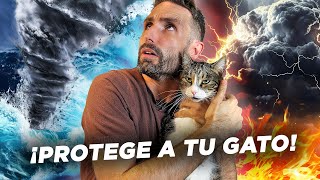
Veterinarian Carlos walks through how to protect your cat during natural disasters like fires, earthquakes, hurricanes, and floods. He covers building emergency kits, handling cats during crises, and keeping them safe when disaster strikes.
Foreign Hi, I'm Carlos and I'm a veterinarian. Welcome to the Happy Pets and Families Channel. When natural disasters occur, we have to be prepared and have very clear instructions to follow. And that also includes our feline companions. Because if during all that confusion, we have a lot of things to worry about. Imagine if we live with a cat and have to think about theirs too. That's precisely why we need to be prepared, because they don't know where to start. Bye. Today I'm going to tell you about the most important things you can do to be prepared in an emergency situation with your feline companions. First of all, we have to remember that when any natural disaster occurs, there are two clearly distinguishable situations. On the one hand, there are those situations that occur without prior warning, such as an earthquake, a tremor, or even a fire in our building. On the other hand, there are situations that we can be warned about in advance, such as tropical storms or hurricanes or floods that may occur in our area, even electrical storms that often scare our feline companions too much. There are a couple of things you have to consider to prepare for these situations. First, an emergency kit for our feline companion. This way, if any of the situations I'm going to tell you about happen, we can always have it on hand to run out of our house. What do you have to put in this toiletry bag? Well, something very simple. Your feline companion's documentation, such as a passport or vaccination card or documents that are required or mandatory in our countries. Apart from this, one or two cans of food. Cans of food have a very, very long expiration date. Therefore, even if we have them in our toiletry bag for months without using them, we know that they are not going to expire. In any case, we write down the expiration date so that if it is close, we can use it to give it to our cat and replace it with a new. Likewise, if our cat has some type of special medication, for example, because it has a kidney or heart problem and is taking pills, it is always a good idea to have a blister pack of pills in this survival kit. What I recommend is that when you buy a new box, go to the survival kit, take out the old blister pack and start giving it to your cat and put a new blister pack in to replace it. That way the medication will not expire either. Another very important thing is that you always have the carrier, crate or carrier or whatever it is called in your area on hand. That is why I recommend that you always have it set up in your home that your cat integrates it as part of your home so that it does not see it as a foreign object and so that it does not get nervous just because of how you set it up. That way, you'll always be able to use it and not have to worry about looking for it at that moment. It'll also make it easier for you to get your cat inside in the event of an emergency. Okay, so let's start by talking about those situations that can't be anticipated. Let's start with fires. In addition to the survival kit and the transporting kit for these cases, I always recommend that you find out if there is an evacuation plan in your building in case of a fire. This will allow you to get out of the building more quickly during a fire. I recommend that you stay calm. Okay. It seems quite simple to say, but above all, it's important because it will allow us to better follow the instructions of the firefighters regarding our kitties. Since our cats detect smoke very quickly, it's very likely that they'll try to hide and that will make it difficult for you to find them later. So as soon as you know that there's a fire in your building, the first thing you have to do is put your cat inside the transporting kit. And here some people's fears begin to arise. Like my cat who doesn't want to get in the carrier every time he sees it and hides under the bed. This video isn't about that, but I'm going to give you some tips so that you can put your cat in without any problems. Place the carrier with the door facing up vertically. You can use your legs to hold it in place, for example. Then hold your cat's front and back legs with your hands first. Put its back legs in and let it fall gently. Close the door and your cat will be inside. Just like with people, we can also practice with our cats. That's why I propose a game. Put your cat in the carrier in everyday situations at home so that you can practice and show your cat that it's not dangerous at all. Then open the door, let your cat out, and give it a treat by playing with your cat. They will get used to the fact that nothing will happen inside the carrier and everything will be much easier for you in the event of an emergency. On the other hand, I recommend that you know the safest places in your home. Firefighters often recommend that we do one thing or another depending on the situation. For example, if we see smoke in the hallway, they tell us not to go Outside to avoid poisoning ourselves and to lock ourselves in a bathroom. Well, depending on these situations, there are a lot of protocols that firefighters tell you how to act. Please take a look at them, because they are quite important. Also, in the same way that a damp towel over our mouth helps us avoid inhaling smoke, it also helps our feline companion to cover the carrier with a damp towel. If you are ordered to evacuate your home, you must collect your cat's survival kit in the carrier and go to the door or wherever the firefighters have indicated. It is very important that your cat stays in the carrier. Do not carry it in your arms, because in that situation everything is confusing and your feline companion may get scared and try to escape. And let's put ourselves in a very complicated situation that could happen. For example, if you have not been able to put your cat in the carrier and it disappears from your sight as soon as you detect the fire, if the time comes to evacuate and your cat is not with you, it is very important that you listen to the firefighters and evacuate your house, but also tell them that you cannot find your cat so that they can look for it when the time comes. And although it is very complicated, try to remain calm, because it is very possible that your cat has found a safe place. Its survival instinct is very powerful, and the firefighters may end up finding it once the dangerous situation is over. In any case, to avoid this. That is why it is so important that you do the drills that I have mentioned with the transportation, so that this situation never happens to us. In a very large fire that occurred here in Spain, in Valencia, in some very tall building towers, a person had to evacuate their home and did not have their cat with them because they had lost sight of it. Luckily, the firefighters ended up finding it in a safe place a couple of days later, and all the Spanish media reported on this happy ending to the tragedy that was the fire. Well, now let's move on to the aftermath of the fire. After we have left our home, it is important that regardless of whether we seek the help we need, we also give it to our cat. So we will have to take our feline companion to the veterinary clinic to have them take a look at it. I have to remind you that most people who suffer injuries or even die in fires do so due to smoke inhalation. And smoke also greatly affects our cats. Smoke poisoning can be very serious because we do not see external signs. And in the end, our feline companion's lungs do not work as they should. That's why it's so important to take your cat to the clinic, have them do a thorough examination, and make sure that everyone is safe and sound. But what can we do if, for example, there are earthquakes, tremors, or tremors in our area? In these cases, in addition to preparing a survival kit and a transport kit, which I'll always tell you, it's important to know where to find shelter in our home. As you probably know, when an earthquake or tremor occurs, we shouldn't run away in fear. Instead, we should protect ourselves inside our home and only evacuate the building if we're ordered to do so. For example, find sturdy tables or furniture so that we and our feline friends can get under them. Well, take a look around your home and identify those places. During an earthquake, the most important thing is to have our cat in its transport box. I'm going to give you another recommendation for that. If several people live in your home, it is important that the person in charge of putting the cat in the carrier is, for example, its favorite human, so that the cat feels safer in their presence. Just as with fires, it is important to remain calm and also close doors and windows. It is possible that our cat, when it detects movement of the ground, since they are a little more sensitive, may want to try to escape. There are some cases in which it has been described that cats try to get to safety by jumping out the window, and obviously we must avoid this at all costs. However, just as with fires, it is possible that you have not managed to put your cat in the carrier bag. In this case, if your cat has sought refuge under a bed or under some furniture, do not try to get it out. Your cat is completely terrified and feels more or less safe there. It is possible that you start fighting with it to get it out of there, and your cat may start fighting you, scratch you and complicate the whole situation. Once the dangerous situation has passed, we will have to listen to the emergency services. If, for example, we have been ordered to evacuate our house because there is a risk of collapse, or because, well, the condition of the building needs to be assessed. The most important thing is that at that moment you do put your cat in the carrier. If it was not already inside, never carry it in your arms. In these situations, everything is confusing. There are people shouting, dogs barking, people coming and going, and all of this can be very frightening for our cat. We may open the door of our house to try to leave, and our cat may get scared, leave and go somewhere we do not know where, even putting its life at risk. That is why the most Important thing is to put it in the carrier and then go out. And of course you must have the emergency kit with you in the event of earthquakes or tremors. Well, a priori there is no situation in which you should take your cat to the vet to have them checked out unless they have suffered a blow or a piece of furniture has fallen on them. Well, that's all for those situations in which it is more complicated to prepare because they happen unexpectedly. Now let's move on to those that are more likely to have been worn by either the media or the public protection services or, well, I don't know, the government, such as adverse weather conditions. That's why it's easier to be prepared. But that doesn't mean we shouldn't think a little bit before they happen. Let's start with hurricanes or tropical storms. Well, I don't need to tell you that here in Spain we are not very used to these situations because they don't happen. But despite that, I have been doing some research so that you have some guidelines that you should follow. In this case, the survival kit is a bit more extensive because in addition to everything I told you at the beginning of the video, logically, if we have stockpiled food for ourselves, we will also have to do the same for our feline companions and look for food, feed, care, kibble, balanced food. I recommend that in this case, for example, it be dry and that it be enough for the dangerous situation that is going to occur. Bottled water is also very important because in storms and hurricanes it is possible that the water service may be interrupted and the water we have available may be contaminated. I also recommend that you have a bag or a box of bedding, sand and small stones, more or less medium sized, so that our cat is always taken care of. Another super important thing is that if there are evacuation centers in your area, find out if there are any that do not accept animal companions. Or better yet, find out which ones accept cats and dogs so that you know which one you have to go to. Similarly, identify the safest areas in your home. In general, during storms, hurricanes and the like, these are usually rooms that do not have access to the outside and do not have windows. If the storm is strong enough, the windows and glass can break, which can be dangerous even if you have secured them. And pay close attention because sometimes these safest areas of your home can even be inside closets. So take a look. For the entire duration of the emergency, stay in the safest place in your home, including your cat. Of course, in these cases it Is not necessary for your cat to be inside the carrier all the time. It can be outside with you because there will be no situation where you will have to run out of your house so quickly. And if it does happen, you, you will be notified in advance so that you can have everything ready in that safe room. You should have your carrier ready to avoid wasting time. Do not leave your home until the emergency services have instructed you to do so. There are times when a storm or hurricane is brewing and you see that the weather outside is improving and everything is calming down, well, it could get worse quickly, so don't take that risk. If you've had to evacuate your home, your feline companion is going to spend a lot of time inside the carrier, because even if you go to an evacuation center, I don't recommend that you take him out of it. There may be other cats and dogs in that center. Your cat is probably nervous and wants to hide. Of course, if your cat is used to wearing a harness or a leash, you can use this resource because it allows you to take him out for a short walk so that he can stretch his legs. If, on the other hand, you've been lucky enough not to have to leave your home and the dangerous situation has passed and you've been warned by radio, for example, before taking your cat out of the safe room, go out yourself and close the door. Make sure that everything in your home is in order. Pick up anything that could be a danger, and then allow your cat to go out. And once the danger has passed, avoid at all costs letting your cat drink stagnant water, whether it's in a flower pot or a puddle, because this water, as I've said, could be contaminated. And right now, the last thing we want to do is add another problem to the ones we already have. Not only could the water be contaminated, for example, with some chemical product or because it has spilled gasoline from a car, but also bacteria can grow in flood water and stagnant water, which are very dangerous for both us and our feline companions. Obviously, we are much more aware and try to avoid this water. But it is possible that your cat accidentally ingests it, and these bacteria can end up affecting it, causing diarrhea, vomiting, and ultimately a bacterial infection such as cholera. And this can be quite dangerous for your cat. And now let's talk about floods. Well, it's a little bit related to tropical storms and hurricanes, Although, for example, here in Spain, flooding can occur quite frequently due to storms or damage. And, well, there are some areas where it happens very, very Frequently. That's why we have to be very clear about how we have to act with our cat. In addition to the survival kit and the carrier always ready, we have to identify in our house which are those areas where the water will not reach. For example, if we live in a house with two floors, we are going to move all our things and those of our cat to the upper floor. If, on the other hand, we do not have such a big house, you can put your feline companion's things on top of a cupboard, on a shelf or a rack so that they are safe. That will be your cat's little refuge in case the water starts to enter your house. Although these situations are usually much calmer than hurricanes and storms or anything we have mentioned before, you also have to know very well how you have to act. If you are going to have to evacuate your home because floodwaters have started to come in and you have been advised to do so, you should of course put your cat in its carrier. Make sure that neither the carrier nor your cat comes into contact with floodwater after a dangerous situation. If you notice that your cat is intoxicated, dizzy, vomiting, or has liquid diarrhea, or cannot stand up in any of these situations, you should take it to be checked out as soon as possible and as quickly as possible. And of course, you should never leave your cat alone at home. If you have been told that there is a risk of flooding. If you have been ordered to get to safety, then of course take your cat with you as well. Now let's move on to a situation that, although less serious, does not mean less risk for your cat, especially since some cats have a really bad time. I am referring to thunderstorms. This, of course can also be extrapolated to fireworks situations where there is a lot of noise in the street, or maybe because an orchestra is playing under our window. This is not the subject of this video, but it can also help you in these situations. Although this does not pose a risk to your cat's health or well being, it is possible that they will suffer a lot of stress. Since you already know your feline companion, you will know how they react to storms. If there is going to be a storm and they are not doing particularly well, build them a shelter inside your house. You don't need to go all out and build a wooden house or anything like that, but choose one of the rooms in your house, the one with the least contact with the outside, and install the things that your cat needs there. This room may be your bedroom and your Cat may choose to hide under a bed, or you may have chosen another one such as a bathroom. And there you should place a kind of cave for your cat, its bed, a carrier or perhaps a chair with a blanket on top so that it can get under it in case it is feeling scared. I recommend that in any case you lower the blinds in your house because that will muffle the sound quite a bit. Close the windows and lock any doors that are not essential. If your cat has chosen to hide somewhere in a closet or under the sofa, you do not need to take it out. In fact, it is not recommended at all. It feels safe there. And if you insist on taking it out and having it in sight, this is likely to cause it a lot of stress. What you can do is be close to your cat so that it senses it in case it wants to come a little closer to you to seek shelter from the storm. There are some people who recommend that we play calming music or sounds in our home. I only advocate doing this if the sound is truly calming. You don't need to play loud music to try to drown out the thunder because you won't succeed. So if it's relaxing low key music that also helps you stay calm and serene in your home, go ahead, but if not, don't play it. And one thing I've talked about a lot on the channel and that can of course help you in these situations is having the typical and classic synthetic feline facial pheromones on hand. This can make your cat feel less stressed. But other things that can help you are more natural remedies such as Metabi sticks, a little catnip, or even Valyrian pipettes, the ones sold for cats when they travel. There are some cats that are quite relaxed with them and they help them feel less scared. Although these pipettes do not have an immediate effect, you should apply them to your cat when you know that a storm is going to pass through your area so that they start to take effect and they feel much more relaxed. Once the storm has passed, you should not try to get your cat out of its shelter. Let it run its course. If it wants to stay there a little longer, leave it alone and it will come out. When it feels like having dinner or being with you. Do not force it to leave under any circumstances. And of course in these cases, avoid increasing the confusion and noise in your home. You should not scold your cat for wanting to hide. Some people may react this way when they get a little nervous. So apart from that, the only thing you can do is stay calm. I hope you never have to go through these situations, but if they do happen, the most important thing is that we are informed and that we are very clear about how we have to act. I hope this video has helped you with that task. This is one of those videos that you have to watch first, because there are people who watch videos during and during. It's no longer worth it. You have to watch it before. That's precisely why it's so important that you share this video with all the families who live with a cat, because you never know when these situations might happen to you. Also, if you liked the video, give it a like and remember that you can subscribe to the channel if you haven't already. You can also give us a super thank you if you want to support us a lot. And I also remind you that we have a secondary channel called Questions and Answers from a Veterinarian. Come and check it out. Don't leave yet because we have to meet this little girl named Roma who greets us with her human partner, Cecilia from Piura, Peru. Carmen, Ivan and Ricardo, Amanda's human partners greet us from Ponte Vedra. And this little guy with such an interesting face is called Werec. And he greets us with his human partner, Claudia Morales from Zacatecas, Mexico. Thank you very much for following the Happy Pets and Families channel. And we'll see you in the next video. Kachofo and goodbye. Bye. Chofito Fingasesis is purring. There's that little eyebrow. Autumn is coming and it's more noticeable because your cat wants to spend more time with you here. Yes. Ah, okay, okay, okay, okay, okay. This toiletry bag allows us to quickly collect all the. No. And, and this way we can collect them all. Uh, but this way, in any type of this, in this kit, you don't have to put anything that's so bizarre. Well, that's what I wanted to say. Right? I mean, at first, just talk about it, say how to put it in. I mean, explain it at that moment. But anyway, if you want so introduce your cat. Wait, wait, wait, wait. What you just said is nothing new. I mean, I want to tell you I'll find your cat. Sure, we're clear. But they're going to try to hide. But then what do I want to say here? That it's easier to predict that they're going to happen. We're going to remove that word as easy. Okay, okay. Now let's go with the ones that are easier. Oh, sorry if you can't take it to the vet quickly. Like a soft diet. No, no. Because you don't know what's wrong. Wait, wait. Let's explain it. With the water thing. Goodbye to the mess. But you can't see the cat's face with that leg up. It doesn't like it that way. Okay. You like it? It's fine, right? Yes. Hurricanes, lightning. And it doesn't want to lie down. Look at it there, eyes wide open. Scratch. And I look at you in the camera without looking ugly. Yes, it looks ugly. It looks ugly. That's it. It's okay. At least this video will help you prepare. Because when I'm doing CPR on my cat and you're watching the video, man.
More from Javier

Cuando nadie reconoce tu dolor por la pérdida de una mascota: así es el duelo desautorizado 💔




¿Tu perro hace suficiente ejercicio? Mantenerlo activo es clave para que viva mejor 🐶💪

GATIFICANDO UNA PARED PARA MI GATO 😻🧗♂️ Ideas para aprovechar el espacio vertical en casas pequeñas



Por qué duele tanto perder a un perro o un gato: el vínculo que explica nuestro duelo 💔🐾

