Cómo REGAÑAR a un GATO correctamente 🐱✅ (Educación Felina)
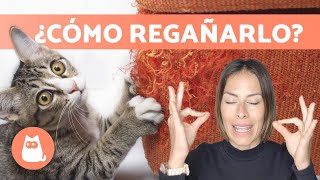
Alba Perez, a veterinarian, explains how to discipline cats the right way. Skip punishment and stress. Instead use play, stimulation, and positive reinforcement to shape feline behavior.
Hello, Hoover's family, and welcome back to the Experto Animal Channel. For those of you who don't know me, I'm Alba Perez. I'm a veterinarian, and I run the Vetropia channel and social media. Some of you may already know me through that channel. If you haven't already. I invite you to visit my channel or my website. But today, we're back on the Experto Animal Channel because I want to talk to you about how to scold a cat or even participate a little in the education of felines. So stay tuned because the video will start right away. The truth is that when we talk about education or managing behavior, it's usually much easier to find information aimed at dogs. But when we talk about cats, things change a bit. There are fewer specialists in feline behavior, and there's less information about feline behavior. Or the information we find can sometimes be a little contradictory. Well, to begin with, what you should be clear about is that negative reinforcement does not work at all with cats. And by negative reinforcement, I mean anything we do that ultimately stresses and therefore makes the cat uncomfortable. For example, if we catch our cat scratching our sofa, yelling at it, scolding it, or even giving it a light spanking will not help or work. This type of negative reinforcement behavior is increasingly being used and is being eliminated in the field of canine behavior. But I assure you that it will not work at all in the field of feline behavior. The only thing you will surely achieve is to generate stress in the cat. You will break the emotional bond with the house cat, which is also very difficult to create with felines sometimes, since they need a calmer and more trusting environment. And you are going to lose precisely this very important part with your cat, the issue of trust. Since if a cat that is normally affectionate, that does not show fears, and that is quite a sweet talker or lap dog, if you start scolding it and it begins to notice too much negative behavior, I assure you that it will move away. Therefore, the strategy that we are going to use to educate or scold our cats is always going to be using positive reinforcement. And what does positive reinforcement mean? That what we are going to do is reward good behavior and not reinforce bad behavior. In other words, our way of scolding cats is going to be not offering that reward when they do something wrong. For example, if our cat suddenly poops or pees in the litter box, and it is a behavior that we want to reinforce, what we are going to do is immediately after it has done so in its litter box, reinforce it with something that is very pleasant for the cat. It does not always have to be food, treats, or a can. You can simply use the fact of paying attention to it. If your cat really likes to be petted on its back, then spend five or 10 minutes exclusively petting and pampering it. That way, our cat will eventually associate a behavior that interests us, such as using the litter box, with a behavior that interests it, which in this case will be petting and caressing. On the other hand, if what we see is that our cat is pooping in a place that doesn't interest us, such as pooping on the sofa at home or peeing in the bathtub, for example, what we are going to do is clean everything up patiently and not say a word to it, and completely ignore the cat during the entire time that we have discovered the action. Therefore, the best way to scold our cat is to ignore it and not reward it. On the other hand, I can also tell you in advance that many feline behavior problems can be solved simply by dedicating a certain amount of time each day to our kitty. Many times you think that unlike dogs, dogs go outside, walk, play, have fun, meet other animals. But normally our cats are indoors. That is to say that they are inside the house. That often causes them to misbehave simply out of boredom. For example, if it is a cat that does not have time each day to be with its owner, to be pampered, to be caressed, that does not have time to play and vent with someone, what will happen is that it will demand attention. Many times they get that attention by doing things wrong. They know that if they knock something off the table immediately after you go and hang out, and for them that reinforces the behavior. Therefore, apart from what I have told you about how you should punish the cat, what you should keep in mind is that it is super important that you force yourself and dedicate a little time every day to sharing that space with and for your cat. For example, half an hour, half an hour a day would be enough for your cat to be with you at least during that time, to strengthen the emotional bond and stimulate its mind. At the same time, for example, you can use a very inexpensive toy, which you can even make at home. Any string hanging from a small stick, a pole or a cane, anything. You can use it to play with the cat. This will reinforce its hunting behavior, will stimulate it, and will also generate a physical attitude. And we will avoid a sedentary lifestyle. In this way, we will prevent negative behaviors from Appearing. Another thing you can do during that time is to dedicate it to putting puzzle games around the house. They range from the most basic to the most advanced levels to stimulate its mind and prevent it from having that need to mess around the house. I also recommend that you have the right house for your cat. Cats are animals with very curious behavior. They love to investigate, and above all, they like to be at heights. So I recommend that you have shelves or spaces available so that they can move around a little, investigate, and be up high without you having to worry about them throwing your favorite figurine at you. Finally, I think it's also very important to mention that it's best not to resort to aggressive behavior. Aggressive. I'm referring to the typical thing about spraying the cat in the face when it does something wrong, because that, again, is only going to cause stress to the cat, scare it and prevent it from coming near you. And in the end, it's going to associate you being around with something negative because it's going to scare it. In addition, you're going to make it afraid of noises and stimuli that it wasn't afraid of before. For example, if you always scare and scold your cat with the noise of the spray, when you start cleaning the house with any household disinfectant spray, the cat will probably take it badly, it will be negative for it, it will hide, and you will generate stress again. And that stress will also trigger bad behavior in the cat, and you will enter a vicious circle that you will not be able to get out of, or it will be very difficult for you to get out. So I do not recommend this type of practice at all. Therefore, to summarize, and what I want you to take away is that first of all, you stimulate your cat's activity. Dedicate half an hour a day to exercising it, playing with it, giving it a good dose of feline affection. And in this way, you will be able to prevent many bad behaviors or unwanted behaviors, because most are generated by boredom and lack of stimulation. On the other hand, if you have reached the point where you need to redirect their behavior a little, you have to avoid punishment and negative reinforcement. Remember, your punishment will always be to ignore them and not reward them. And you must reinforce the positive attitude and the one you want to repeat over time. And remember that reinforcement does not always mean food, but can be giving them attention and spending time petting them or playing. Remember that cats are ultimately very special animals. They are a species that is very delicate on an emotional and behavioral level. And if perhaps you see that you are not getting ahead of the situation and there are too many behaviors that are getting out of control. Do not hesitate to contact an ethologist specialized in feline behavior. Well guys, that's it for today's video. I hope you found it useful and that above all, you know better how to handle those bad behaviors that cats can exhibit. I also encourage you to continue learning much more on the channel. You can continue watching other animal expert videos, or you can also visit my vetropea channel where you will find content related to dogs and cats in terms of nutrition, veterinary medicine, and I am sure you will continue learning. Thank you very much for spending all this time with us pea lovers. See you in the next video.
More from Javier

Cuando nadie reconoce tu dolor por la pérdida de una mascota: así es el duelo desautorizado 💔




¿Tu perro hace suficiente ejercicio? Mantenerlo activo es clave para que viva mejor 🐶💪

GATIFICANDO UNA PARED PARA MI GATO 😻🧗♂️ Ideas para aprovechar el espacio vertical en casas pequeñas



Por qué duele tanto perder a un perro o un gato: el vínculo que explica nuestro duelo 💔🐾

