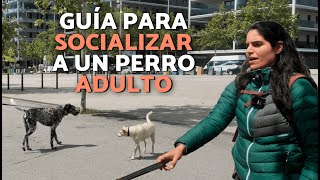
This is a YouTube video titled "¿Cómo SOCIALIZAR a un PERRO ADULTO? 🐶 ¡Todo lo que debes saber!" created on November 29, 2024. The content features Patricia Guerrero, a dog educator known as Patiok9 educator, discussing how to socialize an adult dog named Domi, whom she adopted. The video covers practical advice on understanding dog behavior, socialization challenges, and techniques to help adult dogs adapt to new environments and stimuli. The context is educational, aimed at dog owners or enthusiasts interested in canine socialization.
Hi, we're Domi and I'm Patricia Guerrero, better known as Patiok9 educator. And we've written a book called the Book youk Dog Wants yous To Read. In this book we're also going to talk about what we're going to talk about in this book, which is in this video that we're already tired of, which is how to socialize an adult dog. I chose Domi out of all my dog friends, because Domi, well, we adopted him six years ago when he had a couple of them, or maybe not, who arrived. And we've done a lot of support to socialize him well in our society because he came to us a little, you know, unsocialized. Domi came to our family almost six years ago. @ that time he was a little over a year old. And, well, he came with a backpack full of stuff, stones from some bad experiences, we probably don't know what. But he also came with, well, a lot of lack of socialization, which is due to the life you lead. Well, for example, if they found him wandering the streets of Welva with another greyhound, with another companion, and well, they experienced what they experienced. And this is very common, right? When you adopt, when you incorporate into the family an adult dog that you don't know has lived, that carries its backpacks. Well, I want to share with you how to accompany an adult dog to socialize in our society. Let's go. As I was saying, Domi came into our lives six years ago. He was one and a half years old. He was found wandering the streets of Wolva. And I'm sure you can identify with this a lot. Many of the stories of the families watching this video. How great. We adopt dogs that we don't know where they come from or we know very little about their origin. And this means that they come with, well, a backpack full of stones, many times, sometimes bad experiences. And then they even come without feet, with nothing in their backpack, right? They don't have the tools to face what life brings. Because when we say socializing, dogs are sociable and gregarious animals and they love to live together and share, but they are not used to being in our society. Look at the moment we are recording this video. Although it is a day when there are not many people. Rainy midday during the week, okay? And you can see that this walk, for example, on the weekend is packed, but there are cars passing by, which is the sound, the movement, the textures of the ground. We have already passed quite a few different. Different people, right? People who have even invaded Their personal space to touch a chair that is making noise there because it is windy, the wind moves many things, and it can also scare dogs because there are odor particles in the air. In other words, pay attention for a moment to everything. I have told you that we are socializing here, Domi. So first of all we are going to know what our dog is receiving from all the places we are. We live in a village in Galicia, surrounded by nature, and right now we are in a city that is not ours. Although it is a small city, we are not used to so many stimuli, including myself, because I have become a total villager, even though it may seem like there are few. So you have to take that into account where you are going to live and what stimuli your dog is going to have on a daily basis. First to decide what you want to socialize with, because there are times when. Well, maybe I was also a bit of a pioneer in that right, of thinking that we have to socialize with absolutely everything. And there is no reason why. For example, we come to the city once or twice a year, and here we take care of that. But then during our day to day life, you will rarely see us around the city. You will always see us in the Galician mountains, giving it our all. So you have to decide whether it is really worth exposing your dog to it. Depending on the circumstances, the next step would be to get to know our dog very well. I understand that when he just arrived home, we just adopted him. Well, we don't know him. How do you get to know a dog? By living, having adventures and living in the same space. And then you'll see that you're going to find a lot of surprises. I remember when I first started living with Domi, we went to the beach and, well, he touched the sand and went crazy. He's a very active dog, as you can see in this and other videos, very energetic. And despite the fact that he must be about 7 years old now, he still has overflowing energy. I can't. Well, you can't imagine what he was like when he arrived. Do things, but from a distance. Look, here comes another one. Tomi, this is for another whole video. What happened here was a very interesting conversation, if you notice, he went around, one went and then the other. It may seem that Domi was asking for a game, because he bowed. But what he was asking for was to slow down a bit, because Domi is, well, shy. If he were a human, he would be a shy human who needs his space and time to interact with other dogs. And who sometimes goes from being shy to being a bit rude. Right. Because he starts barking due to his own insecurity. I would like to explain so many things about how to socialize an adult, but I won't have enough space in this video. Hey, I'm going to show you this video that's going to appear on the screen. It's from my students. I want you to observe the play of leashes there, how each one leaves space. These are dogs that have just met. Okay. It was a meeting I organized for canine Explorers. They are well advanced students who have been getting to know each other and studying canine language for a long time. And this gives the greeting this quality, right? And you also see my dogs and well, that whole ensemble is a bit of what I would like to convey. It's very difficult in a 12, 15, 20 hour video. I could spend half an hour to show you how I take into account the nuances in an interaction between dogs. It's almost, I would say, a master's degree in the universe. But yes, if I had to summarize this video in terms of everything we've experienced in these minutes, it would be one where you get to know dog language in depth, to know how they communicate, to know what your dog is experiencing and what they're picking up, to see what they're socializing with, to adjust the distance and everything that has to do with that experience so that the dog experiences it in the best possible way. And then to accompany them that if they're scared or having a bad time, you take them out of that situation and accompany them. And you can also make things positive by giving them a reward or playing a game. But for me, this would be the last thing. And well, and as always, Domi, the basis of all this is trust. Living together and having lots of adventures together so that later you can really trust each other and everything will be easier. And in this case, socializing with whatever is available. I hope you liked it that you connected and well, anything you need, you can find it@patedukadoracena.com where we continue to reflect, debate and well, see the coexistence of dogs from a perspective of enjoyment and respect. Okay, see you later. What is your goal for socialization? That nothing happens, that your dog is comfortable. And that is because you have adjusted the distance, the exposure time and everything that has been happening around him. Domi, I know that walking like this on a leash may seem a bit dangerous because, for example, a car was passing by or something. What else can we do? Well, keep it shorter. In short, we are going to create a space and a way where the dog feels comfortable. If we also want to make the stimuli positive, we can use resources such as food. Very good, right? Where we can reward. But here you also have to be very present to know what you are positively doing. Domi, very good. Because maybe, if I haven't realized it, I am positively doing it to the pigeons instead of a human or a dog. Here it is important that you go prepared for the moment. It is not always going to be so easy, especially those of you who live in big cities. Socializing is sometimes impossible because we are invading the dog at all times. If we live, for example, in a super central street where we go out and there are cars and our dog is afraid of cars. So there you are going to have to adjust the schedule in which you do it a lot and even look for places where you can adjust these characteristics. And then it is really positive for the dog. A very big challenge. He doesn't want to, you see. Let's go. Come on. Domi. Domi, Domi, Domi. Good. Come on. What just happened is something very common, right? We always look for dynamic interaction, right? Come on, let's go. Right? Or proactive. I don't know how to put it. And it's the worst because dogs, in the end, well, that's it, right? In this case, the dog was asking for help. Domi was acting a bit brutal and. Well, it's not that I don't want him to do it, but I'm also very responsible for the experiences that my dog makes him live. It's like going beyond, right? It's not just what he experiences, but also what he makes others experience. That's a life principle. Because I also consider it for myself, right? I don't just think about what I feel, but what I make others feel with what I say and what I do. That's also why my communication with you is always based on what we can do. And not so much on the point of pain, right? Of going to what you do wrong, which we continually screw up. So that's it. That when we work with dogs, the ideal would be to let them always be the ones to decide, both ones and the other. And something that I always mention about socializing with dogs is to get along. That is not just seeing dogs occasionally in a place, but. But also walking them, right? And that the dogs can smell each other and do things, but from a distance. Look, here comes another one. Tomi, this is for another whole video. What happened here was a very interesting conversation, if you notice. He went around one went and then the other. It may seem that Domi was asking for a game because he bowed. But what he was asking for was to slow down a bit, because Domi is, well shy. If he were a human, he would be a shy human who needs his space and time to interact with other dogs and who sometimes goes from being shy to being a bit rude. Right, because he starts barking due to his own insecurities.