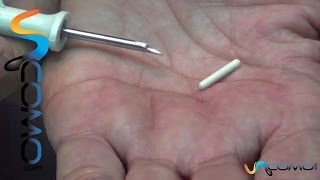
This is a YouTube video titled "Cómo son los chips de perros" created on March 12, 2012, providing an informative monologue about pet microchips. The speaker explains the technical details, implantation locations, and the purpose of microchips for pet identification and recovery. The content is educational and presented by a single speaker without any conversational exchange.
Hello. Well, today we're going to talk about microchips. Microchips are an essential tool for identifying our pets. Microchips are electronic devices about the size of a grain of rice and are included in syringes that have a slightly thicker needle than normal so they can be inserted under our pet's skin. Microchips are radio frequency devices that are called passive. What does that mean? It means that they are only activated when they are on the radar or in the field of a specific scanner. In other words, the microchip does not emit a signal. Many people ask, if we implant a microchip in our dog, will we be able to locate it via satellite? And it should be explained that this is not the case, because if it were this way, it would have to have a battery that would emit a signal for about 18 or 20 years. From a technical point of view, it is not currently possible. Therefore, the microchip will only be activated when we read it with a special scanner. These scanners are only available to all veterinary medical personnel, the police, firefighters, shelters, and all veterinary clinics, which are the ones authorized to have these radars. From an international point of view, the microchip must be implanted in the neck area, in the dorsal area of the neck, or behind the left ear. Only in these two places. We cannot put it in the leg or in the abdomen or anywhere else. It only has to go on the top and on the left side. The goal is that when we find a dog or someone finds a dog at the time of scanning it, we cannot waste much time, because there are dogs that are very large, that have a large surface area. So we are only going to look for it in the neck area or behind the left ear. Like in this case here, our friend Yao, who has it behind his left ear. The microchip simply gives us a number that goes to a database, and in that database goes the owner's data. So if we lose a dog, we pass it through the reader, the number comes up, we go to the database and locate the owner. That's the function of the microchip. Well, at first I hope it has been useful to you. And remember that the implantation of the microchip is mandatory. It's the only way we have to find our pet in case of loss. Thank you very much.