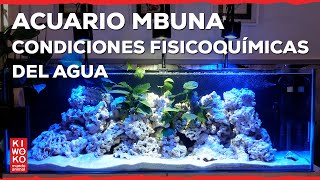
This is a YouTube video titled "Condiciones Fisicoquímicas del Acuario Mbuna 🐟: 【Serie: Parte 3】" created in December 2024. The content is a detailed monologue by a single speaker discussing the setup and maintenance of a Mabuna cichlid aquarium, focusing on the physical and chemical water conditions, lighting, filtration, temperature, and other aquarium equipment. The speaker shares personal experiences and advice for recreating the specific biotope of African lakes for these fish species.
Foreign, yes. Fifteen days have passed and this is the result. The aquarium now has a maturation cycle. Fifteen days have passed. It is using the biological complexes on a daily basis. And today I want to talk to you about two very interesting points. On the one hand, we are going to talk a little about the decoration and the changes I have made addition to the instruments I am using. And on the other hand, and no less important for the Mabuna cichlids, because we are making this aquarium for Mabuna cichlids. We are going to talk about the pH, the KHS, which are the physical and chemical conditions of the water. Well, what changes have we had since the last time? We did not mention the lighting systems. We had only installed one lighting system. This is a kessel, specifically for planted aquariums, that, unlike these two, are for marine aquariums. Let's start with this one. This lighting system will allow the anubias that are here to grow magnificently. In fact, if you see it, I've put a pothos because the leaves are similar. And what I want in the end is for all of this to be included within what would be the same aquarium. On the other hand, we have these two cassi, which would be for marine aquariums. The lighting is actinic lighting. It has a lot of blue. This will help us reinforce the blue colors of the cycs that we are going to put in. It will look wonderful. Remember that all these items are items that I had from other setups and I am reusing them. The cycles started with the lighting for the plants. I am putting them on for eight hours continuously. And the actinic ones, I am turning on for a while in the morning, two hours, and then another four hours in the afternoon. Right now I have them on so that you can appreciate them. But what I am really doing later is a cycle. I put a bit like the light at dawn and then the light at night. Another obvious change is the repositioning of the rocks. We have the rocks that were old rocky rock, or what they call marine rock. The sand, be careful. I used a sand that was a bit fine in grain size. And on top of that, I used one that is like talcum powder. It is super fine and you can see it quite well. This will give it quite a bit of texture. I'll also tell you something. The cichlids in these lakes usually like to dig. And this sand will be wonderful. One thing I would also like to mention is that in the previous setup, you saw that I had placed a movement pump. Well, it Turns out that two days after having the movement pump on. Since it is an item that I have been using for many years. It is. It was broken and I had to take it out. But it had an internal filter and I am using it as an internal filter, but more for the movement of the water. Remember that this aquarium already has a wonderful Hein filter. It is a 600L filter, double what this aquarium would be. If you can see, we have the inlet of the external filter here. And here would be the outlet here. The only thing this internal filter is doing is moving the water in two columns. I have movement on this side and movement on top. Finally, I have a heater that, if you recall, was also the heater I used when we had the turtles. It's a hain heater that comes fully protected. So if the turtles hit it, nothing would happen. The same thing will happen with the Cyclia. They are fish that sometimes when they start moving, can cause a rock to fall and break. Of course, this type of hind heater has a fixed temperature of 25 grams. Yes, 25 grams is the temperature I'm going to have in this aquarium. Having said that, as you know, I'm quite picky about the physical and chemical conditions of water. And this aquarium was no exception. This type of biotope that we are recreating, the large lakes in Africa, such as Malawi or Victoria or even Tanganyika, have has exceptional water conditions. Look, they have very high pHs. We are talking about levels that can range from 8 to 8.4 with very high GH levels starting at 20 and starting at 0.025. All this means that we have to monitor the physical and chemical conditions of the water very carefully before introducing the fish. Of course, we also have to have, remember, zero ammonia. In this case nitrites, zero or 0.025 and very low nitrates. Why do I have to put so much effort into this? Because cichlids are animals that we are going to have to introduce a large volume of during that initial initiation. And I will explain why. Some animals tend to be very territorial. So here we are going to have to play in large blocks. We will talk about that later. I have used these products that Sikken has given me, which are wonderful for adjusting the chemical conditions of the water. On the one hand, we have a buffer that has raised the pH. And yes, I could not resist. I have been periodically analyzing the pH, KH, nitrites, nitrates and ammonium every 48 hours. Imagine how excited I am. And on the Other hand, we have this salt. This salt will help stabilize and add minerals to the water so that the PH never drops. I live in the Community of Madrid and the water in the Community of Madrid is super soft. What does this mean? It has almost no minerals. The problem with an aquarium like this is that over time, if you are not adding mineral salts, it will collapse. And what would happen? The water would become ashy. If the water becomes acidic, it is not good for these animals, unlike for the rest. Remember that we are trying to recreate a very, very specific biotope. We need attention. Very high PHS, right? Starting at 8, take note. And very high KHS. I have them now at 9 and I had them at 22. In other words, it's quite hard water. One important issue is temperature. The aquarium will have an average temperature of 25 grams. I don't want it any higher because I've had cyclia in the past and every time the temperature went above 28 degrees, they became much more territorial and aggressive. I prefer to have them at a slightly lower temperature. Be careful, they won't get cold. 25 grams is an ideal temperature and the animals will be calmer. Another nice thing about these animals, and I'll tell you in advance, is that most of them are herbivores. They eat little algae. That's why we probably won't need a cleaning squad. But time will tell and we'll see. I'm super excited because I've ordered some cichlids from Kehoe, where I usually go, which is in Al Corcon, Madrid, and I know it's coming soon, so I need to have the perfect conditions so I can introduce the animals without any problems. I invite you to follow us as we set up this Mabuna aquarium, which is very easy to set up and maintain. And I also encourage you to use parts you have from other aquariums. It really is fascinating. We'll soon talk about feeding, acclimatization and little tricks on how to handle things when there's a lot of territory or not enough territory. We're going to talk about everything you're interested in. If you have any comments, leave them.