Cosas que haces mal con tu GATO en el VETERINARIO 😾💉👩🏻⚕️ | ¡No lo saques del transportín!
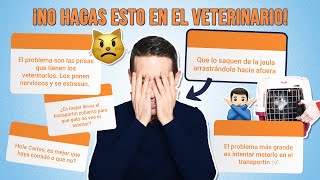
Carlos, a clinical veterinarian, explains common mistakes cat owners make at the vet. Don't take your cat out of the carrier in the waiting room, choose the right carrier, and know when sedation helps reduce stress during visits.
The drama of taking your cat to the vet. You've asked me thousands of questions on Instagram. Well, maybe not even thousands, but today we're going to try to answer all of them. Well, or almost all of them that we can. Hello, I'm Carlos, a clinical veterinarian at Small Animals. Welcome to the Happy Pets and Families Channel. Today, I've done it this way. Many families tell me when they come to the vet's office that their cat is a panther, but at home it's a cotton ball. Why is that? It's true that we vets earn it when our patients, well, in quote, marks, hate us. But everything you do with your cat before coming to the vet's office and also inside the vet's office also has a lot to do with it. And I wanted to make this video. And in fact, the other day I asked you about this on Instagram. And that's why I, based on your doubts and my professional experience, I'm going to give you advice that perhaps no one has told you so that you can take your cat to the vet. And there are no dramas. And be warned, it will also depend a lot on your cat's catnip. But this will definitely help you. Throughout this video, we're going to see things you should do, but especially things you shouldn't do and that you should stop doing immediately if you want your cat to behave well and not suffer so much stress at the vet's office. I'm going to organize the video into things you have to do before or prior to going to the office, things you have to do in the waiting room, and things you have to help the vet with during the office. And at the end, I'll add a little sauce. Okay. And I'm going to leave the separate chapters below on the YouTube timeline so that you can move around freely. Come on, let's go. There's a lot to talk about. The first thing you need to look at, and no one has asked me about it. The carrier, please. How come they haven't asked you? They haven't asked me specifically about the carrier. What characteristics the carrier should have. That has a huge influence. If your cat is already comfortable in that form of transport, it will be much less stressed and everything will be much easier. The most important thing is that the carrier is large. Well, that your cat has enough space to be able to turn around inside the carrier. Rigid or soft, it doesn't really matter. But I like the rigid ones better because they are more resistant, they are more robust, and at the end of the day. If there is any kind of unforeseen event during transport, your cat won't have as many consequences. But there are also good soft carriers. Of course, in soft carriers, what I like is for the zipper to go all the way around the lid so that we can open it completely. It's also very important that if your cat is a bit heavy or chubby, you don't use this type of carrier because the zipper might not hold up well enough and it could end up coming undone in the middle of the street. The most important thing is that the bottom of the carrier, the floor, is hard and rigid, because, well, some people bring them in a travel bag or something like that, and then when you pull on the handles, the bag deforms and the cat can't fit comfortably lying down or standing up or anything like that. Another very important thing is that the carrier can be disassembled, that we can remove the top part so we can access the cat without having to handle it too much. And I want to emphasize this a lot, because it is very common for the pieces that join the two parts of the hard carrier to get lost and for you to bring them back to me with any kind of fix with cable ties with screws, and it is impossible to take that away from you at the consultation. It is very good that at some point you put a fix with a cable tie so that the carrier is assembled, but we cannot disassemble it at the vet. We have to mess around because we have to drag your cat out and so on. Do not hold it by the handle unless it is absolutely necessary. The handle gives a lot of mobility and you can be giving the cat well this way and that, and end up being very dizzy. At the consultation. It is better to hold it from below so that in addition, if for some reason the top part comes off, your cat does not end up in the middle of the street and can go wherever it wants. And this may seem like complete nonsense to you, but honestly, these things happen and they have happened to me. I used to work at a clinic on a street and I had to leave the office to look for a cat whose carrier had broken in two. The cat had escaped and ended up under a car. I'm not being alarmist, I am seriously. Do you have to cover the carrier or not? That's the question. I'm missing the skull. Have you ever noticed that some cats have their carrier covered with a blanket or cloth so that the cat doesn't feel so stressed during the consultation? I would Say that it depends a bit on the cat, but in general, almost all cats are much more comfortable if the carrier is covered, because that way they don't have to worry about things that they might identify as dangers. A dog that they see on the street, another cat that is in the waiting room, etc. It's better for the cat to have eaten or not eaten before going to the vet. I usually recommend that, especially if your cat gets carsick, that it doesn't eat. If your cat needs to be sedated for whatever reason, it is always better for it not to have eaten because the sedative drugs usually cause vomiting. That way we can avoid it. If you leave it without food for four or five hours at the most, that is enough. And in the waiting room, how can you help your cat not to cause a drama? This also worries you a lot, honestly. And you have sent me some questions, in fact, some that are real allegations, saying to me, you have to convince all the cats in the world that a waiting room just for cats is necessary. And you are right, dear friend. I don't know why this is anonymous. It is very important that cats in the waiting room are not subjected to a lot of stressful situations. And how does a cat get stressed in the waiting room? Well, just because there is a dog next to it, for example, or also because there is another cat with it that can also be quite stressful for it. It is preferable that you ask your veterinary clinic if there is a specific area for kittens to wait. For example, I used to work in a clinic that was very small and we did not have a specific waiting room for cats. We did plan for cats not to have to wait in the same waiting room as dogs. And so, well, we would separate them. Sometimes, even if there were too many cats, we had to put them in the groomers if there was no one there. I mean, if no work was being done there. So, well, your vet might also reconsider and say, oh, okay, I'm going to put them here in this quieter area. Or you can also give your vet an idea if they haven't thought of asking you about it. But what if this is not possible? If there is no place in the clinic where your cat can wait, the best thing you can do is place the carrier on your lap so that your cat is close to you and can smell you, so that your feline companion doesn't say, oh my gosh, they left me here all alone. As I said, it's good to have the carrier covered, but it's a good idea to put the door facing you so that your cat can't see another cat through the door or any gap in the fabric you've put over it, or get nervous as well. In these cases, synthetic feline facial pheromones can also help. And something that we, the veterinarians and the assistants who work with us in the clinics have to repeat to you a lot. Please do not leave your cat inside the carrier. Well, logically, not even if it's dancing around, but especially inside the carrier on a chair or shelf or a high surface that you see there in the office. Because if you go up to the counter for a moment, whatever, you might think that your cat is very calm and behaves well inside the box. But there are many cats that, for whatever reason, get scared and end up falling to the floor. And believe me, that happens. I've seen it too. If your cat is a little restless and gets nervous around other cats, then try to take it to the veterinary clinic at times when there aren't many people around. Look, I'm going to give you a tip from. I don't know if it's from a veterinarian or a computer scientist. If you search, for example, on Google for the name of the veterinary clinic, it'll show you a kind of file on one side, and it'll also tell you how busy it is, how many people are usually there. So choose the times when there are fewer people and you don't know how to look it up online. So you call the clinic and tell the vet and say, hey, look, would you mind making an appointment for me when there aren't many people around? Because, well, cats get very nervous and the vet probably won't have any problems. Okay, very good. And now let's talk about how you can help your vet or your vet while you're in the office so that your cat is much calmer. It's very common that when you enter the office, you suddenly start dismantling the carrier or trying to get the cat out or whatever. Please don't do that. Calm down, relax. You have to talk to the vet for a while because they have to ask you what's wrong with your cat. Well, all the symptoms and so on. It's good for your feline companion to be inside their carrier at that time so that they don't get stressed out, especially if they don't tolerate you taking them out of the carrier. Very well. There are some cats, and I know you'll tell me in the comments that when they arrive at the vet's office, they leave their box and start sniffing around. This has happened to me too. Well, if your cat is an explorer, for example, or if Midnight, who I know you're watching, is an explorer and likes to get under the furniture and stay around smelling everything in the office, then leave them alone because that will also calm them down. Now we're going to answer one of the concerns you've sent me the most on Instagram. For example, taking them out of their carrier, which I understand is the transport system they use dragging them out of their cage. Taking their carrier out when we're at the vets is impossible. That's why I told you at the beginning that your carrier has to be dismantled from the top, because that way we'll avoid dragging your cat through the door and them feeling invaded. It's much more comfortable if you can remove the top lid of the carrier so you can examine the cat or do whatever you need to do without having to move it from its blanket, for example. Or if it's a soft carrier, you can unzip it completely to remove the top part so the cat doesn't have to move. It's much more comfortable for me and for him. Another very important thing when you go into the office is that you don't have to stand against the wall and leave the vet with your feline companion on the table, seeing that you're far away, that you've left it there as if it's been abandoned or sold. Quite the opposite. You have to be next to your feline companion. Well, so that it also feels a little more comfortable, so that it feels like you're with it. It's great if you talk to it softly, that you pet it a little, that you caress it, so that it also reduces its stress level in some cases. You have also told me that your vet bribes your feline companion, or that you bribe your cat during the consultation by giving it a little bit of food to take advantage of the fact that it is eating and is a little distracted, so that the entire examination can be carried out. That is very good. Of course, you should never leave it alone. And one little thing. Well, it is a big thing. Sometimes I ask you to help me during the consultation to, well, hold the cat or something. I just want to say from here, to vindicate the role of veterinarians, that if your vet tells you to help them with something, please cooperate because you make life much easier for us and your feline companion. And also during the consultation, the million dollar question or. Well, I Don't know the controversy over sedation or no sedation. There are some kittens like Coco and Jade who you can't lay a hand on in the vet's office because they get very nervous and aggressive. Well, Rokio knows very well that they need to be sedated and she accepts it. But there are some people who are not used to it or do not understand why it has to be done. Sedation is ultimately a way to help your feline companion not suffer so much stress in the veterinary clinic. So there are some cats that do not take it very well when they are being handled or when the process that has to be done has to be manipulated in some way that they will not be comfortable, like having an X ray or something like that if the animal is a little stressed. If we have not followed everything we have said so far throughout the entire video and the cat comes to the consultation in a panic, then it is more likely that we will have to tell you, hey, look, to prevent this from getting worse, to prevent him from feeling worse, to prevent him from having a bad memory of the veterinary clinic, maybe we have to sedate him and that is why we do it. Not for any other reason. I'm telling you this for the sake of your cat, not because I have any specific interest. And now when I edit the video, Jose is going to bury me in the comments because he had asked me a lot about how you can put your cat in the carrier. What is it that your cat hates the most about having to go to the vet? Have you noticed that there is something that happens that is very curious? Your cat at home does not want the carrier at all. You have to put it in almost by force. When you take it to the consultation inside the vet's office, it does not want to come out, even if you drag it. In fact, when you sometimes literally, and when we have finished doing what we have to do inside the office and we open the door, the cat jumps like a bullet into the carrier. It is very curious that a cat behaves in these three different ways with the same carrier. Therefore, we have to think that the problem is not the carrier. The problem is what reminds your feline companion of its transport box at all times at home. It reminds your cat that it's time to go to the vet and that there, well, sometimes he doesn't have a very good time at the vet's office before taking him out, when it's his little refuge, because they say they can't do anything to me here. And when we're done and we open the door. It's his passport to freedom, to going back home. That's why it's so important for your cat to associate the carrier with something positive in his head so that it stops being a problem. We've already told you all about that here on the channel, and I'll leave the video here for you to check out when you're done watching this one. That's why I didn't include it in this video, because that was already answered. And finally, a little bit of sassy, a little tug on the ear that I also got from the questions on Instagram. Why do many vets treat cats like dogs? I'm really sorry. No, it's true that we were probably well prepared to know that cats have special needs, special personality traits, and that we also need to know a little bit about how to treat them. But fortunately, that situation is gradually changing and more and more veterinarians are becoming aware that cats are not small dogs. They need to be treated as if they were cats, not dogs. In fact, there are quite a few clinics that are exclusively for cats because cat illnesses are not the same as dog illnesses and cats personalities are not the same either. And they may feel more comfortable in a feline clinic. Okay, and now for the second and second little ear pulling or taunt that you've given me here. The problem is that veterinarians are in a hurry. It makes them nervous and stressed. Damn. Well, I'm going to apologize a little to all my colleagues. There are times when it's true that we go here and there and don't pay much attention. I'm so sorry. We try to prevent that from happening. Obviously, I know you're not talking about me, but hey, I don't know if it's ever happened to you at the vet. I hope you understand because we always have something extremely urgent, super important, some problem with an animal that has arrived at the last minute unstable or with some emergency, and that's why we have to run. That doesn't mean that we won't treat your cat well. But hey, I understand that it's not the best impression you can get from a vet. These are some general considerations of things that I see that families generally don't do well when they bring their cat to the vet's office. And that will greatly help reduce stress and also improve your cat's behavior and the overall experience during the consultation. However, I am aware that this is a bit of hard work and that it also depends on the families and also on the Vets themselves. We have to put ourselves in that role too. However, no matter how good the experience is, cats generally don't like going to the vet. Don't they like their vet? Well, although I do have patients who really like me, you have to think that, after all, it's like when you go to the doctor, you also feel a little uncomfortable, a little invaded. It's normal. And if you have any techniques to make your cat behave better at the vet, or I forgot to mention something that you think is super important, or you have any questions, leave them in the comments and we'll find out. Hey, and if there are enough questions and doubts, maybe we'll do a second part. What do you think? And that's it for today's video. If you liked it, give it a like and share it with everyone. Remember to subscribe to our channel if you haven't already. And also remember to subscribe to our secondary channel called Questions and Answers from a Veterinarian. Stop by, hit the bell, like the videos and all those things that help us a lot and we really need them. And today we meet Murad K. Paz. He is Donnie Luna's feline companion. And he asks himself a why do they grow so fast? And this one is beautiful. It's not that I'm giving him a compliment, but that's his name. And he greets us from Guayaquil and lives with Veronica Rivera Guapulema. And you can call this handsome guy either Missy or Peck. He'll pay attention to you. Anyway, he is Mareche's feline companion. And, well, we also have to thank her very much because she does an exceptional job as moderator of our Facebook group. Thank you very much, Merce. And here is Missy as a thank you. Thank you very much for following the Pets and Happy Families Channel. And we'll see you in the next video. Bye. Oh, the drama of taking the cat to the vet. The drama of taking the cat to the vet. The drama. You're going to use all this for outtakes, right? Again, yes.
Oh, I think it will work, right? I think so. Right, that's enough.
I wish the word veterinarian wasn't used in the masculine form at all. You never say veterinarian versus. Okay, I'm going to say it because of course I'm talking about myself. If you search for it on Google, as we say in Spain or Google. No, don't laugh. I'm not saying it precisely so that the cat doesn't get a hot flash from going to the doctor's office. It's just that people think we're there. Struggling with the cat. How patient. Bye.
We always leave some clue about the channels we watch.
Yes, that's true. Oh.
More from Javier

Cuando nadie reconoce tu dolor por la pérdida de una mascota: así es el duelo desautorizado 💔




¿Tu perro hace suficiente ejercicio? Mantenerlo activo es clave para que viva mejor 🐶💪

GATIFICANDO UNA PARED PARA MI GATO 😻🧗♂️ Ideas para aprovechar el espacio vertical en casas pequeñas



Por qué duele tanto perder a un perro o un gato: el vínculo que explica nuestro duelo 💔🐾

