¿Cual es el DIBUJO del PELAJE de TU GATO ?🎨😽 | Descubre TODOS los tipos y su origen 🌎🐈
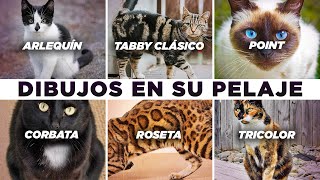
This is a YouTube video titled "¿Cual es el DIBUJO del PELAJE de TU GATO ?🎨😽 | Descubre TODOS los tipos y su origen 🌎🐈" created in February 2025. The content features a veterinarian named Carlos explaining in Spanish the various coat patterns of cats, including tabby, bicolor, tortoiseshell, calico, mosaicism, point type, and others, along with genetic and biological insights. The video is educational and aimed at cat owners or enthusiasts interested in feline coat colors and patterns.
It's actually very, very rare for a cat to have just one coat color, and it's very likely that your cat will have more than one color. So today I've decided to tell you all about our cat's coat patterns. Hi, I'm Carlos, and I'm a veterinarian. Welcome to the Happy Pets and Families Channel. In today's video, we'll continue getting to know our cats by what they look like on the outside. Although you know that I don't like to judge their appearance. There's a ton of super interesting information that the coat patterns of our feline companions can give us. Let's start with the tab pattern, also known by some as tabby. Well, tabby isn't actually entirely correct because there are some cats that are striped tabbies. There are four main types of tabby cats. On the one hand, we have the mackerel tabby or the striped tabby, or mackerel, as the English say, like mackerel. Yes, well, and the tabby is gone because we're not talking specifically about their stripes. The tabby cat is the typical Roman cat, the one that people call the Roman, the common European cat. It generally has a pattern on its coat that corresponds to striped marks, quite well pronounced and long along its body, giving it that typical tiger look. Right. And that's why people call it tabby. It is perhaps the most primitive, oldest of all the patterns that cats have on their bodies, because the gene that produces it, the agouti gene, is also one of the oldest that has been recognized in terms of cat color. What this gene does is that our cat's hair is not a uniform color, but is formed by different stripes. The hair itself, when the agouti gene combines with the tabby gene, the stripes are formed because precisely the agouti gene divides the hairs into different colors. Let's now look at another type of tabby. It's called the Abyssinian. And it is precisely with this tabby that we can say that not all tabby cats are tabby, because their bodies do not usually have stripes, or at least these are not very pronounced. In cats with the Abyssinian TAVI pattern, most of their body simply has hair of different colors. And these stripes are only usually seen a little more marked in the area of the legs or in the area of the tail. And it is the classic coat of the Abyssinian cat and also of the Somali and Singapura breeds. The next type of tabby cat is the classic tabi, which one would think is the most common. However, when we think of Tabby cats, we always put the stripes in a straight line. But the classic tabi has a pattern similar to that of the kocifo. On its sides there are two marks, one on each side, logically more or less circular in shape, which in some texts you can find described as having the shape of an oyster. And around these marks, different types of stripes are arranged. These stripes are well formed, very thick, and are also characterized by a very, very thick stripe on the dorsal area. In other words, it's like the kociofo, if you remove the white color. It's also present in some breeds, such as the sokoke. And this type of tabi pattern is a little less common because the other two that I just told you about, both the mackerel and the Abyssinian, are dominant. So it's more common to find cats with these patterns. And finally, let's move on to the last type of spotted tabi. In reality, in this case, the authors don't really agree on whether it's a specific type or a variation of the striped tabi, because the fundamental characteristic of these bimodeled cats is that the stripes are interrupted, so they form small spots. As I said, you have to be careful because not all tabby cats have stripes. But if you want to know if your feline companion is a tabi, I'm going to give you two ways to identify it. On the one hand, if you find the typical M mark on the forehead, that is an unmistakable sign that the cat is tabi, especially yellow or orange cats in which the stripes are not very visible. In many cases, if you see that mark, you know that it is fine. And the other is that if you have missed this on the forehead, if you find any stripes on its body, pay attention. Pay a little more attention, especially in the area of the legs and in the area of the tail, because that is where they usually appear. That also indicates that they are tabi. In fact, as we told you in the video about orange or yellow cats, it is very rare, if not practically impossible, for an orange cat not to have any stripes. The only thing is that you have to look closely. And speaking of yellow or orange cats, well, I also bring you another interesting fact. Most of them tend to be male. But if you want to know a little more about this type of cat, as I've already told you, we've made a specific video about them on the channel that I've linked below, linked in the description box, as well as the rest of the studies that I've used to make this video. And other videos about the colors of our feline companions. Now let's talk about bicolor cats. When you think of this type of cat, the typical thing that comes to mind when you think of it is the typical cow cat or cat in a tuxedo. But we'll always talk about bicolor cats when they have white in another color. It doesn't matter if it's for example, a tabby or yellow with stripes. Well, as long as there's white in only one other color, they're bicolor cats. Well, let's start by talking about the most classic cat of all, which is the tuxedo, which is the typical cat that looks like it's wearing a suit jacket. It looks very elegant. To identify this pattern, we're going to use snowy as an example. Although this coloration is also very classic in American short haired cats. In this type of cat, the chest and paws are usually white and a large part of the face will also be white. Everything that is not white, that is the back area, the legs up to the middle and the tail will be black. And if instead of being black, we have any other color with this same pattern, we would call them particolor. But in addition to the tuft and the particolor, we have other patterns that well, will be called one way or another, depending on the amount of white they have on their body. For example, the harlequin pattern cat, in this case most of its body, the vast majority is white and there are only a few spots that are usually located either on the head or in the tail area. And the most extreme case of La King would be the cat with pattern B, which in some places you will find written as van because, well, van in English means van. In this case it is the classic coat of the Banterco cat. They usually only have colored ears and also the tip of the tail or a large part of the tail. In this case the rest of the body will be white. And depending on the size of the white spot, then we will have other varieties. For example, if the spot is very, very small and is only located in the area of the legs, we will have shod kittens or with socks as they are called in some places. And if the spot is also small and is located on the chest, we will have cats with ties like that famous legendary cat called Kate. If you do not know the legend, I also leave it below linked in a very interesting video. But this cat, although the vast majority are black, is considered bicolor. Let's go now with the tortoiseshell Or Corelli cats. Well, in this case it is almost better to say female cats, because as you already know, surely if you have seen more videos here on the channel, the vast majority of cats that have this color are female. And when not, well, there is a slightly rarer condition called clean filter cat, which is a male that is basically sterile. And this is because both the black and orange colors are associated with the female X chromosome. So a cat with a kitty pattern or color will have the black color on one of its X chromosomes and the yellow color on the other in order for it to manifest itself in this very curious pattern, like the corre. It happens that in some cells the black is expressed more, and in other cells it expresses more yellow. So we have hairs of these two colors coexisting in the same cat, but in the same way that solid colors or stripes can be combined with white colors. As I said before, bicolor cats also happen with calico cats when white is added to a female correcat. In this case, we will have calico cats, or also called tricolor. This happens because when the spot is very, very large, the white spot, the orange and black colors separate, and then we can see them clearly identified in the form of spots on the cat. But when the white spot is a little smaller, in that case, the colors do not separate in the form of spots. And we can have kittens with white parts and the rest of their body a tan. And there is a very, very, very curious pattern called torbi. In this case, it is like the mix of a tabby with a key. It usually occurs logically in female cats in which there are white parts, but their spots, instead of being tan or tabby, some tabby spots will be black and the others will be yellow. But before finishing talking about tricolor cats, I would like to tell you about something a little special. Sometimes a phenomenon known as mosaicism occurs in our feline companions. Mosaicism, or mosaic type cat, occurs when two embryos that were originally going to be different fuse inside a cat. So it is possible that when it comes to expressing skin colors, slightly capricious patterns begin to appear. For that reason, and well, because in biology, 1, 1 does not always equal 2. Sometimes we can find male cats that have three colors in their fur and that are not sterile because they are not clean felters, they are mosaic cats. And the most curious mosaicism pattern perhaps occurs with chimera cats. In this type of cat, each half of the body, as can be seen very well on the face, is a different color. But if mosaicism is curious. This other pattern is not far behind either. It it is the point type. These are the classic colors of breeds such as the Balinese, the Siamese, or the Himalayan cat. In these cats, a phenomenon called acromelanism occurs. What a name. It has to do with the cat's body temperature. When the temperature is higher in the areas of the body where the temperature is high, one color appears. And in the part of the body where the temperature is lower, a different color appears. That's why, for example, when kittens are born, whether they're a few months old, or the Himalayan, when they're tiny, they look a little white because they're still very warm coming out of their mother's womb. And then, as time goes by, depending on which parts of their body get colder, they start to take on the classic coloration of this type of cat. And which parts get colder the most? Well, the nose, the ears, the paws, and the tail. And although the classic coloration that we're used to seeing in point type cats is brown and the rest of their body is cream colored, they can also be produced with dovey type patterns. In fact, for example, sometimes these types of cats are called red points because the part of their body that's coldest, instead of being dark brown, is a reddish color, and we can usually find little stripes on them. Cats with discolored hair. Well, I called this characteristic that because I didn't really know how to say it. In this case, the same thing always happens. The base of the hair is a lighter color than the tip. The patterns of these cats, so to speak, faded, will vary depending on how far that slightly lighter part of the hair reaches. This characteristic is generally manifested in the primary hair, the longest part, and the hair underneath, which is like a fluff, is always light. What are the patterns? Well, depending on the intensity, we have the chinchilla, which is the one with the least intensity. Only the tips of some hairs have a color. Therefore, chinchilla cats, which are a specific breed, will have a more or less whitish color. Depending on how you look at them or how the air is blowing on them or how their hair moves, you will be able to see some shades of a grayish color. And then depending on how much of the hair is affected, we will have other patterns, such as smoky or shaded, which are very common in breeds such as the Maine Kung, or also a very, very widespread breed called Persian, which I am sure you are familiar with. Be careful, because we will not only find these faded hairs with dark colors, such as black or gray, but they can also be produced with coppery colors or even a little brownish. That is why we sometimes call these types of cats smoky or bronze. And they tend to look much better in cats that have long coats. Why? Well, because it is easier to see the difference in color from the base to the tip. And before telling you about the pattern, it is rarer than in cats. Let me tell you a little bit about cats with solid colors. With solid colors where their entire bodies are the same color to begin with. As I told you at the beginning of the video, this is extremely difficult to produce because most cats will have the agouti gene that produces stripes even if they are not very visible. Or also the gene for white spots, because they are very, very dominant genes, very powerful, and are very present in most cat populations. So even if you see a completely black cat, look for its body because it may have a few white spots. Or perhaps the tabby cat is not noticeable because, well, its coat is very, very diluted. If you look closely, it probably has the M on its forehead. But anyway, there are cats that do have a single color throughout their bodies. And obviously where it is most clearly visible is in white cats. Look for a cat to appear white to you, three things can happen. First, it must have a very, very large white spot. And you have not noticed any hair that has a different coloration. That doesn't mean that the cat is completely white. There may be a part of its body that is a little more tinted. Okay. But you're going to perceive it as white. On the other hand, the cat can also be albino cats also have this type of gene that causes albinism in their bodies. There are some albino cats that have very, very light blue eyes and others that have reddish eyes. And finally, there's the dominant white gene. Let me explain a little bit here, although I've already told you about it. The dominant white gene is one of the most powerful genes that cats have in relation to the color of their hair. When it's present, it prevents the rest of the colors from manifesting. So a cat that has a dominant white gene will be completely white. That's why it's so common for white cats to always have some white kittens in their offspring because they've passed on that example, dominant white. This gene isn't found on the female X chromosome or anything like that. It's on a different chromosome, so both males and females can have it. And when two dominant white genes come together in the same cat, some, so to speak, health problems appear. They can be much More likely, for example, it is very common for cats that are dominant white and have blue eyes, or at least one blue eye to be deaf. But it does not occur in all cats, right? In other words, your cat may be white with blue eyes and hear perfectly. And now I am going to tell you about the rarest pattern that can be found in the hair of our cats, which is the hybrid pattern. And what are we referring to? Well, those cats that have a mottled or speckled body like a cheetah, for example. The most classic examples of this type of cat are the Bengal and the Savannah. And, well, although they may seem like a tabby to you, they cannot be classified 100% as tabby cats because although they have this gene, the type of hair they have comes from the crosses that have been produced to create the breed. These types of cats generally come from fairly recent crosses between wild felines and domestic cats. It is precisely from these wild felines that they get their coat pattern. In other words, they can be tabby cats and at the same time have this mottling or these spots along their body. The clearest example is the Bengal cat, which has what are called rosettes on its body. If you notice, this does not fit with a tabby cat, with a tabby cat, or even with the classic tabby such as the artichoke, because the rosettes show different intensities of color, an external part of a much darker color, and as they advance towards the center, they lighten. In the case of Bengal cats, for example, their entire body is covered with these types of markings. The Savannah cat does not have these rosettes, but its body is completely mottled. And these are, in general the patterns of our cat's fur. The combinations that can occur later can be practically infinite. They are usually caused by the mixture between the gene for white spots and the rest that I have been telling you about. So now I probably see you looking at your cat's face to see if you can find the M, or looking all over its body to see if you can find any spots or changes in coloration. If so, and I have surprised you by telling you that your cat now has different colors and you had not realized it, then leave me a comment so I can find out. Also, if you really liked the video, give us a like and remember to subscribe to the channel if you have not already done so. If you want to support us even more, give us a super thank you. We will greatly appreciate it. And also remember that we have a secondary channel here on YouTube called Questions and answers from a veterinarian. And before we go, let's meet the kittens that live with Fernanda Garcia. The white kitten is called Pato and the orange one is Pulveron. They greet us from Mexico. And here we have Musu, who took a selfie to appear so handsome on the channel. Look at what a curious harlequin type pattern he has. And we say goodbye with this beauty called Chufi. Well, although I don't like the bow that much, but oh well. He greets us from Algeciras with his human companion, Luz Maria. Thank you very much for following the channel. Happy pets and families and the sleeping cats. And I'll see you next week. Today I'll tell you all about the pattern of the fur of our cats. About the patterns, about the patterns. And you know what, kitty? Where there's a boss, the sailor doesn't rule. I'm going to meet you. But how can you sleep all day? Don't say that, because then people will think that you sleep all day. And that's a lie. If he doesn't get his 16 hours of sleep, he's not a person, right? He's not going to stay where he never does, because he knows he has to stay there. Well, let's continue. There you go. And it's the classic Abyssinian cat pattern. He's not going to stop the cat. Don't make me work twice as hard. The only thing is that you have to pay attention a little bit more. The only thing is that you have to pay attention a little bit more. The only thing is that you have to pay attention, right? The only thing is that you have to pay attention. If you want. I'll tell you again. This, damn it, is that now he's going to make all the noise in the world. Really? The cat. If you've been sleeping on the couch all morning. Come on, boy, come on. Everything cat. I'll bring you a bag of chips too.
More from Javier

Cuando nadie reconoce tu dolor por la pérdida de una mascota: así es el duelo desautorizado 💔




¿Tu perro hace suficiente ejercicio? Mantenerlo activo es clave para que viva mejor 🐶💪

GATIFICANDO UNA PARED PARA MI GATO 😻🧗♂️ Ideas para aprovechar el espacio vertical en casas pequeñas



Por qué duele tanto perder a un perro o un gato: el vínculo que explica nuestro duelo 💔🐾

