¿Cuáles son los COLORES de OJOS más y menos FRECUENTES en GATOS? 😸👁️👄👁️ | 5 colores + 2 casos raros
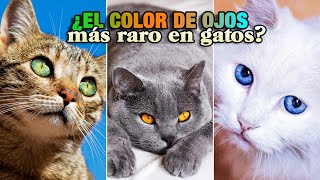
Veterinarian Carlos explains the five most common cat eye colors and two rare cases, including heterochromia. Learn what genetics determine whether your cat has green, amber, blue, or copper eyes.
What color are your cat's eyes? Write me a comment and I'll tell you why. Hi, I'm Carlos, and I'm a veterinarian. Welcome to the Happy Pets and Families Channel. I see you with my own eyes. If there's one part of your cat's face that stands out, it's their eyes. Have you ever wondered why cats have different colored eyes just like people? Why are some colors a little more unusual or a little less common than in people, Like a very intense green or a blue that practically looks like the sea? Well, that's what I'm going to talk about in today's video. First, let me tell you that the area of your cat's eyes that has color, just like in humans is called the iris. In that part, there are cells that have a pigment called melanin, and the cells are called melanocytes. Depending on whether the cells have more or less pigment, your cat's eye color will be different. When there is no pigment, the eye color is blue. Depending on how the amount of melanin in its eyes interacts with the base blue color, your cat will have one color or another, and the intensity of the color will depend on the amount of pigment produced by these cells. All of this will depend on the genes that your feline companion has, as it also happened with the color of its hair. And there are five fundamental colors that our cats can have in their eyes, from blue, which is the lightest, to. Well, at the end of the video, I'm going to tell you what the darkest color is that our feline companions can have in their eyes. And if that doesn't seem interesting enough, I'm also going to tell you two types of pigmentation that are extremely rare. So stay until the end of the video to find out if your cat is even more special. Come on, let's get started. But first, I'm going to tell you that we're going to start with the colors that I've seen that are most common, and we'll advance little by little to the ones that are less frequent. And this is based partly on my clinical experience, but I don't think it's very far from reality. I encourage you to do a poll in the comments. When I mention the color of your feline companion's eyes, leave me a comment and tell me what it is so we can see which ones are more common and which ones are much rarer. Green. Some people would kill to have this color in their eyes, but it is very common in cats. In fact, for example, it is the color that Milou has in her eyes. It occurs when there is very little melanin in your cat's eyes. And it is the color that some breeds have, such as the Russian blue and the Norwegian forest cat, although logically, as with everything, there may be variations. We all have the image of a cat in mind, and if we had to draw its eyes, we would make them green. That is what we often identify with the typical feline gaze, the color yellow. Yes, yes, very much in line with green. It is the typical color of cats eyes. Also, it is sometimes very difficult to distinguish it from the color green, because there are many occasions in which our cats have a very, very light green color, or yellow that is perhaps a little greenish, with small incrustations of green. And we do not know very well if it is really green or yellow. In any case, as I say, it is one of the most common colors, and it occurs when there is a little more melanin in the eye than in cats with green eyes. That is why they are so similar colors and sometimes so difficult to distinguish. It is the color of the gaze of totoro or panther. Black cats very often have yellow eyes, and it is also common to see it in breeds such as the Cornish Rex and the Somali. And sometimes I have been asked if the fact that a cat has yellow eyes means that they see better at night, but it has nothing to do with it. Regardless of the color of their eyes, cats see very well at night because in the back of their eyes there is a kind of mirror. This part is called the tapetum lucidum and reflects the little light in the environment to illuminate their eyes from within and thus allow them to see blue eyes. Here the colors become a little less frequent. Although it is true that blue is also a typical color of the eyes of cats. In fact, all our feline companions have blue or grayish eyes when they are born. That does not mean that they will have that type of color when they grow up, because obviously each one changes the type of color that their eyes show later on. And this happens because when they are very small, the melanocytes, which are what give color to the eye, as I have already told you, have not yet begun to produce pigment. And that is why the color that is seen in all cats is the base color, the color blue. All this begins to change from six weeks of age, which is when the melanocytes begin to produce their pigment melanin. If you see that their eyes are blue or deep blue, then yes, that's probably the color they'll have when they're older. And this color is very common in white cats. Why? Well, because their bodies don't have melanin, which is why their eyes continue to look blue when they're older. It's also very common in point colored cats like Siamese cats, because their bodies have a defect in the formation of melanin. It's only produced in the cold areas of their bodies, like their paws, nose or ears. It's very common for their eyes to lack it, which is why they have that blue look. I've told you this before, but I had to tell you again, especially if we're talking about eye colors. Cats with blue eyes aren't all deaf. I want to put up a giant sign here, Jose, because I want to make it very clear. It is true that some cats that are white with blue eyes can be deaf, in fact, in a fairly high percentage, between 60 and 80% of these cats. But it is only when this combination occurs. White with blue eyes. And even then, there are some white cats with blue eyes that are not deaf. This is because the gene that gives the cat its white color and blue eyes causes a problem in the development of the ear. And that is why these cats can more frequently become deaf. There are also white cats that have one blue eye and the other a different color, Although in these cases, the percentage of deaf cats drops to around 30 to 40%. And of course, they are not blind either. Some people ask me because they are confused. They have heard something and did not know if they were deaf or blind, and they write it to me in the comments. Neither blind nor deaf, they do not have to be. And up to here, if we were talking about a scale of five colors, we had the most frequent ones yellow and green, a medium frequency, more or less blue. And from here on, the colors that can be a little rarer begin. Okay, let's go with the next one, hazelnut. And it's very interesting what happens with this color, because it would be the typical color that wild cats would have, those that would be in the world naturally. And however, it is an unusual color because it is not usual for this color to manifest in breeds that have been selected by man. And that is why it is more usual for them to have one of the others. In other words, the color that could be most common in people, which perhaps in our environment here in Spain would be dark brown in cats. It has become a bit rare because man has intervened and has begun to select the different breeds based on the Color of their fur and eyes. It is a fairly common color in common European cats. The typical striped cat can have hazel eyes. And wild cats, large cats and a bobcat are also very likely to have this color in their eyes. This is almost the color with the highest amount of melanin. And I say almost because we are now going to talk about the rarest color that cats can have in their eyes. What do you think it could be? If you said black, you got it wrong. Because the darkest color that a cat can have in its eyes, the one that contains the most melanin, is orange or copper. It is that typical color that is a kind of coppery orange that is quite intense in many cats that have it and that is frequently seen in certain breeds because they have been selected this way so that the eye stands out against the color of the coat. It is very common in British cat breeds such as Poochie, which is a British shorthair. This is the color that has the highest amount of melanin. It would be somewhat equivalent to the black eye color in humans. And for this reason, and I've been asked this a lot, you'll never find a cat with black eyes or with eyes like mine brown. Another of the most typical breeds that have this color are the main cats. And it's not so common in crossbred cats which come from different breeds, because it's not a trait that can be inherited very easily. And we've talked about the five colors. Lets see. We can't understand that the colors are separate. What usually happens is that a small transition occurs and greenish, yellow or orange yellow colors are produced. In other words, it's not just yellow and that's it. But rather changes occur little by little in cat's eyes. It's like a rainbow, let's say. And that also happens with people. Not all blues are the same. There are blues that can be greenish, there are browns that can be greenish, and so on with everything. There are two types of pigmentation that are very rare in cats. And if your feline companion has them in their eyes, it's super special. I'm talking about heterochromic pigmentation. Heterochromia occurs when either one eye has a different color from the other or there are several different colors within the same eye. Lets start with the first type. When one eye is a different color from the other. Typically one eye is blue and the other has any of the other colors, green, yellow, hazel, or very rarely orange. It is associated with a gene that produces white spots on the cat's fur. Therefore, if you see a white cat that has one blue eye and the other a different color, it is likely that the cat is not white in itself, but rather that there is a giant spot of white that covers the entire cat, including the iris, which is blue. The other eye, for whatever reason, has not been affected by that gene and therefore does have melanin and therefore has color. This is the most common, but it can also be seen in cats that are not white. There are some cats that have other colors in their fur and nevertheless have different colored eyes. Why does this happen? Due to congenital anomalies during the cat's development, no melanocytes were produced in that iris, which is why there is no melanin there, and it looks blue. It can also occur in cats that have a very, very rare phenomenon called mosaicism. Mosaicism occurs when the genes of the embryo were not separated correctly. In other words, an embryo has genes of different types. That is why one eye may have one color and the other a completely different one. If it is caused by the gene for white spots, the color of their eyes could be hereditary. But in the latter two cases, it is not inherited. The offspring will probably have both eyes of the same color. And the last type of eye pigmentation, which is extremely rare, is when heterochromia occurs within the same eye. There may be different colors in the same eye of the cat. It is usually caused by the gene for white spots. What happens is that, for whatever reason, the cat's eyes have only been affected in some areas as spots. And in that case, the spots on the eyes, instead of being white, will be blue. That's why it's extremely rare for a cat to have part of its iris that's brown and part that's blue. But it's not completely impossible. And if your cat is one of those, it's very, very special. No matter what color your cat's eyes are, it's always very special. It's your feline companion. We have to love them exactly the same. We're not making this video because we like one color or another more, but rather out of curiosity to get to know our cats better. In fact, we made it partly in response to a question from a subscriber to the channel who asked me specifically about heterochromia and told me to comment on it in a video. Well, here you have the video. I hope you found it interesting. And I'm running to read your comments because I'm very interested in knowing what color your feline companion's eye is. I'm going to stay on my computer watching it right now. Okay? Also, if you like the video, give it a like and subscribe to the channel Hit the bell. So YouTube will notify you when we have a new video. Also check out our secondary channel called Questions and Answers from a Veterinarian. There you'll know what to do. Before we go, we meet Salim, this enigmatic black cat with green eyes who lives in Buenos Aires with Nati and Eli. And with Nadia lives this little girl named Cleo who has that blue green gaze. They greet us from Jungas de la Paz, Bolivia. We love Bolivia. And this beautiful two legged friend is called Lily and she has the characteristic blue eyes of colorpoint cats. She greets us with her human companion Noelia. Thank you very much for following the channel. Happy pets and and families. And I'll see you in the next video. I'm starring. Over. I'm sick. Recording. Save me. Let's see. The idea is that cats gazes are very enigmatic. You'll tell me. We've already said that and I'll tell you. So what do I say? Why do country ladies hug each other and stick together on the street? I look the same in color as I do in the Tsar's wella. What do I do? A peacock. Well, that's a normal turkey, no? When have you ever seen a cat with brown eyes? But your specific case could be what I'm going to say now. Oh yes, of course. Oh well, give me an example so people don't know. Oh, oh, it's just that I look dumber than you are. Don't you? A pig. Boy, it's like Sandy. Don't you? No, I don't think so. I want people to participate. Oh, leave it. Thank you very much for following the channel. The color. Oh, you are recording me.
More from Javier

Cuando nadie reconoce tu dolor por la pérdida de una mascota: así es el duelo desautorizado 💔




¿Tu perro hace suficiente ejercicio? Mantenerlo activo es clave para que viva mejor 🐶💪

GATIFICANDO UNA PARED PARA MI GATO 😻🧗♂️ Ideas para aprovechar el espacio vertical en casas pequeñas



Por qué duele tanto perder a un perro o un gato: el vínculo que explica nuestro duelo 💔🐾

