¿Cuántas PALABRAS pueden APRENDER LOS GATOS? 😺🧠¿Cómo puedes enseñarles?
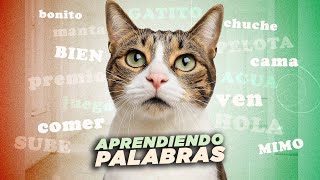
Carlos, a veterinarian, explains how many words cats can learn and the science behind their understanding. Cats recognize individual words and associate them with specific outcomes, though they learn differently than dogs. He shares practical training tips for teaching your cat to respond to commands.
Sure, you also talk to your cat, but the question is, how much of what you say does it understand? Hi, I'm Carlos and I'm a veterinarian. And this one, dozing and purring, is the cat. Welcome to the Happy Pets and Families Channel. Hello to your weekly date with your fans. It's inevitable that you talk to your cat. Well, I do it too. In fact, when I get home, I always greet it or see it around and say, ol cat, how are you? How are you? As if expecting it to respond to me logically. Our cats can't communicate with us with words, although we do observe quite a few responses in them. Sometimes they just meow, other times they simply look away. And on many occasions they also ignore us. And I've always been interested, above all in how much of what the cat understands about what I say to it. Many times when I tell it to come, it comes when I call it, it simply comes after I say the word come. In other words, it's not just because I call its name. This has led me to do some research on how many words our feline companions can learn. Sit down at home and make yourselves comfortable, because I think this topic is very interesting. As I always say, our society is dog centric. And it's possible that all this talk about language and the capacity our animal companions have to understand us has been studied much more in dogs than in our felines. Especially because a dog's response is much more obvious. They usually come every time they are called. They wag their tails. In other words, you can see that they are somewhat excited when they hear commands that they understand. The thing is that our cats, many times they their way of responding is a little more subtle. And above all, as I've told you here on the channel in other videos, there are times when they have a certain selective deafness, so that when we are talking to them, if the command, for whatever reason does not excite them, does not stimulate them enough, they decide to ignore it little by little. As research has been done, it has been shown that our cats are capable of learning and understanding words. As for the exact number of words our cat can understand, well, it is not very clear because there are some studies that say that between more or less 20 and 50, although it has actually been shown that some cats can learn a few more. For example, there is a case that of the kitten Pulli, which has been described and studied, who had high capacities in this sense. In fact, this kitten not only learned words and related them to concepts, but but she was Also capable of communicating in a bi directional way. That is, she was also capable of expressing those concepts to her human companions. How did she do it? Using buttons, which in the case of dogs, there are more dogs that have been shown to be able to do this. But in the case of cats, Billy is like the paradigm that our feline companions also have this ability. Using a system of buttons, the cat was able to tell humans what it wanted at any given time. In this way, it came to learn close to 70 words. And note that when I am referring to the number of words that your cat can understand that it can learn, I am not counting the part of the name, because the fact that they can learn their name and can distinguish it from other cats that live with them, we already know that it is true. In fact, it has been observed in cats that live, for example, in cat cafes, where there are many cats and different people who spend some time with them during the day, and they know perfectly well when they are being called. By the way, all the studies, as always, are in the box, so that you can take a look. As I said, we are going to talk about simple commands or more or less short words that can be interpreted by our cats, such as come, no, get up, all those types of things and words that are part of our everyday vocabulary, although they are not always such short words. Perhaps you have noticed that your cat understands the word vet perfectly, and that when you start moving around the house with the intention of taking it to the doctor's office, it immediately hides well. In that case, it is not only that they understand what the word is, but that they are also very skilled at interpreting the environment, the context, everything that develops around what we are telling them. If your cat sees that you are acting a little strangely, then that is not usual, that you are taking out the carrier, that you are putting it there in the middle. It is possible that they have already understood perfectly where you are going, even if you have not mentioned it. Regarding our cat's learning capacity, it will logically be influenced by many factors, especially by socialization. In early stages, a cat that lives indoors when it is two months old is learning everything, has contact with humans, and is able to retain many things. It is not the same as a feline that has spent its entire juvenile development on the street and has not had much contact with people, although there is also no doubt that there are cats that are much more curious and attentive and therefore may be a little more motivated when it comes to responding to certain orders. Now, let's look at how our cats learn these words, the process is perhaps much simpler than it seems. Our cats learn by association. That is, if a word is always followed by an action that we are doing, it will be much easier for our cat to integrate and learn it. And with it to relate is very simple. If every time you say food, you put a little bit of food in front of it, it's quite easy for your cat to learn to associate that sound with what comes next. If you say toy and you put in its little feathered toy that it loves so much, it's normal that when it hears the word, it's already ready to start playing. So the cat not only learns that the word exists and that it sounds like that, but above all, it can anticipate what comes next. This way of associating words with concepts or things is also very similar to how babies start to learn language, the language that human babies will later use. In fact, in the case of cats, it has been observed that they are faster when they are young at associating concepts than even a human baby. It's very interesting to see how our cats have this intrinsic capacity and coherence is very important for our cats to learn. For example, if we are teaching them the word come so that they come when we call them, what we have to do is approach the cat and wait for them to come. In other words, we might get down on the floor, sit down, and hold out our hands so that they are curious. And when they come closer, the concept of come is reinforced, like, I want my cat to come. Instead, we say come and we just look at them for a moment and then we go about our business. We are not giving them context to support the message so that they understand the importance or the word we are saying. Therefore, if we are involved in teaching our cats things, we always have to be 100% or 200% committed, being a little patient so that our cat can start to learn these concepts through repetition. Another important thing is to address your cat in an appropriate tone. Our cats pay much more attention to us if we address them as if they were babies. Uh, well, with a higher pitched tone, uh, a little cheerful that way. We are making it easier for our cat to pay more attention to our voice. In the midst of all the communication that we humans have, which is sometimes a bit monotonous. If we convey the message with a higher pitched tone, it is easier for our cat to pay attention at that moment. Well, basically, like what I do in the videos, I don't speak like this every day. Just because with that, we are emphasizing the core information. Okay, okay. And now let's look at the key words that our cats are capable of learning. They generally have to do with fairly short or simple concepts, direct orders. I can't tell the cat, please can you come to the kitchen for a moment? Because in that case my cat will have lost all the interest he was giving me. However, if I tell him, come to the cat, for example, he has internalized that command. It is easier for him to respond and do exactly what we are asking him to do. In fact, for example, in the case of the cat, so as not to get on the couch with other cats, when we tell him to come and get on the couch, we usually accompany it with a few pats on the couch itself, so that it also makes that little noise. And the cat has understood that is me wanting him to get on and be by my side. Other things. The issue of food is also quite easy for them to internalize, even though it has three syllables, because it is always directed at the cat at the moment when we are putting his food dish, and it is accompanied by the noise that the food makes on the plate, the smell and positive reinforcement. Well, the most important thing that our feline companions have, which is directly satisfying their stomach. Another word that is also very powerful, although we shouldn't overuse it, is no, because it sounds very well rounded. It is very easily identifiable and is usually accompanied by a completely coherent action. For example, if I see that my cat is eating the plants and I move it away, and at that moment I say, no, okay, well, we are already connecting with the cat, understanding that I don't want it to do that. And I know that many people doubt that this works, but with time, they really do internalize it very well. In the same way, the word good, which is usually accompanied by a reward, a caress, or a little situation on our part because our cat has done something positive, is something they usually learn. And another word that I have seen the cat learn is sleep. When I tell it, let's go to sleep, and it sees that we are going to the bedroom and that we are going to lie down in bed. It always accompanies us and comes with us, and on many occasions it lies down on its bed. And now you'll say, okay, perfect. Well, I really want my cat to learn words. Where do I start? Well, with something you're probably already doing, which is talking to him. It's very important above all that they always use short, simple words related to a very, very strong idea. With a context that is always maintained so that he can fix them more easily. As I always say, routines with our cats are key. They love them. Also, when you talk to him, look at him so that he pays much more attention to what you're going to say. Another thing that can be very, very beneficial is positive reinforcement. Especially at the beginning, when he's learning a new word, you have to reinforce that behavior, that response that we're looking for. If he's come when you call him, don't just pet him. You should also give him a little treat, some kind of goodie that serves as a strong reward for your cat. Similarly, it is positive reinforcement that after you tell him to eat, you put his food dish down. Or, for example, when you tell him to play with him, you also give him a little treat so that he associates it. All of this is closely related to other learning techniques that work with our cats, such as the clicker, which, for those who don't know, is this or this. They are instruments that make a very particular sound and that help us so that after our cat hears it, he learns that he has to do something. I really want to start using them with the artichoke to teach him things. Okay. And if you are interested in the topic, we are. We will make a video where I explain a little bit about the procedure, especially if I manage to get him to learn something. Another important thing is that if you are trying to teach your cat words, the learning and play sessions so that it can relate concepts must be short and frequent, because at first it is normal for our cat not to know what we are saying or to understand the message we are sending. If we continue like this for 45 minutes or an hour, then in the end our cat will lose all interest that it might have had at first. A session of 10 or 20 minutes is enough. Our cats do not have much patience in that sense. Then leave it for a while and try again a little later that same day. And if you manage to get your feline companion to be like Billy and also communicate with you using buttons, hey, perfect. Send me a video. And if it does, your cat can do it too. I am sure that you are already doing this with your cat, more or less unconsciously, because we always tend to repeat the same patterns with them. But if you're trying to teach your cat a new word or what you're doing isn't working for you, all of these tips will help you a lot. What you really need to have with our cats is a lot of patience. Because in the end, they. Many people give up because they're not able to say, hey, look, I'm consistent. I'm going to do this for several days, for several months. Because there are many times when our cats need a lot of time to learn something. And this applies to all aspects of learning in a cat's life. For example, in the case of Alcatofo, to use his food bowl, we also had to spend several days until he understood that that was where he had to feed himself, or where there was food, or if we wanted him to lie down in his bed. We used these types of reinforcement techniques so that he understood that that was the place to sleep. Now with the topic of the automatic and programmable feeder, which is going a little slower than I would like, but I'm sure he'll understand it in the end. And now it's your turn to tell me in the comments, if your cat is able to understand you when you talk to him, it's not necessary for your cat to respond by pressing button. Okay? In any case, if you liked the video, you know that you can give us a like, subscribe to the channel, share it with everyone, and if you want to support us a lot, a lot, give us a super thanks. We have a secondary channel here on YouTube called Questions and Answers from a Veterinarian. Come and take a look. And before we go, let's meet these two beauties called Donnie and Lily. They were introduced to us by their human partner, Sandra. At the time she sent us the photo, Donnie was 16 years old and Lily was 19. Let's continue with these two kittens. One is called Auru and the other is called Richie. They greet us with their human companion, Scarlet from Ecuador. And to say goodbye, we have Ruby, the black kitty, and Catchy, the white one. They greet us with their human companion, Julia from El Calafate, Santa Cruz, Patagonia, Argentina. Thank you very much for following the channel. Happy pets and families and hot summers and see you in the next video. How hot, Chops, I'm sure that, like me, you talk to your cat. Well, what was I going to say? How much of what you say does your cat understand? How many words of what you say does it understand? Come on, come on. It's been so long. It's not that hot, damn it. Sorry. It's not that hot, damn it.
Look, look, look, look. Kitten. Kitty. I love you, kitty. Lots of gas. Lots of gas. Thank you very much. It would be really funny to have a cat that was constantly focusing on him. And here, in a little box below. He doesn't.
Ush us to give him a little kitty kiss. Okay. To the cat. I'm sorry. I'm sorry. You're raising my temperature above what my body can handle. You stay here by my side.
But then there are people who are very shy. Well, shy people. No, no, no. Then it affects you. That's why I'm telling you. Well, well, no, that's with positive reinforcement. That if. I mean that. Well, that. Well, the language always has to be coherent. I mean.
More from Javier

Cuando nadie reconoce tu dolor por la pérdida de una mascota: así es el duelo desautorizado 💔




¿Tu perro hace suficiente ejercicio? Mantenerlo activo es clave para que viva mejor 🐶💪

GATIFICANDO UNA PARED PARA MI GATO 😻🧗♂️ Ideas para aprovechar el espacio vertical en casas pequeñas



Por qué duele tanto perder a un perro o un gato: el vínculo que explica nuestro duelo 💔🐾

