Descubre si TU GATO ES más ESPECIAL 😺✨🧬 de lo que crees | Rarezas felinas que los hacen únicos 🐾
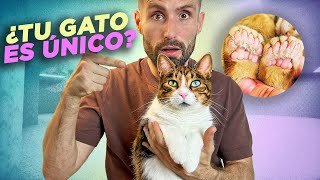
Veterinarian Carlos explores rare genetic traits that make some cats special, including polydactyly, heterochromia, and unusual coat colors. Learn which physical quirks your cat might have that make it truly unique.
Foreign hi, I'm Carlos and I'm a veterinarian. Welcome to the Happy Pets and Families Channel. El Cachofo doesn't want to stay for today's video. El Cachofo is leaving because he doesn't want us to call him weird because today's video is about weird cats. Well, we're not going to use the term special cats because although I'm sure that the most special thing there is for you is your feline companion, there are some cats that have certain characteristics that make them even more special. I don't know if you've observed your feline companion well and know his anatomy by heart, but today I want you to have him close so that you can pay attention to what I'm going to tell you. In this video we're going to talk about characteristics that all cats can have, regardless of their breed. Although it's true that in some breeds, due to genetic selection, some of these characteristics may be much more frequent. Of course, all the information I've used to make this video is linked in the description box with all the scientific articles that I've consulted. Let's start by talking about the toes and paws of cats that I love. Do you know how many toes a cat usually has on all its paws? Well, if you don't want to get out your calculator or count with your fingers, your cat will normally have five toes on each of its front paws and four toes on each of its back paws. That is a total of 18 toes. There are some cats that, due to some genetic characteristics, may have an extra toe. This is called polydactyly, and this situation does not pose any type of problem for their health or anything like that. The cat functions perfectly well, can hunt, can run, can jump. The only thing is that they may have between one and two extra toes on each paw. We can especially observe this in some breeds that have the genes that produce polydactyly much more present, such as the maincome. If you have never counted your feline companion's toes, take advantage of a moment while they are resting and count their claws. The cat is 18. Let me know in the comments if your cat has any of these special characteristics to see how many of the feline companions of the followers of the channel about pets and happy families deviate from the established norms. Now, let's break a myth. Not all cats that are white with blue eyes are deaf. Approximately between 60 and 80% of cats that have these characteristics are deaf. That leaves us with approximately between 20 and 40% of white cats with blue eyes that retain their hearing ability. So if you live with a white kitty with blue eyes who hears perfectly, you should know that they are outside the norm. The fact that most cats with these characteristics are deaf also has to do with their genes, because the genes they have for the white coat are also involved in the development of hearing. These white genes make the hearing develop a little less well, and that is why most cats that are like this are deaf. We never stop talking about cats eyes because their colors are quite good, fascinating, even rare. I love looking at a kitten's face and seeing the color of its eyes. Well, it really catches my attention. I don't know if it happens to you, but among those colors, there are some characteristics that are very, very interesting. For example, do you know what the rarest eye colors are among cats? If your feline companion's eyes are hazel or brown, or perhaps they are a coppery color, like very, very orange. I have to tell you that your cat is extremely special. These are the two rarest colors that we can find in our cat's eyes. The color of the iris is produced by the amount of melanin that exists in it. And it is precisely very, very rare for cats to have brown eyes, like if I have brown ones or orange. And on the contrary, with people, it is very normal for a cat to have green or yellow eyes. And this is precisely the case with Alkachofo. But, well, an even rarer case than the color itself is when Heterochromia iridus occurs, when cats have one eye of each color. This phenomenon generally occurs in cats that have a specific gene that produces white spots on their body. And it is considered that the eye, which is a different color, which is usually blue, is because one of those white spots has been affected. No pigment has been deposited in their iris, and that is why it appears blue. There are some breeds in which Heterochromia iridus is very, very common, such as Persian, Turkish and Siamese cats. But as a general rule, only 0.6% of all cats will have this strange characteristic. So if your cat has different colored eyes, you should know that it is very, very special. And we are going to continue talking about colors, but in this case, not the eyes, but the coat. You have probably heard or been told that all cats that have three colors in their fur, white, orange, and black, are female. This is because the genes that our cats have which give them their black and orange fur color are on the X chromosome, and males only have one X chromosome. So they can only be either orange or black. But of course, this is the general rule. There are some male cats that can have three colors in their fur. This can be caused by two different phenomena. On the one hand, there are males with Klinefelter syndrome, which you've probably heard me talk about on the channel before. Males with Klinefelter syndrome have two X chromosomes and one Y chromosome. That's why they could be orange, black, and also white, which doesn't depend on the X chromosomes. These males also have another characteristic that makes them a little special, which is that they are sterile. There are some people who think that the fact that they can't have offspring means that they can't go into heat. It has nothing to do with it. What happens is that when they try to have offspring, they. They can't fertilize the cat. The cat is giving his opinion on the subject. He's saying, by the way, people often tell me that I have three colors, and that's why I'm very special. Well, I'll tell you what happens in a moment, because first I have to tell you about the second possibility that can occur in a male cat that has three colors in its fur. And this is much rarer and has a very low probability of occurring. In this case, we're talking about a phenomenon called mosaicism. Cats have three colors in their fur. They can also be females, but often with very whimsical patterns, such as those known as chimera cats. And why does this happen? We and our cats have the same DNA sequence, the same DNA fingerprint in all our cells. That's why when they're looking for us, they can find us by a saliva sample or a hair sample, because everything has a unique mark. What happens in cats or in people who have mosaicism is that inside their bodies there may be cells with different DNA. And this occurs because when they are gestating, there are two embryos that fuse. And in the adult, in the cat or in the person, there are cells from those two embryos, the each of them with different DNA marks. So it is possible that there are some cells that have genes that make the hair black and others that have genes that make the hair orange. And because of this mixed in their body, they can give rise to quite interesting patterns in their fur. If you want to know a little more about how the colors of cat's fur are formed, I explained it to you in a very simple way in a video here on the channel that I have linked below and that you will surely Find very interesting. And now I am going to answer the question that we left hanging earlier. The French bulldog is not a tricolor cat. Well, when many people see it here in the videos, they say, oh, how curious the cat. How strange that a male cat has three colors in its fur. And I always say, no, what cat is tricolor? Because although you can see some hairs that may seem a little yellowish, that is actually the washed out or diluted brown that is produced by other different genes. What happens is that it gives rise to a slightly lighter coloration, a little more hazelnut colored, but it is not the color orange. Therefore they are two, black and white. Although black can have different intensities or tones, also giving rise to the color brown. Right, the cat, yes, but the cat actually has orange here. Right? It does not have orange. One thing I have to tell you, I am aware that I am explaining genetics to you in a very, very basic way so that everyone can understand each other and that it does not require you to have prior knowledge of genetics, biology or anything like that. I have received some comments that have told me that it was not quite as I was saying it. Well, that is precisely because I am simplifying it to make it much more accessible. Well, we are going through the entire anatomy of cats, but there is another part that although it may seem to you that they are all the same, I assure you that there are some very special ones. I am referring to the tail. In fact, it is most common for our feline companions to have a more or less long tail. For example, it helps them to keep their balance when they are walking on a very narrow part. We all know how fearless cats are and they use their tails to balance their weight so as not to lose their balance. Well, there are some cats that have peculiarities in this part of their anatomy. For example, there are some cats that have very short tails or none at all. This is caused, among other reasons, by the so called Manx syndrome. If you recall, I've already talked about Manx cats on this channel. Well, I told you about them in a video where I talked about all the cat breeds that exist. Manx cats had a very specific characteristic which was that they didn't have a tail. In fact, there was a legend about these cats that when Noah put the cats inside the ark, one got distracted and got its tail caught in the door, which is why it lost it. And that's how these tailless cats came about, legends aside. Well, the fact is that these cats don't have tails like almost everything else due to Their genes, they have a specific gene that makes them born without a tail. This characteristic is not exclusive to Manx cats. In fact, there are many other breeds that also have this characteristic, such as the Japanese bobcat or the cats of the Kuril Islands. But hey, I'm telling you that many times it has nothing to do with its breed. In fact, it could be that you are currently living with a kitten that you rescued from the street and that you don't know its history, and that it has arrived at your home without a tail. Many people say, oh, poor thing, what else could have happened to it? Did it get its tail cut off in the street? Well, although that possibility exists, it is also likely that the cat does not have a tail due to a genetic condition. In addition, there are very interesting studies. Well, if you are a little curious, they talk about how many Asian cats have tails of different sizes, and it is very common to find kittens without tails in that area as well. But let's keep talking about tails. There are some cats that have a very special characteristic in their tail, which is that it is not completely straight, but rather at the tip it looks like it is broken. And again, there are many people who think that their cat has had an accident while walking around their house or on the street, got its tail caught and broken. However, in most cases it has nothing to do with this, but rather it is the genes that are causing the cat's tail to have such a whimsical shape. In fact, you have sometimes sent me a photo asking me, calling Carlos, should I worry because my cat's tail is like this. Maybe it has broken. And I always ask you the same thing. Or, well, if it has happened to me, for example, in the consultation, I say, hey, is it new or has it always been like this? In most cases it was like this from birth. This characteristic, well, has a slightly confusing name because it is called a broken or split tail, although I can tell you that it has nothing to do with that. And it is present in many cats. In fact, it is very common in Siamese cats and also by extension in many cats that have a color point coat which is a little darker on the ears, paws and snout, because they are descendants of the Siamese. So leave me a comment and tell me if your cat's tail has any of these more peculiar shapes. If you have noticed behind many of the slightly rarer conditions that our cats may have are their genes. There are some people who think that, well, perhaps they were accidents that their kittens suffered when they were little. But that is precisely because many cats are rescued to give them a chance. And we do not know their ancestors, neither their parents, nor their grandparents. These characteristics probably existed in them too. In any case, all cats are super special. They do not have to have any of these characteristics or be of a specific breed. We have to love all our feline companions, no matter what they are like. Does your cat have any of these characteristics, or does it have some others that make it extra special? Well, leave me a comment so we can make a second video. In any case, if you enjoyed this video for entertainment purposes, give it a like and subscribe to the channel. Give me a big thank you if you want to support me a little more. We also have a secondary channel here on YouTube called Questions and Answers from a Veterinarian. Check it out, it might interest you. Also, hit the bell icon to see if YouTube notifies you. And before we go, we meet this little guy named Clip C, who greets us with his human companion, Susanna from Tucuman, Argentina. And this sweet image belongs to Gyro, who greets us with his human companion, Alberto Gaharo from Madrid. And we say goodbye to little Shinji and Aoi, who greet us with their human companion, Alan from Mexico. Thank you very much for following the channel. Happy pets and Families. And we'll see you in the next video. Right, the cat. Yes, kitty to the little cat. Of course these people want to see you. But you don't know who these people are, do you? You don't know and you don't care, do you? Of course, because all you know about is tin cans, hunting bugs and things like that. Well, all these people love you and adore you, and they ask me about you. Mosaicism. Mosaicism. Mosaicism is a phenomenon. Oh, no. Uh, it's. It's called mosaicism. Okay, what does it consist of? Okay, no, it's called mosaicism. It's not tricolor. But the tones have nothing to do with the color, Jose. That's just explained in the. I can't explain the video again about the colors of the hairs that don't have orange. That's not orange, Jose. That's. That's very orange. That's the color. That's the hazelnut color that. I've told you many times that that color is not. I mean, it's all explained in that other video. It's a brown kitten. It's already a little brown, right? Oh. Oh, the horror. And on top of that, I have it on top of me. Oh, I could even chew it. Ah, please, I can't. Oh, what a dense kitty. I can't. Oh. Oh, how it stinks. Look how much I love you. Ha m.
More from Javier

Cuando nadie reconoce tu dolor por la pérdida de una mascota: así es el duelo desautorizado 💔




¿Tu perro hace suficiente ejercicio? Mantenerlo activo es clave para que viva mejor 🐶💪

GATIFICANDO UNA PARED PARA MI GATO 😻🧗♂️ Ideas para aprovechar el espacio vertical en casas pequeñas



Por qué duele tanto perder a un perro o un gato: el vínculo que explica nuestro duelo 💔🐾

