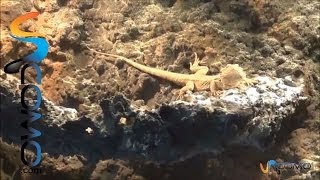
This is a YouTube video titled "Dragón barbudo - Consejos básicos" created in July 2012, featuring Nuria presenting detailed care information about the bearded dragon (Pogona vitticeps), a reptile native to the Australian desert. The video provides guidance on habitat conditions, temperature, humidity, diet, and lighting requirements for keeping these animals in captivity.
Hello, we are at Desert Habitats. My name is Nuria and we are here to introduce you to the bearded dragon or Pogan viticeps. This animal is typical of the Australian desert. Here we are right now in front of a sub adult male. It is a very typical animal in Australia which can withstand temperatures ranging from 2 degrees below zero at night to around 30 to 30, 32 degrees during the day. At night, if the temperature drops too much, they become immobile and do not move. If they are very hot, they lift one leg and remain still until the temperature returns to more or less low. The humidity level for these animals must be between 40 and 50%. Above all, you cannot put a waterfall inside a terrarium. As you can see here, we have a terrarium specifically for them which is a completely desert terrarium. Putting a waterfall in front of these animals would cause them pneumonia, which would cause their lungs to become blocked and the animal would die. These little animals have plenty to drink with a little water bottle. They are opportunistic when it comes to eating in their natural habitat. They might find a termite mound and start eating and won't stop as they can go a month without eating in a terrarium. They usually eat crickets and lobsters. Ah, that's what they normally eat. The temperature they need is what I told you, between 24 and 30 grams. They are perfectly fine. Above all, they need ultraviolet light. In theory, the best ultraviolet light for these animals is 8.0. Normally it is not available and they are given 10.0. You have to be very careful with the heights and dimensions of the terrariums so that they do not burn themselves. Another feature of this male, if you let me hold him, is his beard, which turns very dark when he's in heat. Okay. As you can see, his beard is starting to get a little dark. Okay, thanks for watching these videos. I hope they've been helpful when it comes to keeping exotic animals in captivity. If you want more information or want to visit our terrariums, you can do so on the website www.desertyabitats.com. oh.