EFECTOS SECUNDARIOS de vacunas en GATOS de menos a más graves 😿💉 | ¿Qué es lo peor que puede pasar?
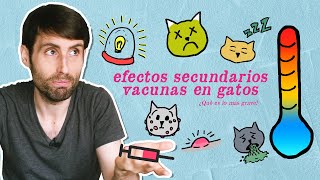
Carlos, a clinical veterinarian, walks through vaccine side effects in cats from minor to severe. Mild reactions include small lumps at injection sites. The worst case is anaphylactic shock, which requires immediate veterinary care. He explains what symptoms to watch for after vaccination.
How can you tell if your cat isn't doing well with the vaccine they've given him? Hi, I'm Carlos, a clinical veterinarian at Small Animals. Welcome to the Happy Pets and Families Channel. It's clear that when we give him a vaccine, an adverse reaction can occur. It doesn't happen to all cats, it doesn't happen with all vaccines, although in general the risk is quite low. Okay, well, today I'm going to show you how you can identify an adverse reaction to a vaccine and what you can do to help your cat if something goes wrong. And only in these cases. You'll usually be able to see the adverse reactions in the first three days after the vaccine has been given. And if you don't see anything in those days, well, that means things are going well. In order to know how serious the reaction is, I've brought this thermometer here that will help me explain it to you. Okay, lets move on to the less serious reaction, the one that's less important, the little lump. It is a reaction that usually occurs in about 1 in 4 cats, 25% of the time. And what you usually see is that where the vaccine was given, it suddenly becomes a little inflamed. The lump can vary. It is usually the size of a chickpea, although it can be a little bigger. Sometimes it is a little warm to the touch, and sometimes it is also a little painful, especially the first few days. It usually disappears after a week. And to help the lump to heal, what you can do is give the area a small massage or even alternate between applications of cold and dry heat. In any case, this type of lump is normal. When we give a vaccine, what we want is for the body to react so that the defenses we are looking for with the vaccine are created. And the lump is part of that. As you can see, I have placed the lump on the cold side of the thermometer. It's not something you should worry about a priori. If you see that after a week the lump hasn't disappeared, you should call your vet and take your cat to the clinic. You if we continue looking at our thermometer, we can see that the next level is that your cat is a bit groggy, as if it doesn't want to do anything, or is lethargic, which is what vets usually say. This is quite normal. You just have to make sure that your cat responds when you call it, when you approach it or even pet it. It usually happens to about half of cats. As you can see, it happens very frequently. And it's something that happens to us too, especially when we get our first vaccinations and we're still babies. Mothers are often told, well, maybe today the baby wants to eat a little less or doesn't want to move much, or is sleepy all day. In any case, don't worry too much if this is all you're seeing in your cat. In addition, this grogginess may also come with a slight fever. What I recommend that you do is pay a little more attention to your cat, especially during the day, because this slightly groggy state usually lasts about 12 hours. If it is, for example, in the afternoon or late evening, then when you go to sleep, wake up every two hours or so, checking on the cat to make sure everything is okay. Also, if you have detected that the cat has a fever, you can also help it lower its temperature a little. Don't put blankets on it, keep it in a relatively cool area, and you can also put a little alcohol on its pads to help its temperature decrease. Well, do you have to worry too much or not? You should take him to the vet if you see that the fever is high, exceeding 39.5 grams, and especially if it reaches 40 in these cases, I wouldn't wait too long and at least call my vet to tell him, hey, this is what's happening to him, so that he can tell you and whether you should take him to the appointment or not. Well, let's go. As you can see, we are already in a fairly warm area. It is still not the hottest. This is where we find vomiting. It is also something that usually happens after vaccinations. It occurs in about 10% of cats. That is one in 10.
It is not necessary.
Okay, okay, what I was going to say, but why did I put the vomit in this slightly warmer area? Well, because here your cat runs the risk of becoming dehydrated, especially if the vomiting is not stopped. What you have to do in these cases is always act the same way. You will have to remove any type of vomiting from him, the food, or any type of water or source of hydration where your cat can go to drink, because if he has vomited and his stomach is quite sensitive, when he drinks again, he. He will vomit again, and in the end we will not be able to stop that or it will take us longer to stop it. You can gradually add a little water when you see that after two hours he has not vomited at all and only a little bit, do not put the whole thing in there. But anyway, I have already Talked about all this in another video here on the main channel about how to handle vomiting and diarrhea in our animal companions. I will leave it here. Right. And in this case, should you take him to the vet or not? Well, if you see that the next day your cat is more or less normal, you has regained his appetite, well, you can let him know by calling him on the phone and telling him, even if it is just to mention it, if you see that during the night or while he is vomiting, he does not stop vomiting and diarrhea. Vomiting, yes. Go to the vet to prevent, as I said, your cat from becoming dehydrated. That's all. And we take a step further on our scale and we come to a rather worrying area. This already makes my hair stand on end. This is the area where we have included swelling, generalized swelling, not the little lump that appears in the area where the vaccine was given, but when you start to see, for example, that their face starts to swell or that they develop small lumps all over their body. It is true that these cats are a little more difficult to see because with such long hair, these lumps are often covered, but you can see them much more clearly on the face. And why am I putting it here? In this serious area, the inflammation is not only occurring in the skin. Sometimes the glottis can also become inflamed. And if the glottis becomes inflamed, it prevents the cat from breathing and can lead to choking.
The.
That's why you have to be very careful here. This happens to about 5% of cats. And you have to run to the vet if this happens? Well, yes, I would hurry up here. At least call even if it's an emergency, so they can tell you. It doesn't mean you have to run red lights on the street, but at least call even if it's an emergency, so they can tell you, because they have to start giving them a treatment that reduces the inflammation. And we've reached the end of our thermometer. And that indicates that this is the most dangerous thing that can happen after a vaccine, and that is anaphylactic shock. That's a major adverse reaction. Their immune system is responding in a very exaggerated way. And we usually see that if the cat, for example, faints, loses consciousness, if you're seeing that in your cat and they've just had a vaccine, you don't have time to waste. You have to run to the vet's office because their life at this point is at stake, cases at risk, whether it's day Night, thunder or snow, or whatever happens outside. You have to either be in quarantine because of everything we're experiencing, or you have to run to the vet and that's it. Well, I just want to clarify that I've used this thermometer to indicate the phases, but the phases can evolve. It can go from a phase that's down here in the cold zone to a phase that's in the warmer zone. For example, it could be that the cat simply starts to be a little listless, a little goofy, and then suddenly its face starts to swell. Or it could be that the cat simply has a little lump today when we gave it the vaccine and then starts to vomit tomorrow. Remember that we have more or less three days. That's why I tell you to always be vigilant, because I do want to clarify that if it evolves from one phase to another, you should go to the vet so that they can give it the appropriate treatment. And I just want to remind you that two videos that we have already made here on the channel can help you a lot in these cases. The first one is the one that we have already made here on the channel. The first one is the one that we have already made to learn how to examine your cat, and the second one to be able to give them the first aid they may need. And that's it for today's video. If you liked it, give it a like and share it with everyone. Remember to subscribe to our channel if you haven't already, and hit the bell so that YouTube will notify you every time we upload new content. Content. Also, I'd like to remind you that we have a secondary channel here on YouTube called Questions and Answers from a Veterinarian. Check it out because I'm sure you'll be interested. And today we meet Reina, who was introduced to us by Maria Ramalo from Montevideo, Uruguay. And this handsome guy is Coco. He was introduced to us, so hip and hip, from Mexico. And we'll finish off with a large family, Lulu, Bardo, Lucas and Leia, who are Sandra Costilla's family. Thank you very much for following the Happy Pets and Families channel. And I'll see you in the next video. If anything. If anything. Well, it doesn't matter. I'm going to say that that happens in most cases. Well, that happens in most cases, right? That happens if something goes wrong with the vaccine. Most of the time it is usually seen between the day it is given and the day. Most of the time it is seen to help lower their temperature. You already said it. And up to. And usually up to three days later, if something goes wrong with your cat's.
Vaccine, you will see it between day zero. We always say it. Okay, okay. To be able to know how much. To be able to know what the reaction is, the severity. And I have already said it. The severity. If something goes wrong with your cat's vaccine, you will see it more or less between the day it is given and up to three days after we have left. Because I do not want to keep confusing the sentence. And if something goes wrong, and only if something goes wrong. These types of things are not in these reactions. Yes. Well, then I put a scale and that's it. And no, no, it is not a thermometer. Okay, okay. And if you do not see anything in those days, well, it is. Because it is. Okay. And if you don't see anything in those days, well. And if you don't see anything, what I recommend. Which doesn't mean that you have to. No, no, it doesn't mean that you have to leave. I mean, because. Because it doesn't mean that you have to. That's it. The anaphylaxis show. I've already said it. Because there you can't do anything else but that. Goodbye. No, because. No, because. Okay, but it's also possible that you've acted and that in the end we'll reach the sixth phase.
More from Javier

Cuando nadie reconoce tu dolor por la pérdida de una mascota: así es el duelo desautorizado 💔




¿Tu perro hace suficiente ejercicio? Mantenerlo activo es clave para que viva mejor 🐶💪

GATIFICANDO UNA PARED PARA MI GATO 😻🧗♂️ Ideas para aprovechar el espacio vertical en casas pequeñas



Por qué duele tanto perder a un perro o un gato: el vínculo que explica nuestro duelo 💔🐾

