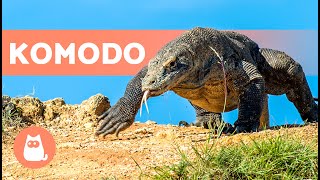
Komodo dragons are venomous, not just bacterial killers as once thought. Their bite contains venom glands that help them take down prey, and they live only on Indonesian islands where they hunt large animals and can grow over 10 feet long.
Hello and welcome to Animal Expert. Today, our friends from Green Ecology have stopped by the channel to tell us a little more about the Komodo monster. I'll leave you with them. The Komodo dragon, or Varanus komodensis, is an imposing reptile that has a lot of questions surrounding it. We know that it is the largest monitor lizard in the world and that its bite is very dangerous and even lethal. But can you tell us why it is so dangerous? Is it because of its size and strength? Does it have some very dangerous substance in its saliva like venom? Where does the Komodo dragon live? The largest monitor lizards in the world live in Indonesia, specifically. Specifically on the islands of Komodo, Flores, Rinca, Pilmotang and Hillidas. In fact, the Komodo Islands are also known as the Kingdom of the Dragon. In addition, today they live in captivity all over the world and always in special centers such as zoos and wildlife recovery and research centers, but never in homes as pets, because they are really dangerous and the laws do not allow it. Physical characteristics of the Komodo Dragon it is also known as the Komodo Monster and belongs to the suborder of reptiles called Certilia, which are lizards. Within this suborder, they belong to the Barony family. So it is a Burano and it is the largest lizard that currently exists and can live for about 50 years. It has an average length of between 2 and 3 meters and an average weight of about 70 kg, although there are males that have even reached 90 kilogram. It has a very long and strong tail, large claws and very peculiar teeth. It has an average of 60 closed teeth that it changes very frequently. These teeth can measure up to 2.5 in length. Another interesting fact about this large reptile is that it can reproduce sexually or parthenogenetically. So females do not always need a male to reproduce. What does the Komodo dragon eat? They are carnivorous saurians that hunt a wide variety of animals and there have even been cases in which they have hunted unsuspecting or unsuspecting humans. However, they are not only predatory carnivores, but also scavengers and eat everything they can from their prey, including everything from meat, entrails and skin to bones. Other interesting facts about the diet of the Komodo monitor lizards are that they can eat up to 70% of their own body weight in a single sitting and that they are sometimes cannibals as they eat the young of other Komodo dragons or the carrion from the bodies of any specimen of their species. The Komodo dragon is poisonous or not. The truth is that until a few years ago, it was believed that it killed simply by the force of its jaws, or that if it injured a prey, it would die in a few days due to an infection caused by the immense amount of bacteria in its saliva, which caused septicemia and death. More recent studies conducted by various universities have revealed that this giant monitor lizard not only contains more than 5057 strains of bacteria in its saliva, but also has substances that act as poison when inoculated into the blood of its prey. Specifically, the Commodus monster contains two types of substances that cause death. One is an anticoagulant substance, meaning that this substance prevents blood from flowing through the wound, preventing a scab from forming and thus the animal bleeds to death. The other is a hypertensive substance that has the effect of increasing blood pressure, causing the heart to pump blood faster and thus the blood comes out of the wound faster and the prey bleeds to death more quickly. Therefore, this implies that the Commodus dragon is indeed poisonous and that it kills its predecessor prey with a combined attack of force and not the inoculation of toxic or poisonous substances that are anticoagulants and hypertensive and a huge amount of harmful bacteria. If the prey does not die from the impact of the bite, it ends up dying from bleeding out, either from septic shock or from a generalized infection. What happens if you are bitten by a Komodo dragon? If you manage to survive the attack by escaping the bite, you are still not safe as the venom and bacteria have already entered your bloodstream. Therefore, if a Komodo dragon bites someone and manages to escape the scene, the first thing to do is seek medical attention at an emergency center. There are known cases of adults that have survived attacks by these reptiles, but only with medical help. Shortly after being attacked and following medical treatment that mainly includes constant drainage of the wound, taking powerful antibiotics and several daily dressings, the Komodo dragon is in danger of extinction. They are currently in the category of vulnerable species and their population is tending to decrease for various reasons. Many of them due to humans, habitat destruction, reduced prey populations, global pollution, and problems between humans and dragons due to the fact that they enter populations in search of food. Although this is their current situation, there are many specialists and volunteers working to keep this species alive and increase its population in the wild. If you enjoyed this video, visit the Green Ecology Channel where you will find more interesting information about nature and you can find the link in the bio. Until next time, experts.