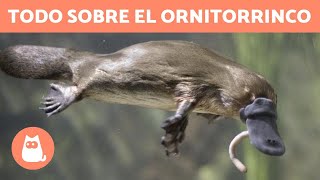
Meet the platypus, one of nature's strangest animals. It lays eggs, produces venom, and has a bill like a duck but is actually a mammal. Found only in Australia, this creature hunts underwater and glows under ultraviolet light.
The platypus is one of the most interesting, special and unique animals in the world. It is characterized by being a mix between a beaver and a duck. Something fascinating considering the notable differences between these animals. Can you tell if the platypus is a mammal? Have you ever heard that it lays eggs? In this video by an animal expert, we reveal all the information you need to know about this fantastic animal. Lets get started. Platypuses belong to the order of monotremes in which only five species currently survive, which are characterized by being mammals that lay eggs. Among the characteristics of this animal, the following stand out. It is one of the few venomous mammals that exist. Male platypuses have a spur on their hind legs that releases a venom capable of causing intense pain in people. Females are also born with this ability, but it does not develop after birth and disappears before they are adults. But is the platypus venom deadly? For small animals, yes. For humans it is extremely painful. If you are curious about which other species are poisonous, here above and in the description, we leave you a video of the 10 most poisonous animals in the world. Each of its body parts can be reminiscent of other animal species. Its tail resembles that of a beaver, while its beak is similar to that of a duck. Its four legs have membranes like those of ducks, although they only use the front ones for swimming. They fold their hind legs with the frill which they use to steer in the water as if it were a rudder. The platypus is considered a mammal, although it is a biparous animal. That is, its young are born from eggs. But the most curious thing is its sex chromosome system. Mammals have two sex chromosomes. However, platypuses have 10. They are more similar to the sex chromosomes of birds than to those of mammals. The platypus lives between water and land, so it is a semi aquatic animal. Their habitats are usually small rivers and streams and scattered across various types of ecosystems. This animal is only found in Australia, scattered across the vast rainforests of Queensland, in the mountains of the Australian Alps or in the Tasman region. The platypus is a completely carnivorous animal. It feeds mainly on crabs, insects, shrimp, worms and other species. But did you know that it is a relentless hunter? Thanks to its electrolocation system, it locates its prey using the electric fields generated when its muscles contract. The electroreceptors are located in the beak, distributed in rows, and mechanoreceptors that are responsible for touch are also located there. These systems send the information needed to orient itself to the brain without needing to use smell or sight. This is very useful for the platypus since it closes its eyes and can barely hear underwater. Before continuing, don't forget to subscribe to the Animal Expert channel to stay up to date with all the videos we upload about wild and domestic animals and much more. The reproduction of this animal is what makes it most unique. Platypuses are born from eggs, although when these hatch there is also a lactation period. Females become fertile from the age of two. From this age on, they can be courted by male platypuses to mate. Courtship is a complicated and arduous process for these animals. The last part of the courtship consists of a dance in the water in which the couple moves intertwined. The male grabs the female's tail with his beak and they move in circles. There is only one mating cycle. Between the months of June and October. Platypuses lay between 1 and 3 eggs between 10 and 11 millimeters in diameter. They develop inside the mother's womb for 28 days and then she incubates them outside for 1015 days. When they hatch, they are small platypuses measuring about 3 cm long. These babies are very vulnerable. They are hairless and blind as their eyes have not yet fully developed. They are also born with teeth that they will lose shortly after leaving cone shaped plates. The mother feeds the babies with breast milk until they are three months old. This milk comes directly from the pores of her skin as she has no nipples. During this period, the mother takes care of the babies almost all day. She only goes out to look for food, although after four or five weeks, the young begin to leave the burrow little by little. According to the IUCN Red List, the platypus is considered a species threatened. Unfortunately, its population is decreasing due to external threats such as the destruction of its habitat, pollution and climate change. And that's it for today's video. If you find platypuses as curious as we do, don't forget to give us a like and leave your opinion in the comments box. Until next time, experts.