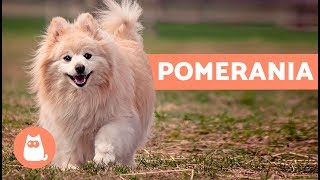
This is a YouTube video titled "El perro pomerania - Características y cuidados" created on September 29, 2017. The content is an informative monologue describing the Pomeranian dog breed, covering its history, physical characteristics, behavior, care requirements, training tips, and health considerations. The video aims to educate viewers about adopting and properly caring for a Pomeranian dog.
The Pomeranian, also known as the German Miniature Spitz, is one of the most popular dog breeds in the world due to its small size and adorable appearance. If you are thinking of adopting one or already live with a Pomeranian, don't miss this new video from Animal Expert in which we tell you about its history and discuss its care and characteristics. The Pomeranian originated in an ancient duchy called Pomerania, located between Germany and Poland. Unlike today's Pomeranian, the first specimens were much larger. They were basically used as livestock dogs. They controlled sheep, cattle and deer. Its original name was W Spritz, which literally translated meant Spitz Wolf. It became popular in ancient Greece and later in Rome, being the favorite dog of ladies who had a certain purchasing power. It was at that same time that the selection of certain specimens for breeding began. This breed is expected to be small in size and have an affectionate and friendly demeanor very different from its previous wolf repelling behavior. The Pomeranian is considered a toy or miniature dog. Unlike the first Pomeranians, which weighed around 23 kilogram, the current breed weighs between 1800 and 2.5 kilogram. It is a European Spitz type dog accepted by the FCI within Group 5. Although we know it as the Pomeranian or German Dwarf Spitz, its official name is still Wolf Spitz. The Pomeranian's coat is long and silky with a dense undercoat that gives it a sweet and adorable appearance. It is characterized by having a greater amount of hair on the neck area and on the tail, which is long, curled and resting on the back. Its expression is lively and fun. Its eyes are medium sized, slightly slanted and dark. The erect ears are small and characterized by being triangular in shape. The nose is neither too long nor too flat. It is usually not too thick, but not pointed either, so it is in proportion to the skull. The nose is small, rounded and black, with the exception of the Brown Pomeranian, which has a nose of the same color. The accepted colors of this breed are mainly black, brown, white, orange, grayish, and it is believed that other colors may also be included. The great variety of colors is truly surprising. The Bomeranean lost its instincts as a cattle dog a long time ago when it became popular as a companion dog. Certain physical characteristics were selected, but some behavioral characteristics were also selected to make it a home dog today. It is a very affectionate and lap dog which hates loneliness and lack of attention. It is also very active, alert and intelligent, even curious. Before adopting it, we must be clear that it will need several walks, constant attention and time to train. Should also be noted that the Pomeranian can sometimes become a Very barking dog, so you must be prepared in this regard. Their relationship with children has changed enormously in recent generations. In the last century, they were considered unsuitable for young children as they tended to be impatient with tail and hair pulling and would even react negatively. Today, the Pomeranian is more affectionate, calm and patient, but for an excellent coexistence, it is important to teach children how to relate to them, always in a positive way and with respect for the animal. The Pomeranian does not require excessive care. They need to be brushed regularly to remove dirt and prevent knots from forming in their coat. During the molting season, brushing should be done daily. As for baths, every one or two months will be sufficient unless they are seen to be excessively dirty. It is also necessary to remove their eye boogers every day, check their nails to ensure they are the right length and pay attention to the condition of their ears. Pomeranians tend to suffer from dental problems, so it is recommended to brush their teeth and perform dental hygiene when necessary. On the other hand, it is important to protect them from the cold and avoid drafts to prevent health problems, especially if they are shivering. Like most small dogs, Pomeranians are usually active and as such, need to take two to three walks a day, in addition to games that keep their mind well stimulated and help them exercise. Since the Pomeranian is such an intelligent dog, they can sometimes be overly spoiled. Therefore, we must be firm in their education and set some guidelines before adopting them, such as determining whether or not to let them get on the sofa, when and where they should eat, etc. Consistency and stability will be very important factors in ensuring that our Pomeranian feels comfortable and at home. During their puppy stage, it is essential to actively practice socialization to teach them how to relate to people, children, dogs, cats and objects. If this process is not carried out, the Pomeranian can become a distrustful and fearful dog. Furthermore, as we have already mentioned, incorrect socialization can also lead to excessive barking towards strangers, loud noises or other animals. Once the dog begins to reach a young age, basic obedience should be introduced, always using positive reinforcement. Teaching him to sit, come here, lie down, or stay still is always advisable. To ensure his safety and strengthen our bond later on, we can train the Pomeranian to apply advanced commands and fun tricks since, thanks to his intelligence, he has no problem internalizing them due to his personality and strong character. Many train Pomeranians to be a guard dog and to warn his humans when strangers arrive. Between four and eight months of age, the Pomeranian puppy loses practically all of his hair to make way for the coat he will have as an adult. So if you notice excessive shedding during this time, you should not worry. As with almost all dog breeds, the continuous crossing of specimens from the same family can lead to serious genetic problems. The Pomeranian is often prone to eye diseases, luxation and dental problems. To prevent and detect any discomfort or pathology, it is necessary to visit the vet. Keep the vaccination schedule and deworming up to date. The Pomeranian is usually a long lived dog, so if we give it all the care it needs, it will be with us for around 16 years, even more. And that's it for today's video. If you liked it as always, give us a like. Don't forget to comment and we'll see you in the next video. Until next time, experts. Oh.