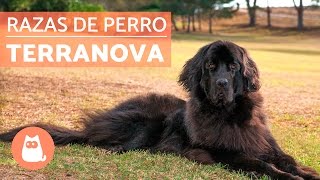
This is a YouTube video titled "El perro Terranova - RAZAS de perro GIGANTE" created on March 22, 2017. The content is an informative monologue about the Newfoundland dog breed, covering its origin, physical characteristics, temperament, care requirements, health issues, and training tips. The video is presented by a single speaker providing expert advice on this giant dog breed.
Hello and welcome to this new video from Animal Expert. Today we're going to talk about the Newfoundland dog, one of the most popular and appreciated giant breeds in the world. The Newfoundland dog originated on the island of Newfoundland in Canada, known in Spanish as the island of Newfoundland. It is believed that the breed developed from the native dogs of the island and from the dogs imported by the ancient Vikings, such as the Black Bear dog. Starting around the year 11, later in 1610 and during the colonization of the island, new breeds of dogs arrived in Newfoundland mainly at the hands of European fishermen. From then on, experiments began with new crossbreeds that culminated in the modern Newfoundland, which we know today. The Newfoundland is a giant dog with a powerful head and a compact body. Like its closest relative, the Labrador retriever, the Newfoundland has webs between its toes, a very useful tool that allows it to swim easily. The undercoat of its hair has very dense oily roots, a characteristic that allows it to repel water and not get wet. On the other hand, the outer coat is longer and smooth and is usually black, black and white or chestnut in color. The approximate measurements to the withers are 71 cm in males and 66 in females. In terms of weight, males usually reach 68 kg and females 54. Despite its imposing size, the Newfoundland is an especially affectionate and loving dog. Very sociable and calm, it is not excessively playful, although it does love water. It usually tolerates contact with other animals wonderfully and is very patient with children whom it adores and treats with great care. Maintaining the Newfoundland's coat requires effort throughout the year and it is advisable to brush it daily. It is important to note that during the two annual shedding seasons they can lose a lot of hair. The Newfoundland is not particularly active, but it is important to motivate it so that it does not become overweight. It is recommended to take it for three walks a day and also to go on regular excursions. Without a doubt, the best place for the Newfoundland is one that has a beach or a large lake where it can swim. It is important to note that this dog will need large quantities of food. Remember that its weight is between 54 and 68 kg, so we will need around 500 grams of feed per day. Lets not forget that Newfoundlands tend to drool a lot, so they are not the most suitable dogs for extremely clean people. We will pay attention to their facial hygiene on a daily basis. It is recommended to keep them in large houses with a garden so that the dog can go in and out of the house. While exercising at the same time. The Newfoundland is a very intelligent dog and although it is not particularly suitable for working on canine skills, the truth is that it is an excellent water rescue dog. In fact, the most popular dog responds very well to positive dog training as long as the owner is aware of the breed's limitations and virtues. And although it is an especially sociable breed, the truth is that it will be very important to separate the Newfoundland dog from its mother and sibling at the right age and to dedicate time to socializing the puppy once adopted. On the other hand, it is very important to note that they frequently need company and can develop destructive habits and even separation related disorders when isolated for prolonged periods. This type of behavior is common in dogs that live permanently in the garden. We will work with the Newfoundland on basic safety commands that allow us to have control over the dog in case of emergency. Essential for any dog but especially important for any giant sized breed. As with all breeds, the Newfoundland is susceptible to suffering from some of the genetic diseases that we will explain below Hip dysplasia, elbow dysplasia, gastric torsion, pulmonary stenosis, diagnosis, aortic stenosis, cataracts and Baun Willenbrand disease. To ensure the good health of our Newfoundland dog, it is essential to visit the vet every six months and follow the vaccination schedule indicated by the vet. In addition, we should also pay attention to deworming it internally and externally with appropriate regularity, especially in summer. If you follow our advice, you will enjoy a happy and healthy Newfoundland dog for between eight and 10 years. A very short life expectancy, but one that increases generation after generation. Thanks for watching the video. If you enjoyed it, give it a like and don't forget to subscribe to our channel. Until next time. Experts.