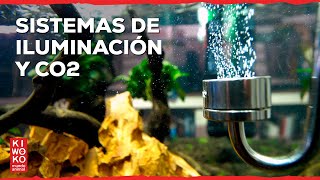
CO2 injection is essential for a thriving planted aquarium. The video explains how proper lighting and carbon dioxide work together to maximize plant growth, which keeps your tank healthy and your fish happy.
Foreign Hi everyone. Here I am with the aquarium. I'm in the middle of cycling the aquarium. Remember that I'm making a cube aquarium which is a community aquarium, planted, tropical and above all of medium level, medium difficulty. Today it's time to talk about the lighting system and the CO2 supply. Well, let's start with what is really going to be the growth engine of a planted aquarium. And here I tell you something. You are going to have to spend money. A good lighting system will guarantee that your planted aquarium is in perfect condition. I insist. A good lighting system will ensure that your aquarium is beautiful. We have chosen this Kessel screen. Kessel is a well known brand. It has different solutions. I am using the 160 version for freshwater aquariums. This has a temperature of 6,000 to 9,000 kelvin. You can adjust it here at the top we have it at medium intensity. One of the things I also like about this system is that it has very good ventilation. You can barely hear it. So the device always stays at an excellent temperature, which will help you. Although you won't spend any money on it because every time it breaks down it costs money. And this system, I tell you, is unlikely to break down. On the other hand, I have what would be its base? It is one of the different bases that Kessel offers for its spotlights. This type of lighting works very well in openings of up to about 50-55cm and you can add a certain depth. I would say that the maximum or the best results I have had are at 60cm depth. I like to highlight one topic, the lighting cycle and photoperiod, which are basically going to be the same. We are going to start this planted aquarium with six hours every week. And each week until it reaches 10 weeks, I am going to add an extra hour of lighting. What does this mean? Week one, six hours, Week two, seven hours, Week three, eight hours and so on. What happens if you see algae appearing? Be careful, analyze the water, make more water changes in your aquarium and above all reduce the intensity and hours of lighting. Here I will stop and explain how we inject CO2 into this aquarium. In this case I am using bottles that are pressurized CO2 bottles. They are very similar to the bottles from soda machines for those of you who have that knowledge, but in a smaller version. These bottles have to be refilled. How long does the pseudo last in an aquarium? It will depend a lot on the amount of plants you have in your aquarium and its size. We are going to keep experimenting, but this bottle will probably last between 16 and 20 weeks. That said, what I am going to do is inject the CO2 that is inside this bottle. It will pass through a pressure gauge. The pressure gauge basically reduces the output pressure and allows me to adjust the amount of CO2 bubbles I want inside the aquarium. It is connected to a solenoid valve. All the solenoid valve does is open or close, depending on what I want. Obviously, as I said before, I will have it open so that the CO2 can flow when the light is on. When the light is off, this valve basically closes as well and does not allow CO2 to enter. In turn, it will pass through a device called a bubble counter which will allow me to clearly see when these CO2 bubbles are being injected into the aquarium. And this basically helps me calibrate the amount of CO2 at a higher level. Personally, I always like to install a non return valve in case a little water accidentally escapes by capillarity and floods the room, which is something I don't want. In turn. This CO2 passes through a tube. Note that it has to be a plastic tube. It has to be 4 to 6 millimeters. And it has to be designed for CO2 that can hold the CO2. It will pass through this pipe. This pipe, what it has inside, as you can see, is basically a very porous stone that divides the CO2 bubbles into very, very small pieces. You need very fine bubbles so that they can mix with the water and the plants can absorb them. Otherwise, if you throw in very large bubbles, you won't do anything. Another issue that you have to take into consideration with CO2 is that I recommend that you have a CO2 reader. Basically what you need is to have this device that I have in the corner with a specific liquid that gives me the CO2 concentration. You have to change it to this liquid every five days or so. It's very easy to do. And this also allows you to have a metric of how much CO2 is. One topic I want to share with you is the inject CO2 from less to more because you can put the lives of invertebrate fish such as shrimp at risk. If you inject too much CO2. The water can be toxic to fish and shrimp and they can die. But you will also greatly acidify the biotope and the plants will also be hard. As always, if you have any comments, leave them. We will continue making a lot of videos related to obviously this, which is wonderful. A tropical community aquarium. Attention. Medium level. Yes. For those who want to dare and do something different. See you later.