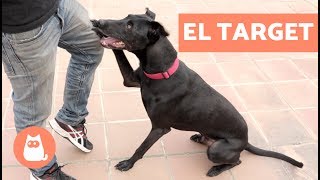
This is a YouTube video titled "EL TARGET en el adiestramiento canino" created in June 2017, featuring Alberto from the Perro Verde Association explaining the concept and practical applications of the "target" tool in dog training. The content is a detailed instructional presentation demonstrating how to teach dogs to touch specific body parts or objects using the target method, including examples with dogs Rocky and Seita. The video also discusses behavioral benefits and training techniques for assistance and therapy dogs.
Hi, I'm Alberto and I'm from Aragon. I'm part of the Perro Verde Association. We're dedicated to rehabilitating dogs from shelters through interventions with animals, training courses and different activities, animal fairs and more. Today we're going to talk about the target. The target is a preparatory element. It's a tool that simply helps us to achieve new exercises with our dog or with any animal, not just with our dog. The objective of the target is simply to get one part of the individual's body to contact another part of the body of another individual that would be the target. The target in the definition is objective. The objective. Therefore, the objective that we seek is that the dog, in this case, touches the hand, our hand, with its snout, with its nose. With its nose in such a way that if I put my hand flat, the dog has to touch it with its snout. This tool is very useful for achieving different exercises, such as the one that passes between the leg that comes when called, or different skills. It is very important, and what it ultimately aims to do is to help or give you one more tool so that you can carry out an activity that you ask it to do. When we say that the target is a preparatory element, what we mean is that it helps us achieve other new objectives. In this way, the preparatory element of physics would be mathematics, because without mathematics, we would not be able to do physics. Therefore, the target will help us above all to do different basic, basic obedience exercises or other exercises that we can teach the dog, such as, for example, pressing a switch, touching any object, pushing a ball, or making a move by hooking its shoulder to our knee. Let's think that the target could be from my hand to the dog's nose, or from the dog's shoulder to my knee, or from its right leg to my left knee, etc. We can also make the dog, for example, touch a cone or any object at a distance with its snout. Therefore, when we work with a target, we can achieve different and more advanced exercises for dogs. We can use the target to teach an assistance dog, for example, to open drawers, turn on lights, or fetch any type of object using the target. We can also do this with therapy dogs to get them to go next to chairs, where the users are sitting, for example. Or we can simply do different skills with our dog nearby. The type of work is relatively simple. It is very easy to teach a dog to do a target. But the important thing is to know what we have to do next with that target, how we have to continue training the dog very well. We are going to do some examples of how to do a target or what a target is. Let's see it with Rocky. Rocky. Rocky, look. Rocky is a 10 year old dog who is already very, very experienced. He has already participated in television competitions, in fairs, in more than 180 exhibitions. And he knows how to do this perfectly. But you will see how it is useful for him thinking that the target, in addition to allowing them to do exercises, can also help resolve behavior problems in dogs. Especially in dogs that are very fearful, as we will see later. With another dog. Thanks to the target, they are able to focus their attention on this target and everything else goes unnoticed. It is a very good tool. Let's see the hand target simply from nose to hand. Let's see how it is done. What it is, Rocky? Touch it. We have seen that he has touched my hand. I give him a piece of the reward for it. Let's put the hand back.
Very good.
Lets do the demonstration. If the dog knows how to do it well, if I put my hand up, he would jump. Rocky.
Very good.
That means he already knows what the target is. We can also do it with the other hand.
Very good.
At different distances with the target. For example, if I wanted the dog to get on the sofa, what I would do is put my hand and the target up. If I wanted him to come down, I would do the same thing by putting my hand down. Another type of target. What could it be? The shoulder to knee target. Let's see how Rocky does it. Rocky. Okay. We see that when there is contact between his body part and my body part. That's when the click sounds. What happens if I show him the target like this? Well, when I take a little step to the right, he knows that what he has to do is hook his shoulder to my leg. What he's going to do is get closer. Let's see together.
Very good.
What we see is that it's our turn, right? When it's our turn, what can we also do? Give him the treat and push him a little bit like this. So that he confirms that what we want is for him to touch our. See another type of target. For example, the one from his hand. The one from his paw to my knee. Rocky, for example, I do it like this.
Very good.
That's what he does, which is a target. From his paw to my knee. The other one.
Very good.
We see that this way we can get the dog to touch different parts of the body if I ask him to. Let's see another application of the hand target. For example, that it passes between my legs or that it stays between my legs. In this case, we are going to see the R. Now what I will look for is for it to pass between two legs. What will I do? Use two targets, One hand and the other hand.
Very good.
We see that he has followed the hand. He has touched my hand, he has passed. And that will give him access to the prize that I am going to give him. In that case, the target would not be very useful. Another application would be, for example, teaching a puppy to touch a light or touch a wall or touch a mark that is on the wall. In this way, we can demonstrate, and we do it in many training courses that we do, how a dog can differentiate between different colors, such as by putting colors on the wall and teaching the dog to touch a specific color. When we move those colors, the dog also moves and touches the color that we asked him to touch at the beginning there. We also see, in addition, these types of things that people sometimes don't know, but that dogs see in color.
Right.
Maybe the colors that we see, but they do see color. And this can be demonstrated with a target. Let's do another example of a target from a distance without it having to do with any part of my body, but with an external object. We're going to do this with Seita. Seita is the dog we have here. She's a greyhound. She's a greyhound that comes from the south. She's a greyhound that was very mistreated and had a lot of insecurity issues, a lot of fear of people, especially men. Currently, her behavior is great. And let's see that she also approaches everyone. She's a very good dog. And thanks to the target, she's managed to solve these behavioral problems she had. Let's see how she does the target with a cone. For example, an object like this. Okay, let's do an example of how to work with a target to a cone or to an object from a distance. Let's see how Rocky does it with this cone. It's a very good exercise to be able to, for example, work with our dogs from a distance. Rocky, cone. We see that he touches the cone. I click and I give him a treat right after. What is he going to do when I reinforce him? Well, he's going to repeat it. Cone.
Very good.
And now we're going to get a little bit further away so that Rocky can see how that distance can be increased. Okay, very good. And the last time, cone M he comes back, we see that he already Knows that he has to do something with that cone. He has to go to a certain distance, and that is rewarded. In the same way, we can set Rocky, for example, to touch, for example, the fence that we have here behind us. How would we do it? Well, we would simply get closer. And with a handheld target, we would help him know what I am looking for. For example, I've made a hand target on the fence, which is where I want him to go. And right after I give him a piece of the reward in the same place where I made the target, I'm going to do it a second time to reinforce that learning. And now I'm going to give him the reward in the same place. Now, when I ask him to go there, we'll probably see how he goes and touches the fence. Exactly the same stick that I asked him to touch. He moves in the same way. We could get the dog to touch the big one instead of one of these sticks. How would I do it? Well, first I'd give him a little support with my hand on the stick, the bigger stick. Do you see how he repeats the behavior? He keeps going to touch that stick because he knows that's what's going to give him a reward. Let's see. Now what I want to do is change that spot. How would I do it? First, I'd give him a little support and give him a peace of the reward exactly where I want him to touch it. Let's see what happens. Okay, I'll give him that little piece of the tree. Let's get a little distance. Maul. Bravo. And that way we can give him those pieces of the tree. In this way, we can get the dog to touch any type of object, not only with his nose, but also with his malve. Pause MBE mole. The target is a tool that will help us with many, many exercises, many skills and many useful exercises for everyday life. Let's see with the leg.
Very good.
He does it with his leg. And now we're going to see if he repeats it here. Malve rope. Bravo. Malve. We've seen how he touched. Malve. Rocky. Again. Bravo. We've seen how the target helps the dog learn the typical dynamics with which we work. In this way, if I make a target for this fence, which he has never touched before with his nose or paw, he knows that since we always do the same thing, it's the same as anything else I ask him to touch. So that's a little explanation of what the target is. We can continue working on this later. And if you want more information, you know www.alparoverde.es or on Facebook alparde. You can contact us to ask us or so we can guide you on your interests or to create exercises like these. In addition, our association also has a training department that does private training and trains people to teach them these things, behavior modification for different problems they may have or other series of behaviors and skills. So if you have any questions, we are at your disposal. Oh.