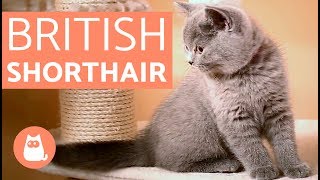
This is a YouTube video titled "GATO BRITÁNICO de pelo corto - BRITISH SHORTHAIR" created on August 4, 2017. The content is an informative monologue describing the British Shorthair cat breed, covering its history, physical characteristics, temperament, care requirements, common health issues, and lifespan. The video aims to educate viewers about adopting and properly caring for this breed.
The British Shorthair, also known as the British Shorthair Cat, is considered one of the oldest and most popular breeds in Great Britain. If you are considering adopting a cat of this breed or a mixed breed with similar physical characteristics, don't miss this video. We will explain everything you need to know to care for it as it deserves. The British Shorthair is considered one of the oldest feline breeds. Some theories suggest that it was the Roman invaders who tried to invade Great Britain in the first century before the year zero who brought the direct ancestors of the breed from Egypt. These felines crossed with native cats, giving rise to cats with a robust build and a dense coat. By various standards, it can be considered that the morphology of this breed has changed minimally over the years. However, around 1914 and 1918, according to the International Cat association, this breed was crossed with Persian cats to obtain the long haired variety. The British Longhair the British Shorthair is a compact, powerful and balanced cat. Females are slightly less coarse than males who have a larger chin and head. These details can be appreciated when the cat reaches sexual maturity and full development around three to five years of age. The British Shorthair's coat is short, very dense, close fitting and firm to the touch with a shiny appearance. Contrary to what it may seem, this breed does not have a double coat or undercoat. The British Shorthair's colors are white, black, blue, red, cream or smoky. The cat can reach an adult weight of between 4 and 8 kg. The British Shorthair stands out for being a sociable, affectionate and friendly cat. It is a feline that especially appreciates the love and affection shown by its owners as it is usually very attached, loyal and devoted. In addition, the British Shorthair loves to transmit a cheerful and spontaneous so we will enjoy a kitten. Even in its adult stage. They are usually calm, quiet and discreet, so they tend to fit in perfectly with other cats, dogs and even small pets as long as they are properly socialized during their puppy stage. They also get along well with children due to their friendly and fun nature, although it is likely that they will retreat halfway through a game to rest peacefully in their soft bed. It will be important to regularly clean their face with a damp gauze soaked in serum to remove eye mucus and dirt accumulated in their mouth. From time to time we will clean their ears with a dry gauze to detect mites or other problems. They do not need excessive care since cats clean themselves and sharpen their nails on scratching posts, so brushing them two or three times a week will be enough. Don't forget that for your British Shorthair to be happy, they will need some basic items in their home, such as a comfortable and soft bed to sleep on, toys and various accessories to play with, cat houses, scratching posts and a nest. When it comes to feeding, it will be essential to find a complete quality food, learning feline language, hygiene habits, sharpening their nails, or the natural behavior of the species that the kittens learn from their mother. That is why it is so important to know when to separate the kittens from their mother. From two weeks of age to two months, the cat must remain with its mother and siblings in order to learn everything it needs to know in its adult stage. In addition, during this period the cat is socialized, a process in which the kitten must be accustomed to the presence of other cats, animals, people and environments. It is essential to prevent fears or behavioral problems in its adult stage. As with practically all breeds, the British Shorthair is susceptible to certain hereditary diseases. Below we will show you the most common polycystic kidney disease Feline hypertrophic cardiomyopathy. It is important to visit the vet every six or 12 months to avoid and prevent certain diseases. It will also be necessary to strictly follow the vaccination schedule and internal and external deworming, especially if you have access to the outdoors. With good care, a cat of this breed can live up to 12 or 15 years, even longer. And that's it for today's video. If you liked it, give us a like and subscribe to our channel to watch the videos we upload every week. Until next time, experts.