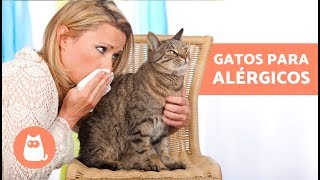
Hypoallergenic cats don't really exist, but some breeds produce fewer allergens than others. The video explains which proteins trigger cat allergies and recommends spending time with a cat before adopting to see if you react.
Welcome to animal expert. So called hypoallergenic cats have become popular due to their ability to reduce allergic reactions. But how much truth is there in this? Can they really minimize symptoms? In this video we will discuss this topic and mention the most recommended breeds. Don't miss it. Some people believe that the main cause of cat allergies is the animal's hair. For this reason, they consider hairless felines to be the best solution. However, the most common cause is not hair, but the feld1 protein produced by the sebaceous glands and the feld4 protein present in saliva. Since these allergens are found in saliva and skin, they can accumulate in the animal's hair during its grooming session and be distributed throughout the home when dead fur is shed. All cats produce these proteins, both those with hair and those without. So, stating that a hairless cat is logically hypoallergenic is completely incorrect. We also see that no breed is 100% hypoallergenic. So what do we understand by hypoallergenic cats? A cat is considered hypoallergenic when it produces a lower amount of the main allergen, which in this case is the feld1 protein and the feld4 protein or the characteristics of its hair mean that these substances do not accumulate as much. Thus, the breeds that meet these requirements are the Siberian, Balinese, Bengal, Debon Rex, Japanese or Oriental Longhair, Oriental Shorthair, Russian Blue, Cornish Rex, Perm and Siamese. It has probably caught your attention that the Sphynx cat is not among the most recommended for allergy sufferers. Well, although it does not have hair, it produces a normal amount of Feld1 protein and therefore is susceptible to causing allergic reactions. The absence of hair prevents the protein and fat secreted from being distributed evenly, which is why it is also necessary to take proper care of their skin. However, as we have said, this does not mean that there are no people who can tolerate this breed. If the allergy to cats is mild, it is possible to see reduced symptoms with the aforementioned breeds. However, if the allergy is more severe, it is unlikely that the aforementioned breeds will cause reactions. On the other hand, it is worth noting that each person is different and it is possible that the same breed considered hypoallergenic does not cause any reaction in one allergic person, but it does in another. By this we mean that if you are thinking of adopting a cat with these characteristics, it is best to first meet the animal and spend a few hours with it to check that the reaction is indeed mild or non existent before making the decision. And that's it for today's video. If you liked it, don't forget to like it and subscribe. If you have any questions, leave us a comment. Until next time, experts.