Guía Práctica: Cómo LIMPIAR LOS OÍDOS DE TU GATO sin estrés y de forma fácil 😼👂🏽✨
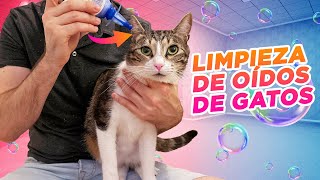
Veterinarian Carlos walks through how to clean your cat's ears safely and prevent infections like otitis. He covers proper technique, what to watch for, and how to handle young or rescued kittens without stress.
Foreign Hi, I'm Carlos and I'm a veterinarian. Welcome to the Happy Pets and Families channel. Here again with Alcachofo. This week, taking advantage of the fact that this little guy needs his ears tuned up, I've decided to show you how to clean a cat's ears. And why is this important? Well, because our feline friends can often develop certain types of problems there. Otitis. Otitis occurs when the part of the ear becomes inflamed. But inside, right, it's like the ear canal as it's called. This part of a cat's body can become inflamed when there are certain problems, such as infections caused by bacteria or even microscopic fungi called yeast. Sometimes it's mites, which are like little spiders that live inside cats ears that end up causing problems. In any case, what we're going to see in our cats is that this area itches and can start to ooze. There are times when the ear wax that comes out of our cats can be a more or less light color or sometimes dark black, almost like Nutella. In all these situations, I recommend that you go to the vet to have it checked out. But to prevent any of these. Goodbye. But to prevent all this, we can routinely clean their ears. And how often should we do it? If you see that your cat's ears are clean, which do not need to be cleaned for any specific reason because they have not had Titus in the past, because they are not prone to developing dirt inside the ear, as is the case with alcohol, you only need to clean them once a month, many times. By over cleaning, we end up causing otitis because we wet that part inside the cat's ear canal too much and bacteria ends up growing precisely because of that excess moisture. It is very important to make sure that the area is left completely dry. To clean your cat's ears, you need to use a specific cleaner, a normal ear cleaner, a cerumenolytic cleaner which removes earwax from your cat's ears. You can't use hydrogen peroxide, water or saline solution because in these cases the earwax may not be removed and you won't be doing anything at all. For example, with hydrogen peroxide your cat may itch because it has a wound and this could complicate things. In addition to this, you need to use gauze. Never use cotton swabs because if they are already problematic for people, imagine if you use them on your cat. You don't know how deep you are reaching with the cotton swab and you could damage the eardrum. So it's always better to use a piece of gauze and your little finger. It is very important to use at least one gauze pad for each ear. That is to say, in this case, I have more or less. Well, I have one or two extra gauze pads for each ear, mainly because I will use one to clean the first thing I take out. And then, if necessary, to leave it drier, I will use the second one. So they always have to be separate gauze pads for separate ears. Because if there is a problem in one of the ears, if we use the same gauze pad, we will transfer the problem to the other.
Okay?
And then it is possible that if there is an infection or something like that in one ear. In one ear, we will transfer it to the other. It is also very important to clean the ears when cats are very young, and especially when we have just picked them up from the street. For example, young kittens have a slightly less developed immune system. And that is why it is possible that if they are also outside without eating, without being fed well. Well, in the end, they will end up with common diseases. And one of them is otitis. That's why when we rescue a kitten from the street, we always take a good look at its ears and make sure they're always clean. Well, I won't go on and on about it anymore, and I'm going to show you exactly how to clean your cat's ears. It's very simple, and it won't hurt your cat at all. First, we need to know where the cat's ear canal goes. Look, if we turn our cat's head sideways like this, we can see that its ear is here. So of course it touches here. Find your cat and touch it here. And look at this area here. You'll notice that there's a slightly harder area here. That's the cat's ear canal. Cleaning it is very simple. We're always going to have to hold its head like this, horizontally, and we'll hold its ear up. This way we can see the inside of the ear. In this case, the cat's ears are pretty clean. But if your cat had a little bit of ear wax built up, we could see it here. And from here we would start cleaning it. Right now, the cat is super relaxed. I always recommend that you start with your cat relaxed for these things, okay? Avoid letting them dance around because they might be more nervous at that moment. I recommend that you always put the cat in a normal position.
Okay?
Put them like this, with their head horizontal and hold their little ear up. We are going to have this open, okay. And this is inserted like this, holding the kitten. Come here to the cat. Come, come, come. Just like I showed you on the channel.
Okay?
We lift the little ear up and insert the cannula in a vertical position.
Okay.
Like this. Down.
Okay.
Like this.
Okay.
We insert the cannula. These cannulas are also made of rubber. They are very good. And now we press a little. It is normal for the cat to do that.
Okay? Okay.
In fact, it helps us a lot because it releases all the earwax. Okay, that's normal. And now we're going to do a little massage in this area, in the hard area that it has down here. We have to hear a chup, chup. If we don't hear the chup chup, the earwax may be escalating. Yes, yes, we can hear it. Okay, Very good. Little earwax. So after doing that little massage, we take the gauze and again, holding the ear up, we put a finger in. We don't have to press too much because gauze, especially the woven ones.
Okay.
They're a little abrasive on the area.
Okay.
And then we take it out. It does have a little dirt.
Okay.
But that dirt is normal. I'm doing this cleaning routine on the earwax because although it's true that I haven't seen them very dirty, I have seen that in the last few days, he's been scratching a little more than usual.
Okay.
So it's normal for a cat to scratch its ears. But since it's been a while since I've looked at its ears and cleaned them, I decided that this was the time. See, the second time we've put it in, it came out much cleaner. Well, with this, we've cleaned one of its ears. Now we're going to clean the second one.
Okay, Again.
Squeak, squeak.
Okay. Okay.
A little bit more. Only one person can do it, but it's better if two people do it, because one person only needs to be a little more skilled.
Okay.
And again, in this case, we can see that this one was a little less dirty. Bye. And that's it. Now, it might stay like that for a while, shaking its head a little, because it could be that some liquid remains inside or that its ears are a little lower, because, well, it might look a little strange after we've cleaned it, which is completely normal. But anyway, after about half an hour or so, you'll see that it becomes completely normal. And to thank the cat for its collaboration we're going to give the cat a treat. Very good, my cat. Do you want another one? Come on, you've been really good. Here you go. Very good. His ears look like Yoda.
And have you ever bothered to look inside your cat's ears? Have you perhaps discovered a hidden treasure there? Well, tell me in the comments so we can all find out. Also, if you like the video and want to support the cat and me, you can give us a like and a super thans. And remember to subscribe to the channel if you haven't already. If you Click the bell, YouTube will notify you if we upload a new video, but only if you have all notifications activated on your phone. Also, remember that we have a secondary channel here on YouTube called Questions and Answers from a Veterinarian. Stop by and take a look. And don't leave yet because we have to meet this beautiful calico kitty named Peachy, who greets us with her human companions Melissa and Facundo from Buenos Aires, Argentina. Henriqueta is a big eater, playful and affectionate. She has it all. She greets us with her human companion Ella from Honduras, and we say goodbye to the kitty Yoyo, who greets us with her human companions Luis and Daniela from Costa Rica. Thank you very much for following the Happy Pets and Families channel and I'll see you in the next video. And goodbye to the little guy. Come on, sit here. Come on. Come on. Ah, ah, ah, ah. What claws do you have? Oh, oh, sorry. Move S.M. rena to sit on the arm. Right? Well, I just want to say it because everyone. Oh, the little guy is a saint. I don't know what it is. Come on here, guys. Oh, oh, oh. Wow. I've covered myself in batter. Looks like I've eaten cat. Now I look like. Alright. Look at him. Say hi to the little guy. Oh boy, what a cushion. Hello, cat. Please, little guy.
More from Javier

Cuando nadie reconoce tu dolor por la pérdida de una mascota: así es el duelo desautorizado 💔




¿Tu perro hace suficiente ejercicio? Mantenerlo activo es clave para que viva mejor 🐶💪

GATIFICANDO UNA PARED PARA MI GATO 😻🧗♂️ Ideas para aprovechar el espacio vertical en casas pequeñas



Por qué duele tanto perder a un perro o un gato: el vínculo que explica nuestro duelo 💔🐾

