¡Hacemos ARENA CASERA PARA GATOS! Milú la prueba pero sale FATAL 😾❌ | #DIY: Arena barata y ecológica
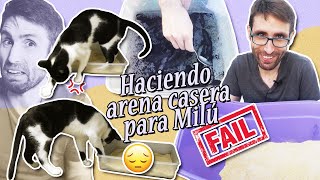
This is a YouTube video titled "¡Hacemos ARENA CASERA PARA GATOS! Milú la prueba pero sale FATAL 😾❌ | #DIY: Arena barata y ecológica" created on November 11, 2020. The content features a clinical veterinarian named Carlos and another person named Jose discussing and demonstrating how to make homemade ecological cat litter. They test the litter with a cat named Milou and share their observations and results, which indicate the experiment was unsuccessful. The video includes practical details about materials, costs, and the cat's reaction, aimed at viewers interested in DIY and eco-friendly pet care solutions.
Is it possible to make ecological cat litter at home? Well, that's what we're going to see today. Right now, I'm quite skeptical. Yes, well, it's been a bit of a fail so far. Hi, I'm Carlos, a clinical veterinarian at Small Animals. Welcome to the Happy Pets and Families Channel. To tell you the truth, all this ecological litter stuff sounded like gibberish to me. At first I had no idea. But in the end, I've been doing some research and hey, I want to try it. That's why I'm going to show you how to make ecological cat litter. And we're going to show it to Milou to see if Meelou likes it. Because if it turns out, it's a very interesting option. And after I've tried it for a few days, I'll also tell you if it smells more or less than the traditional one he uses, which is clumping. And I know you like the idea of money. We're also going to compare whether it's cheaper or more expensive than traditional cat litter. One advantage of this type of litter, which we are going to make, which is ecological and homemade, is that it is perfectly compostable. You can throw it away somewhere where you can make compost, or you can even dispose of it in the organic waste bin. Therefore, we have to find a substrate that does not have an impact on the environment. For that we are going to use corn flour, although you can also use tapioca or cassava flour. Well, whatever you have on hand. For me, corn flour has been easier because it is more accessible and you can also find it at a slightly more competitive price. But for that I also had to look for it, because at first I started looking and the corn flour that suppliers offered me online was for human consumption. And that flour came out super expensive, more than €1 per kilo. With that, obviously it was not going to be profitable for us to make the substrate for our cat's litter box. We had to find a much more affordable option. That's why I've already done the work for you. We've found that cornflour can also be used in these cases, but not for human consumption, but for animal consumption. The kind used to make feed for cows and livestock in general, that's much cheaper. And I was really happy to find. Took me quite a while. Well, it came out to around 4.50 for 10 kilogram. The truth is that it can be done, of course. That way I can show you if it works or not. Because if we Start with something that's much more expensive than normal litter, then we're done. Since it's an edible product, your cat might be attracted to the smell and end up eating what you put in its litter box. And that's not good. Of course. That's very important. It doesn't have to be a fine flower, because if it's too fine, it will raise a lot of dust and that can be harmful to the cat's respiratory system. It has to be a fairly coarse flower so that when the cat digs and so on, it doesn't form an impossible cloud of dust. Other YouTubers are sent makeup creams and I'm going to do an unboxing of 10 kg of cow feed. They sent it to you. You bought it? That's right. I bought it myself. This is the product. As you can see, it's a little thicker than if it were corn flour that we buy for home. Even so, it looks a little dusty, to be honest. I'll leave all the links that I use to buy the materials that we're going to use today below in the description box. But they're Spanish stores that. Can you ship here to Spain? Honestly, with quite low shipping costs, that's also important. The shipping costs were around €3, so it was around €7.50. But I also have to tell you that to make the litter, we're going to use normal baking soda, the common all purpose kind. I mean, this one isn't special or anything like that. It was the cheapest of all, logically. And this little jar, which is like 200 grams, came out to about 60 cents. Come on. Well, this is from a normal supermarket. The bicarbonate will help us collect or capture the odors of what your cat does on it, and so they won't spread throughout the room. In contrast to this recipe, which is, so to speak, the basic one, we also have the mystery box. The mystery box. This box contains activated charcoal, but this is simply an extract because activated charcoal has been shown to collect the odor of what your cat does on the litter box very well. As I told you in another video here on the channel, the I bought the activated charcoal at an industrial drugstore. I found it much cheaper there. If you're wondering what activated carbon is, it's usually made with coconut shells, which keeps odors from escaping. And it can also be used in other applications, such as cleaning aquarium water and so on. In other words, it has millions of uses. In this case, we simply want it as a sand deodorizer. Activated carbon has been a little more expensive, but it's also true that much less activated carbon is used. A kilo of activated carbon cost me €13, which is with shipping costs, it came to around €20 and 19 cents. And something. I'm going to tell you the price per liter box, because that way it's easier to calculate. Hold on, I've got the cheat sheet here. In total, the tray cost us around 28 or 29 cents. Everything we put in it, including the activated carbon. And you might say, well, is this a lot or a little? Well, let's compare it to how much vegetable sand costs, which is also biodegradable. It comes out to around 20 or 40 cents. And we also add a little bit of activated charcoal, which, as I said, is optional. Well, let's see. We have what we're going to use as a litter box for Milou. Come on, let's see if we can open this. This stains a lot, but hey, it's only going to be a very, very small layer underneath. Well, the first thing we're going to do is take some activated charcoal with a sp. Okay. You can see that it's normal charcoal, but it's very fine, and that's why it stains a little more than it should. So we're going to distribute it more or less on the bottom. You distribute it like this, a little on the bottom, and that's it. And now we have to add the substrate. We only have to put a large layer of substrate in the litter box, more or less, so that the cat can use it with about two or three fingers. Well, at first glance, it seems to me that it creates more dust than normal litter. That's my impression. This residue doesn't normally stay in the litter box. It's possible that when the cat starts digging in the litter box, this dust flies up and forms a cloud of dust. Well, I don't know. We'll have to see how the cat behaves, how it behaves with Meelou now when we give it to him to try. But it's true that it has these fine particles. My hands look black because of the charcoal. Right? I think this layer is more or less enough, although you'll see gaps here in the corners. Since now I have to add the baking soda and mix everything. Well, so now we'll mix everything together in principle with the activated charcoal. Baking soda might not be necessary, but I'm going to make it following the recipe that I'm most convinced by. That's why I'm using baking soda and Activated charcoal. There's nothing wrong with mixing them or anything like that. It just might have more power to retain the smell and the baking soda. Well, about a spoonful. We spread it out. We have to try not to get all the way to the bottom when we spread it out because we want the activated charcoal to stay in a layer. Otherwise it will mix with the sand, no problem. But that way it will be better. We even it out and that's it. Enough so that the cat can bury it and dig it up. Well, and that's it. Let's see what Meloo thinks of the invention that we are making him try. Right now. I'm quite skeptical. I thought it would have a different consistency, but oh, well, let's see. My Lou is very, very used to his little stones. Maybe now we put this in and he'll say, em, I'm not going in there. Come on, let's put it in. We're going to leave it there and see if he doesn't notice. He'll see that my mother has put his food next to the sand. And that's not allowed. That's not allowed. But. Oh, well. First impression, it wasn't bad. He came in, he's been tracking around a bit and honestly, well, it seems like he was curious about what we had put inside the tray. That's not a bad thing. Something caught his attention. He smelled it quite a bit. He's been digging around and so on. Maybe it's because it's something new. And he says, well, what is this? And where's my toilet? Well, that could be it. That's the cat's first impression. My first impression. Well, the truth is that he left the outside of the litter box quite dirty when he got out because his paws brought in quite a lot of corn. So. Well, that could also be something. That could be a downside. I've decided to start from scratch again. Give him his litter box, the one Bun uses, because it might be too much of a change. Change the litter, change the tray, and then maybe he'll use it better. Maybe this time it'll be the last time because it's been a bit of.
A failure so far. It's true that he's shown interest. Jose wants me to come in and do things as if the cat were obeying us. But that's not the case. The cat will do it when he wants. Let's see, let's see. I'm still quite skeptical, to be honest. So let's go to his place. Camera. Well, we've spent about two days, letting Milou try the litter to see what he liked. And now we have the verdict. Well, the truth is that my cat didn't like it too much, I can't lie to you. Although the first day he reacted quite well because he started to show quite an interest in getting into the litter box and exploring a bit. The truth is that little by little, he lost interest. In any case, we left him his clumping litter so that he always had the option of doing his business somewhere if he didn't like the homemade litter we were making. And we've been like this for two days and it's been a failure. The cat has only gone in a little bit to play around and dig around in the litter box where we had put the homemade litter, and that's about it. But he's continued to do his thing in the clumping litter. He didn't want to know anything about the other litter box, so. So that's the main downside for me. So I can't tell you how it smells, although we've put in everything to try to make it smell like baking soda and activated charcoal. The second downside is that it's dusty and very dirty, much more so than regular clumping litter. It's made of quite fine particles which stick to the cat's paws and when they leave the litter box, they leave it all covered. And what are we going to do with Meelu? Well, obviously we'll leave him with the litter he uses because he likes it and uses it. But of course, you might have found it interesting and want to try it at home and have your cats use it. And in that case, hey, it might be a good option. Let me know in the comments if your cats are using it in the end, because, hey, it could be that it's just Melu the Weirdo and that all cats love this type of litter. I don't know because I've never tried it in my life. I hope you liked the experiment we did, even though in our case it was a total failure. But hey, at least this way you've learned a little more about the world of homemade biodegradable litter. And that's it for today's video. If you liked it, give it a like and share it with everyone. Also, hit the bell. So YouTube will notify you every time we upload new content. And today we're meeting. Wait, no, we haven't met anyone yet. Remember that on YouTube we have a. Remember that on YouTube we have a secondary channel called Questions and answers from a veterinarian. Check it out and subscribe. And today we meet Agatha, who loves listening to Totoro's Meow, which is unusual. And she lives with Natalie Hong. And this is Angelina, although at home they affectionately call her Ms. Yoli or Pandemonia when she gets a little nervous. She lives with mon amor in Mexico. And we finish with Chema, who Maria Cecilia Esperanzo rescued from the street a short while ago. Well done. Thank you very much for following the channel. Happy pets and. And families. And I'll see you in the next video. I'm going to make a little video for you. I don't want to tell you to try it because Obviously it's like 4.50 per kilo, not 10 kilogram. 10 kilogram.
Yes, yes. Sorry. If you see me mooing and I start eating it, it's because I think it's from cows, an extra that. I'll tell you what it's used for later.
Well, no, you already said it in another video.
Oh, it's true. If you like this type of video and you want to suggest.
More from Javier

Cuando nadie reconoce tu dolor por la pérdida de una mascota: así es el duelo desautorizado 💔




¿Tu perro hace suficiente ejercicio? Mantenerlo activo es clave para que viva mejor 🐶💪

GATIFICANDO UNA PARED PARA MI GATO 😻🧗♂️ Ideas para aprovechar el espacio vertical en casas pequeñas



Por qué duele tanto perder a un perro o un gato: el vínculo que explica nuestro duelo 💔🐾

