LIMPIEZA DE GATOS SIN AGUA con CHAMPÚ CASERO EN POLVO 😽🧼 ¡Adiós malos olores! |¿Vinagre para pulgas?
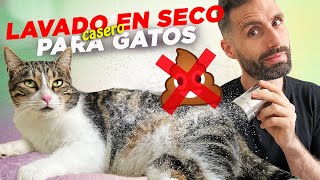
Veterinarian Carlos shows how to clean cats without water using wet wipes and homemade dry shampoo powder. He explains whether vinegar actually works against fleas and offers practical hygiene tips for cat owners.
Foreign Hi, I'm Carlos and I'm a veterinarian. Welcome to the Happy Pets and Families Channel. We know that our kitties usually keep themselves pretty clean, but this week we had one of those cleaning emergencies at home that required our full attention. The cat went to its litter box to do its business and suddenly it came out and hadn't covered one of its poops properly, so it stepped in it, and that's why we had to rush to clean it. And in this video, apart from telling you how to clean the cat's paws and the smaller parts of its body, I'm also going to tell you about another method so that you can clean your cat without having to put it in water. In other words, completely dry, so that cleaning it isn't torture. And finally, I'm going to tell you about another one of those remedies that you see around the Internet that promises to keep your cat clean and above all, free of fleas, which is using water with vinegar. In addition, I'm going to tell you today whether or not it works. And all the scientific articles that I've consulted to bring you this information, as always, are in the description box. So let's get started. How can you clean a cat without having to bathe it when a small part of its body gets dirty? With alcachofo, we use wet wipes specifically for cats. It's true that they may not be available in your area. If this is your case or you don't have them on hand, you can use a slightly damp cloth with a little water and neutral soap. These soaps do not have artificial colors or perfumes and can be used for all skin types. They cannot cause allergies. So it is much more appropriate for our cat because residue can remain on its skin and it can swallow them and get dirty. Well, these types of wipes have really been a lifesaver for us, not only because we can use them to clean between their little toes, between their pads, and leave their paws very clean, for example, but we also use them to clean their chin area. As you know, cats have a problem called acne, and we try to keep it under control as much as possible. So these wipes specifically have a little bit of chlorhexidine, which is an antiseptic that helps us keep acne at bay. Since they are specifically for cats, we can make sure that they are not contraindicated for them and that if the area we have cleaned is left a little damp, even if they get hot quickly, which is what cats usually do, they Will not get poisoned. And of course, they are very suitable for the type of ph that cats have in their skin. For example, the cat litter box is the place where we use it the most and it gets dirty the most because it loves going out to the window, sitting on flower pots and usually coming in with its paws covered in dirt. And sometimes it comes back really dirty. It's true that it often grooms itself, but if we're with it on the couch and we see its paws dirty, sometimes we also use wipes for it. And you often tell me that your cats, for whatever reason, come out of the litter box and don't leave their backside or bottom very clean. Well, wipes work very well for these cases too. In fact, we've used them with the cat litter box on occasion. These types of wipes work best with cats that have short hair. For long haired cats, a very damp cloth from your household will work much better so that the moisture penetrates properly and you can clean the dirty area thoroughly. Come on. And now I'm going to tell you about that topic of vinegar water for cats. It is very common to find videos or blogs on the Internet that tell you, look, I'm going to teach you how to wash your cat in a supernatural way that is completely non toxic to them and also has an anti flea effect. And in those videos they usually prepare a small bowl of water into which they add a dash of vinegar and use that to rub all over their fur. So there are many people who write to me and ask me if this could be a suitable remedy for their cats in the event that they go outside and come home with parasites. How much truth is there in all this? Well, it is true that vinegar has a certain disinfectant power that can kill bacteria, fungi and even viruses. It does this because of an acid in its composition called acetic acid. Conventional vinegar has approximately 3 to 5% of this acid. So its ability to kill bacteria, well, as you can imagine, is not very great. Although it is true that it can eliminate some of them. But of course this effect is speaking of it when we have pure vinegar, but in most of the videos we see online, vinegar is not applied directly to the cat, but rather diluted in water. Therefore, that effect, that capacity will also be diminished. Well, here we have the first limitation of this type of treatment that we can give our cats, because to begin with, the vinegar will no longer have as much strength to kill viruses, bacteria and fungi. In addition, most sites tell you that to avoid having to bathe your cat and well get it all dripping with vinegar. Simply wipe its fur with a cloth moistened with vinegar water. If we only wet the superficial layer of the skin, it will not reach the deep layers of the fur. Therefore, the effect against bacteria, fungi and viruses will also be greatly diminished. Apart from the little effect it already had due to the vinegar being diluted, what I have found are some sources also, although they are not 100% reliable or very scientific, that say that vinegar is a flea repellent. It's true that I've heard it from some people. Well, popular knowledge, you know, those things that are passed on by word of mouth. But it's also true that they always refer to pure vinegar, never to water with vinegar. And it also refers to a repellent effect. It never has the effect of killing fleas. You might say to me, well, it's a repellent. I don't care. Because if my cat doesn't have fleas, because they'll get away from it because they're infected by vinegar, well, look, I've already gotten rid of them. In the hypothetical case that that works, that's precisely where the danger lies. When your cat leaves, they'll be all over your house, on your sofa, on your curtains, or even on you, so they can bite you. But you might say to me, well, what if instead of water with vinegar, I just rubbed 100% pure vinegar on it? Well, in this case, in my opinion, you're making a huge mistake. To begin with, vinegar won't keep your cat clean because vinegar has an odor. So your cat will end up smelling like vinegar that you'll want to remove later. With a bath, you won't be getting anywhere. And to continue, the acetic acid in vinegar is quite irritating and stings, especially if your cat has a small wound that you may not have noticed. So it could be that because you want to do it a favor, you're doing the opposite. I certainly wouldn't dream of using artichoke in my life. I have to say that it's true that vinegar is not toxic and that it will not be harmful in any case if you use it diluted in water on your cat. However, from my point of view, it's not at all recommended. Well, now let's move on to dry shampoo for cats. I already talked to you about this in a video some time ago, and you found it quite interesting. And there I already told you a little bit about how it was made. But today I'm going to make it at home and you're going to see first hand, how it's done. First of all, I have to tell you that this dry shampoo, in quote marks, because it's not soap, is used mainly for those situations in which our cat, for whatever reason, smells bad. Because, I don't know, well, it got dirty with its poop. You cleaned that area, but of course you didn't bathe it completely. And so, well, it still smells a little, or because, I don't know, it was in a smoky environment, even though it shouldn't have been, and all of that smoke got on its fur and, well, it gives you the creeps that your cat still smells like that because that means that all those substances are still there, impregnated in the fur. For those cases, you can use this way of cleaning cats, which, as I said, doesn't require you to wet it at all. Of course, there are commercial products, dry shampoos for cats that you can find in any specialty store and that you can use in these circumstances and that they also solve the problem for you. But hey, since this channel is watched by everyone in many different locations and you may not have access to these types of shampoos, that's why I'm here to give you this natural, homemade alternative that's completely harmless and innocuous for your cat. It's a safe shampoo, even if your cat gets cold feet. What ingredients do we need? Cornstarch, which is the most widely distributed brand. On the other hand, we also need baking soda, which the English call baking soda. I don't know what it's called in your area. If you use those baking powders that come in sachets, make sure the ingredients only contain baking soda, no other type of chemical leavening agent, because in that case, it may not be safe for the cat. And I can already see the controversy coming that some of you sometimes send me and tell me, hey, Carlos, I've seen that baking soda is toxic to cats. This dry shampoo that you tell me is safe is also toxic because it has baking soda. No, that's not true. According to the American College of Veterinary Pharmacists in the United States, baking soda can only poison our cats if consumed in excess of a specific amount. I have the amount written down here in a cheat sheet of 10 to 20 grams per kilo of weight. That means that a cat, more or less like the Caciofo that I have here next to me, although you can't see it, would have to consume approximately between 40 and 80 grams, well, almost 100 grams of baking soda for it to Be a problem for it. It would have to eat the baking soda by the spoonful. The shampoo is completely safe for your cat because it doesn't contain that much baking soda. So even if it grooms itself and consumes it, nothing will happen to it. And now you can tell me, well, will that work or not? It will be like vinegar. Let's see. Baking soda has proven its ability to combat bacteria, specifically the bacteria that cause bad odors in human armpits, for example. In fact, there is a very interesting study that shows that baking soda has the ability to stop the growth of these bacteria, practically the same as an antibiotic. How do you do it? We are going to use a bowl to mix the starch and baking soda. First, add three tablespoons of cornstarch. Next, add one to two small teaspoons of baking soda and mix it all very well. These are the only ingredients it is effective in removing odors from your cat. Do not use any type of perfume, talcum powder, essential oils, or anything like that to mix with all this to make your cat smell better because it could be dangerous for him if he swallows it. Once the mixture is well prepared, we are going to put it in a container with a lid with holes. If you are going to reuse any that you have at home, like spices, make sure to wash it very, very well so that there are no residues and it is still safe for your cat. Perfect. Well, now you have the dry shampoo for your cat. How are we going to apply it? I recommend that you put a towel or a blanket underneath because, well, since it is a powder product, it is possible that it will disperse a lot and your house will end up full of this powder. And that way, well, we save ourselves the trouble of vacuuming. Then apply it to the area that you are going to treat. In this case, we are only applying it to the cat's back paws because, as I said, we had that catastrophe with the poop and it still smelled a little bad. I recommend that you move the hair very, very well aside so that all the mixture can come into contact with the skin. You can give your cat a quick massage with the seasoning if you want to distribute it throughout the coat and improve the effect. Once it has been thoroughly absorbed, brush your cat thoroughly. First, we are going to do a pass against the grain so that the coat is lifted and all the dust comes out from underneath. And then we will do several passes with the coat. This will remove the excess dust, even if there is a small residue and it is groomed it will be completely fine because what we are applying is 100% safe. Once you have brushed your cat, if you want to reinforce it, you can pass a towel over it and that way you will completely remove any residue. There is no need to rinse, wash or wet it, and it is ready. And how often should we apply this to our cat? I never recommend using shampoos or dry shampoos on a regular basis, only when absolutely necessary. Because when applying any product to our cat's skin, especially if we do it frequently, we can affect the bacteria that live on the skin and help keep other bad bacteria at bay. If the good ones die because we are applying these products, bad bacteria can grow and problems can appear, such as dermatitis. So if your cat doesn't need it, he will stay completely clean with his daily grooming. And someone might ask me, well, what happens if my cat goes outside and comes back covered in engine grease? In those situations where our cat's hair gets covered in things that could be harmful, the most important thing is to remove all that product that could be dangerous for your cat. And we achieve this with a bath. In these cases, I do recommend that you use products, shampoos and soaps that are specifically designed for cats because they are suitable for the ph of their skin. If you don't have any on hand because they aren't sold in your area, as I told you at the beginning of the video, use neutral soap. But hey, you already know me and I've been telling you on the channel for many years that you don't need to bathe your cat. But in today's video, I'm going to tell you about the exceptions so that you know how to do it and when to do it. Well, what do you think about all this? Have you ever had to bathe your feline companion because he's covered in something? Tell me in the comments and if I've given you any good ideas and you like the video, give it a like. And remember that you can subscribe to this channel if you haven't already. You also have a button where you can thank us very much for the videos called Super Thanks. And I also remind you that we have a secondary channel here on YouTube called Questions and Answers from a Veterinarian. Stop by and take a look and don't leave yet because we have to meet these three beautiful kittens named Tom, who is the black and white one, Tomasa, who is the orange kitten, and Tomasito, who is also the black and white one, but smaller. They greet Us with their human companion, Rumi. These two little ones greet us from Istanbul, Turkey, and their names are Cosmos and Mia, and they do so with their human companion, Barbara. And from Peru, this cute little one with those freckles greets us. Her name is Gordita and she lives with her human companion, Gabriela. What do you say to the people of the Kocifo? Thank you very much for following the Happy Pets and Families channel, and we'll see you in the next video. And for those of you who are asking me what neutral soap is, well, when I talk about soap, a neutral soap, what I mean by neutral soap, I mean, people usually always refer to soaps with. But that's what it's called. Natural neutral soap for all skin types. It's called neutral soap. That is, it's suitable for all bodies, for all skin types, even if you have allergies or perfumes. Okay, well, they're special soaps. Uh, I don't know if they're special, but anyway, they don't contain dyes, perfumes, or other components that are usually present in industrial soaps. I know what I was saying. We're talking about pure vinegar. The properties, not the ability, the lack of ability either. The effect. Well, popular wisdom has also said that. Because people have also said it. But of course it's pure vinegar. It's just that all those vinegars have a tremendous smell. I mean, imagine your cat smelling like vinegar and salad. Look, my cat smells like roses from the Amazon. No, I'm not going to try it. I'm going to tell you. I'm going to go out there, like me. Preparing the mixture according to the American College of Veterinary Pharmacists in the United States. Yes, I have it. I want to say it. Well, whatever. It was silly. How many naps did we take today with the cat? But it doesn't go far, does it? Look where it ends up. Let me finish the video. Come on. Don't look at me like that, because then I won't be able to stop doing things to you. Yeah.
More from Javier

Cuando nadie reconoce tu dolor por la pérdida de una mascota: así es el duelo desautorizado 💔




¿Tu perro hace suficiente ejercicio? Mantenerlo activo es clave para que viva mejor 🐶💪

GATIFICANDO UNA PARED PARA MI GATO 😻🧗♂️ Ideas para aprovechar el espacio vertical en casas pequeñas



Por qué duele tanto perder a un perro o un gato: el vínculo que explica nuestro duelo 💔🐾

