LOS GATOS NOS IMITAN 🐱✨ y así puedes comprobarlo 👀
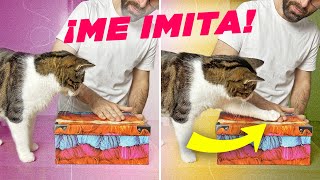
Carlos, a veterinarian, explains how cats imitate human behaviors and other cats, backed by scientific studies. He walks through experiments you can try with your own cat to see imitation in action and understand how they bond with you.
Today we're going to talk about a topic that can change the way you see your cat, because it's possible that our feline companions imitate us. Hi, I'm Carlos and I'm a veterinarian. Welcome to the Happy Pets and Families Channel. I'm sure you've noticed that your cat usually looks at you very attentively. But I'm going to ask you something. Have you ever repeated things that you've just done? For example, going to the bathroom after you are yawning after you've done so well? Let me tell you something. We may be on to a great discovery. It's possible that your cat is a professional imitator. In this video, I'm going to talk to you about the ability of our cats to imitate us. And what does science say about it? I'll leave you the scientific links below that I've used to do it. And I'll also give you a challenge so that you can discover if your cat is capable of imitating you. I'm going to start by telling you about a very specific story, which is that of the cat Ebisu. Ebisu is a very, very special cat because he began to demonstrate behaviors that had only been seen before in other animals, such as dogs and primates, which was imitating his human. And this has been demonstrated in a laboratory, and there are videos and everything. Well, during the video, I'm going to show you some of the exercises that were done with Ebisu. This conclusion was reached after Ebisu's human, whose name is Fumi Higaki, began to apply techniques to him that she already did with dogs because she was a dog trainer, using the do as I do technique, which means do as I do, which consists of the human first doing something and then generally telling the dog, do it. When the dog receives that command, it repeats the action that the human has done. Well, exactly the same thing was done with Avisu. The exercises that were given were first touching a box with a paw, then opening a plastic drawer, also biting a rubber rope, and finally rubbing his face against something. First, the human would do it and give Ebisu the command, which was to do it. Ebisu then did the same as his human, obviously to achieve positive reinforcement. Ebisu was always rewarded if he did it. Well, the interesting thing about this is that until 2021, which is when the experiment was done, it had never been possible to demonstrate that cats had these abilities. And the fact is that Ebisu was very, very effective. Well, I have the data here. He was given 10, 18 trials and repeated the action 81% of the time, which is a very high percentage. The only drawback of this study is that it was only done with one cat. Normally, to be able to say that an animal has a certain ability or that the same thing always happens in that species, it has to be done with many more cats, because it could be that Bisu was a very smart cat. But anyway, this has given us a precedent to continue investigating this path and to get to know our feline companions better. By the way, we're taking advantage of this video to pay tribute to Ebisu, because I learned that he passed away not long ago. Some conclusions can be drawn from Ebisu's study. The most interesting one in particular is that this imitative behavior is not something that has only developed, for example, in primates or in animals with more developed brain function, but rather that it is possibly a mechanism that many animals may have, possibly to better adapt to their environment. But anyway, since I don't think that Biswasi is the only cat in the world that has these abilities, I have a suggestion for you. Now, you're going to help me prove that other cats can do it. So we're going to do an experiment with your feline companion, and you're going to let me know the result in the comments. Of course, this requires a little training, so you can't tell me the result five minutes after posting the video. Work a little with your cat. But anyway, let's get started with the experiment. Let's do the simplest one, which is for your cat to touch something that you've just touched. The best thing is a box. I'm going to try it with the artichoke. Although it's true that he already repeats some of the behaviors that I have with him, I'll tell you what they are later. We're going to use a small box and also treats. We need our cat to be a little aware of what we're doing, so that will be the playtime of the day. When he's a little awake, it'll be enough to simply touch the box and put the treat on top of the box at the beginning so that the cat has to touch it to eat the treat. When the cat touches the box to eat the cookie, you'll tell him, do it.
Do it.
Quote, very good. And that way he'll associate the command with what we want him to repeat. If you prefer to do it in English, because your cat is multilingual, you can do that, too. And, well, little by little, it's possible for your cat to continue repeating that behavior even when the treat is no longer on top of the box. As I said, it requires a little training. This type of thing will also strengthen the bond that you have with your cat.
Do it.
Very good. Oh, my goodness. By the way, if you do it, record yourself and upload it to social media and tag us on Instagram, we are happy pets and families. And you put the hashtag my catimitates me. Good. Well, let's go. Let's leave the observation experiments for now because I'm going to suggest something else later. But what I'm interested in knowing is why it's possible that your cat imitates you. Generally, I think it can be explained by three reasons. To start with, because our cats tend to reflect our own emotions. When we're relaxed, they're relaxed when we're nervous, or we're going to go to the vet, then detect it. So our companions can be said to be emotionally synchronized with us. The second reason why do they like to learn things. And if in that learning process, we're also rewarding them with something they can put in their mouths, that's also an incentive. In other words, it's possible that they do it for that reason, too. And the third reason is basically because there's a bond, a connection with us. So our cats perceive the things we do as something positive, per se, as something that won't harm them in any way. And they might find it fun. Okay, but I've kept an ace up my sleeve, and that is that I told you that I didn't think that only Ebisu had the ability to imitate. Why? Well, because cats are also capable of imitating each other. In other words, it's not a behavior that only cats that live with humans have and cats that have left their natural environment. Rather, our feline companions, when they live with other cats, can imitate behaviors because that gives them an advantage. It helps them fit in better with the environment to avoid fights, for example, and to know what the other cat is saying. And this is also scientifically proven. In fact, in a very, very recent study that came out at the end of last year, it was seen that there was a certain facial mimicry that cats imitate, the grimaces or faces that the cats in front of them make. It was done with an artificial intelligence that, as I told you, is going to revolutionize the entire field of cat studies. And it was shown that when our feline companions communicate with Each other, cat to cat, they can imitate facial gestures to transmit messages. In fact, it's very interesting because these messages are very fast, very, very fast. Cats can very quickly interpret small changes, small gestures made by the cat in front of them to know the intentions with which they are approaching. And in fact, it's a very, very powerful tool because it has been shown that this facial mimicry, these rapid signals that are sent only with their gestures, intervene in at least 22% of interactions between cats. The important thing about this study, Apart from the fact that cats can imitate each other and learn gestures, is that it shows that our feline companions are much more sociable beings than is generally thought. Why? Well, because they develop communication strategies to transmit messages to their companions who live in the same habitat. And once again, it opens up a huge window for us to continue investigating other small behaviors that may also transmit information between cats. Everything we humans understand better about how cats communicate can also make it easier for us to interpret what is happening to them, what they want to tell us at any given moment. And now I ask you to do another observation exercise, another experiment. If you have more than one cat in your home, Observe whether they usually do activities together. For example, if when one goes to sleep, the other accompanies her afterwards, or if they look at each other before starting to eat, because that could be where many messages are being transmitted. Okay, but now how can we extrapolate all this information that I have just given you to living with your cat? Well, let's find out if our cat imitates us, if it usually repeats certain behaviors when given similar stimuli on our part. For example, there are some cats that if they have the litter box in the bathroom, they go and pee at the same time as us or Clara. I know. Cleo does it. They interpret that it is time to go to the bathroom, and they do it at the same time as humans. Other cats, like this little gentleman with the cat, usually goes to his blanket at the same time that we go to bed. He interprets that this is the time when he falls asleep at home. Or, for example, if I bring my face close to him. It is very common for him to interpret that I am showing him affection, and he returns it by stroking my beard. All these behaviors and some more that you can leave me in the comments can be interpreted as acts of imitation. So now you know that if your cat does it, it means that he is really connected with your emotions and with you. Well, now it's your turn to do all those experiments that I just told you about in Surf Science. Let me know in the comments. And also, if you liked the video, give it a like and subscribe to the channel. If you haven't already. We have a secondary channel called Questions and Answers from a veterinarian. Come on over and check it out. And if you want to support the Kociofo and me, well, s. Leave us a super. Thanks. Before we go, let's meet Anders large feline family who greet us from Galicia. They are Lucas, Mr. Gato, who is the father of everyone except Sam, Lola, Finn, San and Diego. This little girl with those beautiful eyes greets us from Mexico City. Her name is Lunetas and there she lives with her human companion, Daniel. And from Illinois in the United States, Jose and Eli Greedis, who are the human companions of Shiro and Yuma. Thank you very much for following the Happy Pets and Families channel. And here with the Kociofo, the imitator or the kisser, we say goodbye until the next video. Kisses, kisses. Sure, sure. But I need this little stuffed animal. Big stuffed animal. Stuffed animal. Ah, ah, ah, ah, ah. But don't. Oh, oh. What is this? Feline acupuncture. She's a master of Tai chi. Have you ever noticed that your cat watches you very attentively? I'm sure you've noticed. I'm sure you've seen that your cat. I'm sure you've seen that your cat. No. Okay, I won't go on any longer. No. So you can show me that. So you can see if it's capable of imitating you. In this video, I'm going to tell you what not to do. In this video I'm going to show you. Okay? After Ebisu's human, who was called. Who was called. Started to be able to. No. Oh, no. She started to know. It's just that. Oh, I had said it right at the beginning. Now I don't know.
Using the technique of, for example, if I go up to the Chaff and say kisses, kisses. And he usually grooms me. Well, right now it's the same. But I'm going to like you. He does it to me a lot.
Come on.
Kisses. Kitty kisses. Of course, of course. I'm not making this up. The other day they asked me, why is Chaff always asleep in the videos? I said, because we record in the afternoon and it's time for his eternal nap. Right. What does Chaff do in the afternoon? Sleep on the couch. More kitty kisses. It can't be.
More from Javier

Cuando nadie reconoce tu dolor por la pérdida de una mascota: así es el duelo desautorizado 💔




¿Tu perro hace suficiente ejercicio? Mantenerlo activo es clave para que viva mejor 🐶💪

GATIFICANDO UNA PARED PARA MI GATO 😻🧗♂️ Ideas para aprovechar el espacio vertical en casas pequeñas



Por qué duele tanto perder a un perro o un gato: el vínculo que explica nuestro duelo 💔🐾

