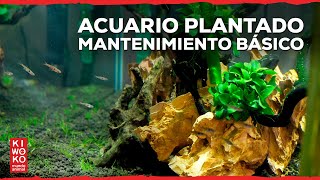
This is a YouTube video titled "Mantenimiento Básico para un Acuario Plantado 🌿🐠 | Guía Fácil para Principiantes | KIWOKO" created in April 2025. The content is a detailed instructional guide presented by a single speaker explaining the process and importance of water changes and maintenance in a mid-level planted aquarium. The speaker covers safety precautions, tools needed, techniques for cleaning and siphoning, and tips for maintaining a healthy aquatic ecosystem. The video is aimed at beginners and intermediate aquarium enthusiasts and includes practical advice on aquarium care.
Foreign. Hi everyone. Today we have a super exciting video. Today we're going to talk about why you need to do a water change and a brief maintenance in a mid level planted aquarium. Because the how to is very simple. It's basically emptying, cleaning the algae and refilling. Remember why before we start? First things first. Safety in both aquariums and terrariums. When you're going to do maintenance, you must disconnect the devices that are in direct contact. In this case we're going to have to disconnect the filtration system, the heating system, and I'm also going to disconnect the CO2 system. Lighting is not necessary because it's not in contact with the water. Also wear shoes because we don't want you to get an electric shock. So I'm going to get started. For the maintenance you're going to need, I recommend some Perlon to clean the glass. Of course, always have at least a couple of buckets and I'll explain why. You're going to need one for when you empty the water. And you're going to need the second one so that you have water beforehand. Attention conditioned. It is always a good idea to prepare the water for at least 48 hours. What does this mean? You leave a bucket of these that has about 20L your water prepared two days before making the change, or three days before or week before. But it is always a good idea to leave the water in contact with the conditioner for at least 48 hours. I have explained this in many videos. Once you have the water prepared, it is time to start the mechanical part before the mechanical part. Interesting tips. Always mark your aquarium so that you know more or less where the 10, 15, 20% is. If it is a small aquarium, you are going to have to change more water. Why? Because in the end the nitrogen complexes are much more concentrated and this is going to cause you problems. In this case, we are going to be changing 20% of this aquarium routinely. Attention. This maintenance must be done in less than 20 minutes. Have everything ready so that you can truly enjoy your aquarium and not always have to worry about changing the water. I always choose Prolon for cleaning the glass. It is a non abrasive material that will not scratch the glass. And in addition its white background helps me reach all the spots and make sure that I have cleaned the algae. Lastly, I go over all the sides, the three visible sides. And very carefully remember that we have fish, shrimp and snails inside. Now it's time for the suction or siphoning. There are different tools that you can use for this type of aquarium with this type of plants and this type of nutrient substrate care. I am going to use a siphon that I made myself. The important thing here is not to go all out with the siphon in the nutrient substrate. In fact, I do not recommend it. I recommend that you go very surgically cleaning all the corners here. What you want to do is reduce the organic matter that remains at the bottom and perform the water change. That's all here. It's important to control the suction force. And I'm going to use my thumb to absorb the part that I want to come out. Be careful. It's important to be very, very, very surgical. As you can see, I'm barely removing the substrate. Why? Because I need the plants to maintain their roots and to be very careful with the fish. I want to stress once again that we're working with nutritious substrate and it's not recommended to siphon the nutritious substrate. We would obviously take away all the nutrients that the substrate has and the aquarium would end up being a muddy. As you can see, we're almost at the mark. So my partial water change is almost finished. Let's see who can tell me in the comments what I'm going to do with this nutrient rich water. And finally we have to top it up with water that I've previously dechlorinated. I prepared this water about three days ago, and now I'm going to prepare the new water with conditioner that will help me have everything ready in two or three days. What tool should I use? Hey, to fill your aquarium, you can use small jugs, which is the most orthodox method, or you can create an invention that is nothing more than a pump, a pipe. And basically what it does is help me fill my aquarium calmly while I'm doing other tasks. Charon, as you can see, the maintenance and care of a planted aquarium like this is very simple. But I don't want you to just stop there. I want you to understand why. Let me remind you that it's a small ecosystem, okay? It's a biotope where in addition to plants, fish and some invertebrates, we have to go a little further. We have to understand that inside there are a lot of microorganisms that need these changes. And it's very simple. I explain it in many videos. The solution to pollution is illusion. What does this mean? If we are able to maintain a planted aquarium with nutritious substrate, that is starting the level safely, analyzing the water, this will help us to maintain our ecosystem in a correct way. In future videos, I will talk about the value analyses that you had to take into consideration. But what is important here is for you to understand why not all aquariums are the same. The frequency of maintenance and cleaning that you do will depend a lot on it. If you have a small aquarium, you should know that if it is less than 60L, you will have to do much more maintenance than if you have a 120L aquarium. If you have an aquarium larger than 120L, you can extend the water changes. It is also important for you to know that it will vary according to other parameters, such as how many animals you have in the aquarium, what type of water you have. The water in Madrid is not the same as the water in Pontevedra, Mexico City or Buenos Aires. Here it is also important for you to stop and think, hey, what type of aquarium do I want? Because this will greatly influence the work you will put into having a beautiful aquarium. Finally, I hope you understood. If not, you can leave me a comment. I will be happy to answer. I remind you that we are going to continue doing a wonderful series on planted aquariums at an intermediate level, where we will have time to talk about fish, plants, CO2 lighting. One click. Thank you very much. And remember that many of these products are available in our Kiboku stores, okay?