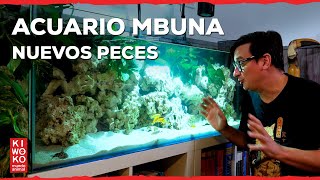
This is a YouTube video titled "Nuevos Peces para el Acuario Mbuna 🐟: 【Serie: Parte 6】" created in January 2025. The content features a single speaker providing a detailed narration about adding six different species of cichlids and a catfish to an aquarium, explaining the fish behavior, aquarium setup, water conditions, and care tips. The speaker also discusses the territorial nature of the fish and the importance of creating hiding places. The video is educational and focused on aquarium fish care and maintenance.
Foreign. Can you catch me? Yes, with my hands. In the aquarium, as I mentioned, I'm in the process of changing the decor because today is a big day. Today we're going to add new fish. I'm bringing six different species of cichlids. And A surprise. As you know, these species tend to be very territorial and. Yes, but as you can see, there are big changes. If any of the plants come loose while you're moving the decor, it's okay. We'll put them back later. I'm just saying the fish are already acclimating. As you can see, the room is a little darker than usual. They're getting acclimated by dripping. They've been here for over 40 minutes. Now. What's left is to add the new fish. I'm finishing moving some of the rocks so I can create as many caves as possible. Remember that these fish need a lot of caves so they can avoid the most territorial part, those aggressions that usually happen. Now we're going to get these beauties out. Let me explain a situation that I often go over with you. I had to leave some of the lighting on so that we could take the fish out and put them back in. After the last fish comes in, I turn the lights off again so that they can be calm. Another thing to notice is that I have completely changed the arrangement of the rocks. I have, of course, changed all the stones and rocks. And I have created new caves because new fish are going to come in. Remember that we are working with Mabuna cichlids, African cichlids from Lake Malawi. They are quite territorial. And it is important to always keep this in mind. We are going to change the arrangement of the rocks. Another thing that we are also going to have to take into consideration is that we are not going to feed them. We have previously analyzed the water conditions. Today, the pH was 8.2, quite high. Remember that this is a high PH for these species. We are going to introduce them little by little. Another thing I want you to know is, although I'm using a book that's wonderful for identifying fish. Possibly because the fish are a little stressed, they won't have all their color. So later we'll make technical files for each of the species that have entered the aquarium. I'm going to start catching the first fish. I want to start with the ones called Melanochromis auradis. Let's see if I can catch them. Okay. They're going to start hiding in each of the caves. And this is because they're very territorial. This is going to be a quick one. Let's go with a Melanochromis johanni. They're blue. This one is a little stressed. There it goes in. Here we go with the largest specimen that's coming in, which is another Melanochromis. I think this one is a Joan. Look, it's very pretty. Here we go with another Melanochromis. That could be the migano. Yes, look how pretty it is. They're coming in. Well, as you can see, they go in immediately and hide. Okay, let's continue. Let's move on to a pseudotrophy axi. These are super pretty. These usually have yellow dorsal fins, a blue body and yellow fins. As you can see, they're coming in a little stressed and well, here they'll have time to find their hiding places and everything. Here we have a pseudo trophy Sokolophy. These are quite common, these African cyclia. There are usually many differences here with the albinos. Here we go with a pseudo trophy. Let's go. Elongatus is coming in. Oops. Come on, come in. Wow, how they hide, huh? It's been hard work focusing on these fish because they really disappear as soon as they enter the water. Also, as I was telling you, it's difficult to identify them because the patterns, when the animal is a little scared, stressed, you can't really see them. But basically we've included Melanochromis and Cetotrophes. The variety is super pretty. We have six species. But now comes the surprise. Although it is not from the same Lake Malagui, this one we are going to put in is a catfish, a Cynodontus multipuntactus. It comes from another of the Great Lakes, Lake Tanganyika. Believe it or not, the water conditions are quite similar. Very high pH and very high Kh chess. Of course, it is a beautiful animal, but you have to be careful. All the ends of its fins have a poison and it is like being stung by a wasp. That is why you have to be careful when putting it in. Why do we put them in the aquarium? Well, this type of fish helps us to control a little the waste that is generated from the food that the fish do not consume. And on the other hand, I am really putting it in because of its beauty, its patterns, white body and wonderful black spots. It is really pretty. Let's get it. Okay. As you can see, I released the fish not using the net, but this container because as I mentioned before, the ends of the fins have some tips that serve as harpoons. So what I didn't want was for it to get tangled in the net and then have to risk getting my fingers stung. That's why I left it like this. Now we're going to leave it alone. The fish are basically measuring it to see. But in a little while, when we turn off the lights, it's going to hide and they're going to leave it alone. Okay, I already put all the fish in. Now I'm going to finish filling it with water. Remember, we're not going to feed the fish today. I'm going to turn off the lights and leave the aquarium completely dark so that the new fish can adapt properly. The combination is wonderful. As you can see, it's an aquarium that has a lot of life. Important. Subscribe. We will continue making content about feeding, care and oddities. These are fish that incubate their young in their mouths. With a bit of luck, later, we will be able to see this biological part that is super interesting. In addition, we will continue making new content. And I remind you to leave me a comment about this aquarium or any other. I am here to help you.