PLANTAS TÓXICAS (y no tóxicas) para GATOS Y PERROS | 🌿Aloe vera, helecho, costilla de Adán, menta...
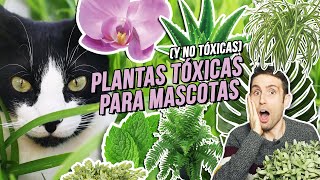
This is a YouTube video titled "PLANTAS TÓXICAS (y no tóxicas) para GATOS Y PERROS | 🌿Aloe vera, helecho, costilla de Adán, menta..." created on January 13, 2021. The content features a discussion primarily between two speakers, Carlos, a clinical veterinarian specializing in small animals, and Jose, who assist in presenting information about various common household plants and their toxicity to pets such as cats and dogs. The video aims to educate pet owners on which plants are safe or toxic to their animal companions, providing practical advice and examples. The tone is informative with some casual conversational elements, but it is not centered on a diarized conversation involving Javier Pariente.
Today I bring you a complete guide so that your passion for botany and your animal companion are not incompatible. Hello, I'm Carlos, a clinical veterinarian in small animals. Welcome to the Happy Pets and Families Channel. I don't know if you know that many of the decorative plants that we have in our homes are toxic. I've already told you here on the channel back in prehistoric times about a lot of plants that were toxic to our animal companions, dogs and cats.
The other video was only about cats. Oh, yes, yes. Oh, well. And of course, I only want to focus on the negative things in today's video. I'm going to talk to you about very common plants, which you've asked me about in some comments on the channel that may or may not be safe for your animal companion. It doesn't matter if they are dogs or cats, in this case, for all of them. Okay, I'm going to tell you the common name of the plant. And below here, when Jose edits the video, he'll put the scientific name, because if not, I could invoke the Antichrist here in Latin and Jose would already be hating it a little bit for that. If in your area it's called something else and you want to help us, let us know in the comments so that everyone knows what it's called in their area. Come on, let's get started, because we have a lot to talk about. The first plant we're going to bring you is the areca. In case you don't know, it's that palm tree that's quite pretty. Honestly, I like it a lot. And if you live in a house with lots of light, it can be a very good option. I have to tell you, and someone who asked us, I don't remember the name, about whether it was toxic or not, that it's not toxic to dogs or cats, they can have it at home without any problems. It's true that Raquel says that she put the orca next to her cat and that the next day it threw up after eating it. The cat didn't vomit because the plant was toxic, but rather it's very likely that it had a good binge on areca leaves and did so to purge itself. And if you also like Eureka, as I do, you might also want to have an elephant's foot in your home. It's not that I dried it, but there's a plant called that. This plant is also not toxic, so you can have it with your dog and your cat. And now let's move on to one that's practically a staple in many homes. The pothos, or pothos, I don't know how to pronounce it with the th. Well, the pothos is a very hardy plant that can be grown practically without paying any attention to it. But I have some bad news for you. If you like pothos for their hanging shape and everything else, it's toxic to your cat and your dog. And I'm especially referring to cats, because pothos have that beautiful hanging shape and tend to be high up, so dogs usually can't reach them. If you have it high up, it's possible that your cat could climb up some area. So keep it away from any access that your feline companion could have and could binge on this, which can be very toxic to them. My mother might be having a heart attack right now because there are pothos in my house. The thing is, I've never told her to take it down because it's high up on a shelf and my cat can't have access to it in any way. If we saw that the cat was starting to show any interest in the plant, we would see about removing it or putting it somewhere else or whatever. And what could happen to your animal companion if it eats pothos? It has a very irritating effect on the mouth and also on the esophagus. So it's very likely that you'll see it become very alert. This usually happens with quite a few plants and that it might even start to vomit a little if it has eaten a small amount, it's possible that nothing will happen to it. If he has eaten a lot more, it is possible that it is much more serious and that you may see him vomiting without any type of control. Fern is a plant that is practically thousands of years old. In fact, I am going to tell you something interesting that has nothing to do with veterinary medicine. I don't know if you know that it reproduces by spores, not by seeds like other plants. Well, because with Carlos, you not only learn about cats and dogs, but but also about plants. If you like that prehistoric touch that ferns give to any type of environment, I have to tell you that it is a plant that is not toxic to dogs or cats. In other words, your animal companion can be completely safe by your side. You can have them and they can have access to them. In fact, they usually don't even pay much attention to them or even nibble on them, from what I know. And now we are going to talk about bamboo, which I also really like. The bad thing is that there are some dogs and Cats that think they are pandas and that they rush to eat bamboo as if there were no tomorrow. You don't have to worry too much because bamboo is not toxic to them. Most likely what will happen to you is what happened to our follower Marcella Villanueva, who had her cat eat the bamboo, ate all the shoots, and in the end the plant died simply because it was devoured by the cat. So if this happens to you with your animal companion, well, you know that it's better not to have it around because it will never grow. And now let's move on to the Monstera, also known as Adam's Ribbon. And don't let its scientific name fool you. Despite its name being Monstera deliciosa, it is a plant that none of our animal companions should eat because it can be extremely toxic to them. It gives me mixed feelings because it has become very fashionable. But if you live with an animal companion, especially if it is a bit mischievous, you should not put it in its environment. And what does it usually cause? Well, irritation in the mouth, excessive drooling, difficulty swallowing. Therefore, if you see that your cat begins to show, well, your dog begins to show a little bit of, so to speak, love for the Monstera, it is better to remove it from his her side. And what about aromatic plants and spices? Well, be very careful because they are usually toxic. In fact, I have a comment here asking me if mint, peppermint and thyme are toxic. Regarding mint and peppermint, they can be toxic, not in small quantities, but if your cat or dog eats a large amount of these plants, they can be a laxative. In the case of thyme, on the other hand, it is not toxic and you can have it around your animal companions without any problem. And the next one I love is the Bird of Paradise. This plant with that characteristic flower can attract the attention of many animals, especially cats, because, well, since it has that shape, they can try to hunt it. However, it's a pretty bad idea because the Bird of Paradise is also a toxic plant for them. So I wouldn't recommend that you have it in your home if you live with an animal companion. And in this case I have to be a little more serious because in addition to the above difficulty swallowing, excessive drooling can cause incoordination in cats, and in some small animals, such as rabbits, it can even cause death. And now let's move on to succulent plants. Well, they're called that because they have very fleshy leaves and in fact they. They're very adapted to growing in Areas where it doesn't rain much, for example, in countries like Mexico, they're quite common. Among them we'll find, on the one hand, aloe vera, which in this case, I have to tell you, is toxic to your animal companion, both your dog and your cat. In fact, aloe vera causes all of the things we've been talking about before. Difficulty swallowing, excessive drooling, etc. And there are some species of aloe that also cause problems with urine. It can cause your cat or dog to urinate a reddish color. However, not all succulents are toxic. In fact, in this group of plants, there are many that are completely safe for your animal companion. Among them, for example, we have the donkey tail, or the ponytail, or the horsetail, which is called by many names. That one is completely safe are also the H. Echeverias. And one of the typical plants that at least here in Spain is in many homes is the ribbon plant, because it also requires little care less little water, etc. They are those that are elongated and green and yellow in the center. These types of plants are completely safe for any type of animal companion, both dogs and cats, and even small rodents. They do not have any type of problem or contraindication. In fact, I know that there are quite a few cats that eat them and end up purging themselves with them. And if you are a botany enthusiast, you might go for the most difficult one yet. And you love growing orchids. Well, as we all know, and if you don't know, I'll tell you, for me, they are quite difficult to grow. If you live with an animal companion, you have to know that your orchids are not going to cause them any problems. Even if they are exotic and it seems like, hey, maybe we shouldn't go near them. Cats and dogs can be around them without any problems because they are not going to harm them. Make sure that all the plants you have in your home are safe for your animal companions. In the case that you live with a cat, it is quite good to have some types of plants so that they can purge themselves. In this case, I am referring to the classics canary seed barley, those that you put in a pot and grow and the cat eats them. In fact, it's a great idea to always have a pot of this type. If you have any type of plant in your home and you want to prevent your cat from eating it so that it can have access to those little green shoots and doesn't destroy your other ones that you have so much trouble growing. Whenever you go to the nursery or plant store. To buy any type of pot, make sure to write down its scientific name, because that will help you in two different ways. On the one hand, you can search the Internet yourself to see if it is toxic or not for your pet. And on the other hand, if you have written it down and in the end it turns out that it is a plant that can be harmful to your cat or dog, you can always tell the veterinarians so that we know if a specific antidote should be used or what to do if your pet has been poisoned. And since finding out which ones are toxic and which ones aren't is a job that's practically endless, we have some tools to help you find out what types of plants can be harmful to your animal companions. And I'm going to leave a direct link below to a very, very complete database so that you can enter the name. I recommend that you enter the scientific name because it's in English, because if you have to enter the common name, it may not be the same in English as in Spanish, or it may not recognize it and therefore you won't be able to find out if that plant is safe or not for your animal companions. And if you have questions about other plants that can be toxic, such as the poinsettia, diaphanbachia or oleander, we've already talked about those here on the channel and I'll leave the video up here for you to watch. And that's it for today's video. If you liked it, give it a like and share it with everyone. Remember to subscribe to our channel if you haven't already. And hit the bell so that YouTube will notify you every time we upload new content. Well, we also have a secondary channel here on YouTube called Questions and Answers from a Veterinarian where we upload your questions that you send us on Instagram. Head over and subscribe. And today we meet Iris and Gala, who, according to Merce, they're human, weren't given wings so that we wouldn't think they were angels. How poetic. Ezunilda lives with Elmer and Luna, who are her four legged family. Francisco Garcia adopted Coco three weeks ago, who is one year and nine months old, and he says that so far everything is fine. No wonder with that amusement part. Thank you very much for following the Happy Pets and Families channel and I'll see you in the next video. There will be a spider living up here. I think it's a surprise so that you can see it either the cat with the smile or the cat or the cat like that. Yes. Well, I. I'm just mixing them up a bit to my taste. I don't know. I think it's because they don't pay attention to it. Right? No. Right. Ikea plants, they're not like that. Right. They have, like hair on top. There must be extraterrestrial life here. No. Central America? No. In Mexico. I don't know if you know that hydrangeas have to have their roots exposed to the air because with those roots you do photosynthesis and all that. Yeah. No, no. Hydrangeas are the ones that look like butterflies. They're kind of round like that. Hey, but they look good, right? They're really good. If they had dust. Yes. Well, now, before you put this in place, you have to dust it with a feather duster or something. Right? Okay. And that's it for today's video.
More from Javier

Cuando nadie reconoce tu dolor por la pérdida de una mascota: así es el duelo desautorizado 💔




¿Tu perro hace suficiente ejercicio? Mantenerlo activo es clave para que viva mejor 🐶💪

GATIFICANDO UNA PARED PARA MI GATO 😻🧗♂️ Ideas para aprovechar el espacio vertical en casas pequeñas



Por qué duele tanto perder a un perro o un gato: el vínculo que explica nuestro duelo 💔🐾

