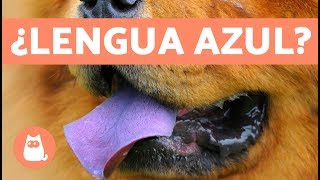
Chow chows have blue tongues because of a genetic trait that produces extra pigment in their mouth. The video explains the science behind this unusual coloration and debunks myths about what causes it.
The reason why the Cho Co has a blue tongue lies in its genetics. Since both the mucous membranes of this dog and its tongue have cells that other breeds do not usually have, or at least they do not have them in such large concentrations. However, several legends have emerged around this peculiar characteristic. Do you want to know them? In this video by an animal expert, we will talk about the blue tongue of the Chow Cho and explain both what science shows and what the legend tells. Since the Chowcho was a dog that was originally dedicated to guarding and protecting Buddhist temples, legend has it that one very cold day, a monk became seriously ill and could not go out to look for firewood to light the fire. So the Cho Co, who was in the same temple, went to the forest to collect wood, but only found charred pieces and took them to the monk. When he picked up the charred wood in his mouth, his tongue turned blue due to contact with the coal. The second legend says that the Cho Chow's tongue is blue or purple because one day a dog of this breed followed Buddha when he painted the sky blue. Since the paint from the brush left traces, the dog licked up all the drops that fell. And from that day on, the Cho Co became a dog with a blue tongue. Although the legends offer us very varied explanations, the real reason that justifies this coloration is found in the scientific studies that have been carried out on the subject. Thus, the Cho Chow's tongue is blue or purple due to the presence of pigment cells, that is, cells that contain elements called pigments that give it that color. Genetically, it has a higher concentration of these cells and therefore its tongue is a different color than other breeds. These cells, in addition to being found on the to, are mainly found in the mucous membranes. That is why the Cho Co is the only dog with lips, gums and palate characterized by this blackish blue color in its entirety, or almost. An interesting fact is that this characteristic is not only found in certain dogs such as the Cho Chow, but it is also present in other animals such as giraffes, Jersey cattle breeds and some families of bears, such as the polar bear. In fact, some studies conclude that the Chow comes from the emissions, a species of mammal that is between the dog and the now extinct bears and that lived in the Miocene. However, there is still no definitive scientific evidence to support this hypothesis. So for now, it is just that, a hypothesis. Another interesting fact that we have already mentioned is that the Chow is the only dog with lips and nose characterized by a blackish blue color. In fact, there are many breeds of dogs or crossbred animals that have spots of this color, but their mucous membranes are never completely dark. It is important to note that the Chow Chow was not necessarily born with a completely blue tongue, but that it begins to experience the coloration from two months onwards. Another breed of dog characterized by having a blue tongue is the Shar Pei. In this regard, it is important to clarify that the fact that any other dog has blue, purple, or dark spots or dots on its tongue does not mean that it is descended from a Chow Chow or another Chinese dog. More than 30 dog breeds also have spots on their tongues due to the pigmentation of their skin. And that's it for today's video. Did you find it interesting? If so, give us a like. Don't forget to subscribe and we'll see you in the next video. Until next time, experts.