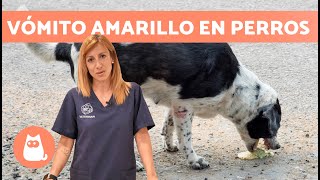
This is a YouTube video titled "¿Por qué mi PERRO VOMITA AMARILLO? 🐶 (Causas y Tratamiento)" created on September 26, 2022. It features a detailed monologue by Gisela Matic, head of the dermatology department at bet24 hospital, explaining the causes, diagnosis, and treatment of yellow vomiting in dogs. The content is educational, aimed at pet owners and veterinary students, and includes advice on veterinary protocols and when to seek professional care. There is only one speaker, and the content is not conversational.
Hi, everyone. I'm Gisela Matic and I'm the head of the dermatology department at bet24 hospital. We work as a collaborating center with bet formacion. And today we'd like to talk about the pathology of vomiting, especially yellow vomiting. We're going to focus a little more on canine pathology. We hope this video will be useful for your knowledge and for any concerns you may have. Well, your animals, and I'm going to focus a little on dogs now, have probably vomited at some point. When they're yellow, it might worry us a little. The yellowish color is usually because the animal has been fasting for a few hours or has vomited a lot. It has vomited several times in a row and then there's no more content in the stomach or it's the first thing in the morning when the animal hasn't eaten since last night. So what happens when they vomit? Well, generally when the owner decides to call the vet to consult. Right. What we're going to ask you for is a little bit of information about this vomiting, when it started, if it was acute, if it's been vomiting for some time, how many times it's been vomiting, to also know if it's one a day or six in less than an hour. Knowing a little bit about how many vomits and chronicity can give us an idea of whether it's something that has happened. Well, yesterday we were at a barbecue and our dog was eating things that weren't supposed to, or if there's a pathology related to a food allergy or if it could also be a problem with parasites. When we have, for example, a puppy or a geriatric animal, it's especially important for the vet to assess it to be able to prevent at least dehydration. We're going to use the same diagnostic protocol in almost all patients. But what we're going to take into account is symptomatic treatment of a patient who is at higher risk of suffering from dehydration. When a patient comes to the consultation, the first thing we need to do is take a good medical history and complete a complete medical history. Even if the animal is stable, it is more important to know a little about the previous history before getting started with our patient. What information can we normally ask for? Well, if the animal has been vaccinated and dewormed, if the animal has eaten anything unusual yesterday or days ago, if it is on a strict diet, if, for example, it seems that we have given it something after drinking and it has also vomited if the animal has been fasted, if there is one at home, if, for example, we have offered the animal something it likes, and even though we know that it is the animal's favorite food, it does not want it, or if, on the contrary, we have given the animal a soft diet for a few days and the patient has still not improved. Once we have enough history, we usually continue to gather information at the end of the consultation. But once we have a general idea of the history, we proceed to treat the patient. One of the first things we are going to do is examine the mucous membranes. It is a very easy way to see the patient's hydration status, to know if they have already started to become dehydrated, if they will need to be admitted or not, then we will continue. We will do it. It should always be done in an orderly and systematic way. So we will continue. We will perform a palpation of the nodules, the lymph nodes. Sorry. And we will make sure everything is fine. Parasitic diseases must also be ruled out many times. One of the parts that will give us the most information when we are doing a physical examination of an animal with digestive problems is abdominal palpation. In this case, what we often look for is if we find any points of pain, we will start the palpation from the cranial and we will go down and see if our patient complains, if there is air, if the content is more liquid, sometimes foreign bodies can even be felt. When the animal is quite thin, it is easier. We move on to perform an auscultation to see that everything is okay. When we perform auscultation, we also have to take into account the pulse, see if it is synchronous, look at the capillary refill time. That is, we also look at the color of the mucous membranes to see if they are perfusing well. And once we have a little bit, we check the temperature. We have done everything. We finish our physical examination. Then we proceed to perform the complementary tests. When we are treating vomiting or diarrhea, sometimes it requires the use of ultrasounds, analytical X rays, because vomiting is not always related to the digestive system. That is, we may think that vomiting is always related to the digestive system, but sometimes it can also be of renal or hepatic origin. In many cases, there may even be a uterine infection in unspayed females and also cause vomiting and diarrhea. In this case, once we have the tests, we can give a definitive diagnosis. And at this point, the veterinarian is the one who decides whether the treatment can be symptomatic at home or if the patient requires hospitalization to try to prevent dehydration. If we are talking, for example, about a puppy that has parbovirus, then it will probably need several days of hospitalization and normally the treatment is focused on ensuring that the animal does not suffer pain above all. In other words, we give great importance to analgesics. We would also start with antiemetic treatment, gastric protectors and if necessary, if it is necessary to go to the operating room because our animal has had access to a ball, a rag or something, a piece of a toy or something unusual, sometimes they have to go to the operating room to remove the foreign body that is causing this obstruction and as a result our animal vomits. If we see that the animal is stable and has simply vomited once or twice, it may not be necessary for our animal to remain hospitalized and can go home with symptomatic treatment and see how it evolves. If the evolution is not favorable, then we will have to go to our veterinarian again. Well, we hope that this video has been useful for your pet in day to day life. Now, if you have any questions regarding vomiting. As we mentioned, we are a collaborating center with Betaceone. If you have more concerns and want to turn your concerns and passion into your work, we invite you to look at the BET training page for a little information on how to train as an auxiliary veterinary technician and come to work with us. Thank you very much.