¿Por qué TU GATO NO QUIERE COMER? 😾🍽️ Gatos caprichosos con su comida
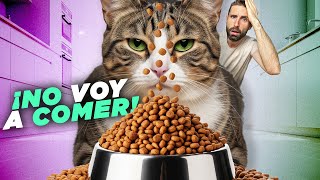
This is a YouTube video titled "¿Por qué TU GATO NO QUIERE COMER? 😾🍽️ Gatos caprichosos con su comida" created in July 2025. The content features a veterinarian named Carlos discussing why cats can be picky eaters, explaining behavioral and medical reasons, and offering practical advice to cat owners on how to manage and improve their cats' eating habits. The video includes detailed explanations about feline food preferences, feeding routines, and tips to stimulate appetite. The tone is educational and aimed at pet owners seeking to understand and help their cats with selective eating.
Your cat is always sniffing food and ends up rejecting it. Do you feel like you're feeding a very picky eater? You're not alone in this, and today we're going to remedy that. Hi, I'm Carlos and I'm a veterinarian, and this is Alcatofo. Welcome to the Happy Pets and Families Channel. We've decided to talk about cats with selective food. Cats that are a little fussy and who occasionally get bored with their food. Today I'm going to tell you how you can identify this behavior in your cat, and above all, and most importantly, how you can help prevent it from happening. Before we start, I want to ask you to support the channel like. Like the video. Share it with everyone, and if you really want to help us continue making content, give us a super thank you. Well, but what do I mean when I say a cat is fussy or selective with food? These are the cats that suddenly, from one day to the next, without anything having changed at all, start not wanting to eat their food, their kibble, their care, their croquettes. Or they are also those cats that suddenly start asking you, hey, please give it to me, give it to me. I'm desperate here. And when you fill their bowl with food, they say, well, you eat this. This behavior is also usually accompanied by them spending a few minutes there, sniffing, turning the plate around, as if to say, the thing is, I kind of want it, but I'm not going to try it. In short, it is a behavior that drives all families who live with a cat to despair. I say this because we have to differentiate it from medical problems that cause our cat not to want to eat, okay? Sometimes our feline companion, because their mouth hurts or the their little teeth, they have an ulcer, a sore in that area, or also because of some diseases such as kidney failure, or because they have digestive problems, such as gastritis, which makes digestion a little difficult, which causes them to vomit. Well, sometimes these cats stop eating, okay? So I'm not referring to this type of cat. If you see that your cat has reduced the amount of food it eats and that something is wrong with it, that it is accompanied by diarrhea, vomiting, weight loss, etc. You have to take it to the vet because it is very important that our cats eat enough food. Because many times when our cats stop eating, a situation called hepatic lipidosis occurs, which is very serious and very difficult to overcome. Today we're not talking about that. We're talking about those cats that say, I could eat But I just don't want to. Okay, lets get into what causes this type of behavior. There are several reasons, right? The first of them is the survival instinct. And you might say, what nonsense, Carlos. If my cat eats whatever falls on his plate, it won't hurt him at all. In fact, that's what I usually put in his food. There are some cats that have neophobic behavior. That means they're a little afraid or respectful of foods that are new or that have a slightly different flavor than what they're used to. So it could be that your cat has become a little picky about his food as a result of a slight change that you've made, or that you buy him the usual food and suddenly the composition has changed and you don't know about it anyway. Well, for those types of reasons, this is because our cats perceive flavors in a slightly different way than we do. They are able, for example, to better distinguish flavors such as bitter, right? Which could indicate in nature that a substance is toxic, that a plant is not good for him, or that a food is decomposing. I'm not saying that your cat's food is decomposing in that case, but those little variations in flavor can make the cat say, hey, I'd rather not eat it just in case. But of course, since they are cats, nothing is as simple as it seems. There are some cats that instead of being neophobic, that is afraid of new things, are neophilic. They are slightly attracted to that novelty. What happens in these cases is that although at first we see that this new flavor excites them, it really catches their attention. Little by little, that interest decreases. And then, well, yes, at first they eat it very well, but then they start leaving it on the plate. It simply doesn't catch their attention as much anymore. And all this will depend on the previous experiences the cat has had. How can we work in these cases in. In the case where our cat is neophobic or neophilic, if your cat is a little scared of new things, what you have to do is make the food transitions very gradual, okay? I already told you some time ago on the channel, in fact, I think I was even wearing this T shirt. I don't know about how you had to introduce new flavors to the cat or changes in diet, give them by 10% every two or three days. In any case, this should always be done this way to prevent your cat from getting diarrhea, okay? Because the food doesn't sit well with them. But for cats that are a little more hesitant, perhaps this transition can Take a little longer. And for cats that are attracted to new experiences, what can we do? Well, in this case, it requires a little prior research. If you see that at some point you have given your cat another food that has caught their attention, keep that in mind, because it may be beneficial for these cats to prevent them from getting bored. To change the type of food you give them more or less every six months. For that, my personal recommendation is to use the same brand that you are giving them for dry food, care, kibble and balanced, so that you identify two different proteins. Well, I don't know. Salmon on one side and turkey on the other. Every six months, make a transition to the food with the new protein. The transition will always be mandatory in the case in which we switch between dry foods. Well, because of the type of digestion that our cats have and also because it represents the largest volume of their diet. However, in the case of canned food, since it is a food that they will eat in smaller proportions, it is not necessary to do it. Your cat may have become a bit picky due to the time of year we are in. And I think that is precisely what has been happening to the cat in recent days. Might say now. Well, that's not my case because I don't offer it churu. I don't offer it treats. What I do is instead of the dry food, I give it a small can. Well, let me tell you that you are doing exactly the same thing. Cans are much more palatable. And that is why your cat will prefer to leave the dry food there for a while to see if it gets something much tastier. And related a bit to this issue of human responsibilities, let me tell you that if you have chosen to have food available to your cat in its dish all day, or that you fill it to the top until it forms a little mountain and it will start to dose itself, you may also be encouraging this type of behavior. The food will then be eaten. It will go a little rancid, it will become a little softer, it will lose its aroma, because, of course, it is in contact with the air and with the humidity of the environment. And then when your cat arrives, it may say, as soon as it is placed there, oh, this is very tasty, and eat a little bit. But as the hours go by, it says, look, human, you eat that. Give me something fresh. So how can you work with your cat in these situations? First of all, don't give in to blackmail. Stand firm and don't give him alternatives. This is almost easier said than done. But believe Me, it works. And maintain certain routines in your home. Fixed schedules work really well. If you feed your cat more or less every one to six hours, it's possible that he'll skip some of the feedings because, for example, he's not as hungry, or he'd rather not eat at that time, but he'll be hungrier the next time. And believe me, he'll eat. If you see that 20 or 30 minutes or a little more have passed and your cat doesn't want to eat it, take it away, put it back in the bag. You don't have to throw it away because it'll just get mixed in with the rest of the food and, well, nothing will happen and you can feed him again when it's his turn. In these cases, you can leave him a interactive feeder with food. For example, in the case of artichoke, it's little green ball. Why? If the plate is no longer available, it will always be able to use that feeder, move around a little, and at the same time do a little exercise to get the food it craves so much. And it can also help you a lot to reinforce these routines if you make a little noise every time you put the dry food in the plate. Stainless steel bowls are very good for this, because when the seeds fall, they make that characteristic sound like a bell that activates your feline companion's appetite. It's a bit like conditioning. Let's go. It may also not eat its food due to monotony. It is a little related to the issue of neophilia. And it is true that monotony kills everything, even your cat's appetite. If your feline companion knows what it is going to have, every time it goes to the bowl, it already knows that it always gets the same food, the same kibble. Well, it says, how boring, right? Okay, okay. Then later it's like this. That's why if there's no change in texture, flavors, etc. Your cat may lose interest. How can you work in these cases? For these cats, it works very well to give them the titration once a day. But instead of doing it routinely, for example always dropping it at night, try giving it at random times of the day. That will always give your feline companion a reason to explore. Why? Because they love that food. And just saying, hey, maybe it's in my food bowl is reason enough to come over and maybe eat a little more things. Well, if you heat it up a little in the microwave, nothing. In other words, less than 30 seconds, the titration will be Much more appetizing for your feline companion, and that can stimulate their appetite. This usually works quite well almost all year round, but in the case of summer, if it's really hot, do it the other way around. Give it straight from the fridge. And taking advantage of the whole summer theme, you can also make ice cream for your feline companion. How do you make it? Well, I already told you about it in a video some time ago, and I'll leave it link below in the box so you can see a bunch of tricks to keep your cat warm. More things that can help you break that monotony. Your cat's hunting instinct. Any type of game, just through physical movement and calorie expenditure, will stimulate your cat's appetite. But specifically, I recommend that you play hunting games with your feline companion. The act of stalking their prey, jumping on it, eating it, even if they don't end up swallowing it because it's a stuffed animal or with a stick or a feather duster or whatever you play with your cat will stimulate their hunting instinct a little bit to do what they would normally do in the wild. So since in these cases they usually eat their prey after hunting it, I recommend that you play right after this type of game. Don't give him food while he's playing, because that's probably what's awakening that feline appetite. But if, even then, if he doesn't want to go to his food bowl, what you can do is reward him while you're playing with your cat with small amounts of his dry food. That way, if you save a portion, he'll be eating without realizing it and he'll finish it all. And I think that with this, we've talked about all the reasons why our cats are a bit picky with their food. Surely with all these ways of working that I've been telling you, you can get him back on track. Be careful that sometimes you have to combine different methods because it's not always due to a single reason, but rather a combination of several. Okay. And if your feline companion finishes his entire plate, one. Well, thank you very much for watching the video. Hey, that also helps us, not just your cat. In any case, I hope that in this video you've learned something that will make your cat enjoy his food even more. And, well, now it's your turn. Have you ever had your cat finish his entire plate? Has your feline companion become a bit picky when it comes to eating? Does he leave food on your plate? Have you figured out why? Leave me a comment and tell me all about it because I want to find out also, as always, I have to ask you to show us lots of love, share the video and give it a like if you enjoyed it and subscribe to the channel if you haven't already. We also have a secondary channel here on YouTube called Questions and answers from a veterinarian. Check it out and if you want to support us a lot, give us a super thanks. Don't leave yet because before we go we have to meet Mira. The kuchofu raised his head. This precious little cat named Coco greets us with her human companion Eric from Costa Rica. And this beautiful tricolor kitty is named Yelena. She lives with her human companion Omar in Mexico City. We're not leaving the American continent because Pepe and Michi greet is from Uruguay. They do so from there with their human companion Veronica. Thank you very much for follow the happy pets and families channel with a relaxed artichoke. I'll see you next week. Oh, now I know. I understand. I know why I don't wear this shirt more often. Because it's a bit too big. Like this. Please, please look at it. Grateful and excited. Those people want to see you. Come on, point it here. Like this, like this, like this. Your little bird. They receive those slightly sour, slightly bitter flavors better.
They receive. They perceive. They perceive. I said they perceive. They don't receive. You don't. You don't perceive it because you perceive it differently. Oh, kitty, I'm going to put you down.
Huh?
You're making me feel so hot. Get on the blanket. Well, the artichoke is leaving. His current collaboration. Come on, get down here on the blanket. There, there it is. Great. In fact, they have a greater capacity for. Oh, I have a lot of cat hair in my hand. Like. They receive bitter flavors better. You said they do, but sometimes the food they have is very sweaty. I already have the little channel right now that we're leaving. Well, that's the one over there. As I said, it's not something you want. There could be more noise. A man with a drum and cymbal could pass by the window. M.
More from Javier

Cuando nadie reconoce tu dolor por la pérdida de una mascota: así es el duelo desautorizado 💔




¿Tu perro hace suficiente ejercicio? Mantenerlo activo es clave para que viva mejor 🐶💪

GATIFICANDO UNA PARED PARA MI GATO 😻🧗♂️ Ideas para aprovechar el espacio vertical en casas pequeñas



Por qué duele tanto perder a un perro o un gato: el vínculo que explica nuestro duelo 💔🐾

