Preguntas INCÓMODAS que NO TE ATREVES A HACERLE A TU VETERINARIO |Gatos, medicinas, alimentación y +
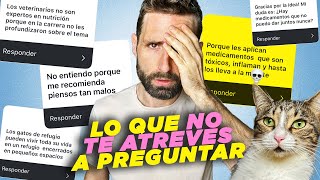
Veterinarian Carlos answers the uncomfortable questions cat owners are too shy to ask: how medications actually work, what vaccines cats really need, whether shelter cats carry diseases, and what they should actually eat.
Foreign medications that you should never give your cat together? Or what does it mean when your vet tells you to have your cat on strict bed rest? Sometimes we feel embarrassed to ask these and other questions during the consultation, and today I'm here to answer them all. Hello, I'm Carlos and I'm a veterinarian. And this is Alcajofo. Welcome to the Happy Pets and Families Channel. Au ca Chafee dough. I have to admit it, sometimes you go to the vet's office and you leave with a sea of doubts, often out of embarrassment or because you don't dare to ask your vet the things they've just explained to you. You go home with those doubts and then you don't know exactly what to do with your cats. That's why today I've set out to answer the most frequently asked questions that you usually have after returning from the consultation. So I won't ramble on any longer. And let's get started. Well, I'm going to apologize for my voice because I have a bit of a cold. Let's start with the most common questions about medications. To begin with, what does it mean to give this pill after eating? What we're mainly referring to is that our cat has to have a full stomach. It's not necessary to give it to your cat immediately after eating, but within a range of about 20, 25 minutes or half an hour. But of course, there are times when they tell you that your cat has to fast. What does that mean? Generally, the fasting period has to be about eight hours. We usually recommend this before surgeries, so that the stomach is empty and that our cat doesn't vomit, for example, when we give them anesthesia. But there are times when we want our cat to fast for a test. Well, in that case, as it can be for various reasons, such as to check blood sugar, or for example, to see if the liver is working properly. Your veterinarian will tell you in those cases how long your cat has to go without eating. And please respect that time, because otherwise the blood we take will be useless. I have also been asked which medications should never be given together. Well, this will depend a lot on the type of medication we are giving our feline companion. There are many types of medications and many can interact with each other. For example, a very common one that can be given to cats when they have ringworm and skin fungus is called reconnozole. Well, this usually has reactions with some antibiotics. Or if our cat has diabetes, it can also affect the medication we are giving them to Control their sugar. That is why it is very important to stop being embarrassed and tell our veterinarian that our cat is taking some treatment or ask about the interactions it may have, because it is essential if we continue with the topic of medications. Someone asked me that they did not understand how cortisone works. Cortisone, for example, is part of those steroidal anti inflammatories, also called corticosteroids. These are very useful medications. They greatly reduce inflammation in our cats and also in people. But in addition, at certain doses, they can also affect how the immune system works, reducing our body's ability to defend itself. This can be good. For example, when we are suffering from an allergy, there are times when we want the immune system to act a little less so that the symptoms are less. But if our cat has a chronic infection, for example leukemia or feline immunodeficiency, we have to be very careful because small changes in our cat's immune system can cause the virus to reactivate. Another thing, this question is why do they give them medications that are toxic, cause inflammation and even lead to death? Let's see. Let's see where this person gets all this information. Please. Let's make it known to all of us. Because the claims that they cause inflammation are toxic and so on are things or statements with very little foundation. What is always done when any medication is applied that we already know can eventually have a small or major adverse effect. In some people, even it depends. It is always necessary to assess the benefit obtained against the risk run by using it. For example, this is very clear in cats or in people suffering from cancer. Cancer is a very serious disease. If it is not caught in time, and if it is not treated properly, it can be fatal. What about chemotherapy, which are very aggressive therapies, very aggressive and have a large number of adverse effects. But what is the aim of chemotherapy? To save the life of a person who, if that antibiotic that is so aggressive and that works against cancer is not given to them, would already be doomed. Or that of a cat too.
Right?
In any case.
Right.
So what is always intended is to take the risks that we can based on the benefit that we are going to obtain. The benefit is enormous. It is either live or die. But the risk is also very great. Why? Because in those cases it is more worthwhile. Well, this always happens when any medication is prescribed or approved. The purpose of the medication is assessed, the risks of not taking it, and the benefits of taking it, even though taking it also involves some risks. Now let's talk about the tests that can be done on our cats during the consultation. The first question really caught my attention. They asked me, if you take great care of your cat and everything, and she looks very healthy, is it necessary to take her to the vet? Well, what do you think? It is true that your cat doesn't need to be stuck in the vet's office all day because everything will probably be fine. But I do recommend that she go to the vet at least once a year. There are things that we miss that, well, we are not used to seeing, and yet our vet can detect them very easily. But of course, a blood test is a different matter. How often should it be done? It is true that these are more or less general recommendations, but I do recommend that in very young cats it should be done more or less once every two years. From the time our cat is 5, 6, 7 years old, I would recommend that we do a test once a year. And for sure, 100% sure, from the time our cat is around 10 years old, we should do it once or twice annual tests, because the small changes that we detect in the tests will help us prevent future illnesses. Especially our other cats have a little delicate kidneys. And if we start to see that the kidney is working with a little difficulty, we can make small changes, for example, in the diet to prevent greater problems. Sure, but it can happen to you. Like a follower who asks going to anesthetize our cat because we need to remove a small wart or a small lump on the skin, then in that case we can take advantage of it and perform castration or sterilization. But in other procedures that are considered dirty. For example, if our cat has had an intestinal obstruction, it is only advisable to do a single procedure for operation. Here two things are the well being of our cat and on the other hand, the safety and time of the anesthesia. And related to this, I've also been asked what types of anesthesia there are and which ones should be chosen. We really choose one or the other, depending on what we have to do. There are some that are lighter, such as sedation, and there are others that are a little deeper. For example, there's intravenous anesthesia or inhalation anesthesia, depending on the type of surgery, you can choose one or the other. In any case, your veterinarian will choose the one that best suits your cat, which doesn't depend on the client's taste. It depends on the type of procedure that needs to be done. And we'll end this part about surgeries with a very interesting question. They asked me what is meant by resting a cat after an operation. It will also depend a lot on the type of operation. There are some surgical procedures that require strict rest that our cat practically doesn't move at all. Okay. I'm referring, for example, to herniated disc surgeries in the spine, which need to heal properly because it's a very, very delicate area and any false movement in the first few hours can greatly complicate recovery or even cause our cat to lose mobility in its legs. So that's why we need it to move as little as possible. And there are other surgeries, for example, those called ambulatory, which don't require the cat to be so immobilized. They simply don't require it to exert itself too much, not to jump high up, not to get on the couch so that the stitches can heal properly. In this group, we have, for example, castration or sterilization, which are much simpler, or skin surgery to remove a lump to keep our cat at rest. I'm going to give you some very, very important advice. If you are very strict about resting, keep your cat in a room and remove everything from that room. That has to do with heights, beds, sofas, chairs, so that your cat cannot climb anywhere and always walks on the floor. Put your bed there so that it is warm and comfortable. But now, if our vet tells us that he cannot even walk in these cases, sometimes the first night or the first day, they have to spend it in the carrier so that they do not have the option of moving around. If you have the option of a slightly larger cage that could also be used. I know it is very sad, but in these cases, you really have to listen to the surgeon, and it is the best thing you can do for your feline companion. And if the issue of surgeries, castrations, and so on was very important, this is no less important. Now let's talk about vaccines. First question, what vaccines are mandatory? Well, I have to tell you that except for rabies, which may or may not be mandatory, depending on the law, you have to do a lot of research depending on where you live. The rest are optional, but that doesn't mean they aren't beneficial for our cat. They protect them from a lot of diseases, so he should get them according to the vet's recommendations. And to not go into too much detail on this, I'll tell you my opinion and what the vaccination schedule is for a cat. Depending on where you live, I'll adapt it for everyone. In this video we made a while ago, where do you go? I read that not on the back, only on the legs. But my vet tells me something else. Oh, this is an eternal question. It's not written anywhere that you have to get vaccinated or that there are no recommendations, okay? The vaccine, of course, has to be applied subcutaneously under the skin in all or almost all cases. That's why you see your vet take a little pinch like this and put the vaccine there. The thing is that sometimes some cats develop an adverse reaction to the vaccine and inflammation can occur there, etc. So that's why the hind legs are usually preferred for vaccination, although if they do it on the back, they not doing anything wrong.
Right?
Because you ask me a lot of questions and you often expect me to tell you this is how it is and this is the law. And it always has to be this way, right? In general, medicine is always greatly influenced by the opinion of the doctor, in this case the veterinarian, right? Who is the one performing the procedure. And your veterinarian is not going to do anything that is wrong and that will harm your cat's life or anything like that, but rather it depends on each person's clinical judgment. But of course, if something doesn't convince you, you can seek a second opinion. You are completely free. Now let's move on to two questions that refer to the same thing. Is it advisable to vaccinate cats that live indoors? And it is true that our indoor cats have access to very few activities that we consider to be risky in terms of contact with other cats, cats that live in, well, uncontrolled environments, for example, on the street, that could suffer aggression and from which these cats could transmit diseases. But that doesn't mean they're exempt from all risks, right? Others too, for example, with our footwear, or if we've touched another cat outside, etc. Etc. We can bring viruses into our home. So it's not like we need to protect our feline companions. Of course, as I've said, they're going to have a very, very low risk of getting infected. And that's why we have to adapt the number of vaccines and how often we repeat them to at risk. Your veterinarian will be able to advise you perfectly. There are some vaccines that in cats that are very exposed, for example, the one for leukemia must be repeated once a year. But there are some other protocols that say, well, cats that are at very low risk can be vaccinated once every two or three years. The vaccination will always depend on the type of life our cat has. And another question they ask me, in what cases is it not recommended to vaccinate a senior cat that does not go outside? It is true that if we look at the vaccine leaflets, which is where they tell us what the indications are, how often they should be given and so on. They do not tell us in any case that older cats should not be vaccinated, however, well in these cases, and especially if they have some other pathologies. Well, well, perhaps we want to avoid the ordeal of having to go to the vet, the injection and all those things. In any case, it is possible to continue vaccinating an older cat, always adapting the vaccination schedule to the risk that our cat suffers or runs. But hey, if our cat, for whatever reason, doesn't do well going to the doctor's office, then it works out. In these cases we can reduce the number of vaccines we're giving them a little bit more about vaccines, People ask me, why do vaccines sometimes produce a different reaction than usual? Vaccines are medicines like any other. All medicines from an aspirin that we take to an ibuprofen or whatever we take can also have adverse reactions. It mainly has to do with allergic reactions. In the same way that your daughter at home may be allergic to pollen and you aren't. There are some cats that are allergic to some of the excipients of the vaccine and others aren't. That's why it's important to always keep this in mind, especially if our cat has had an adverse reaction in the past and we tell the vet, because other vaccines with different excipients can be chosen that are safe and won't cause any reaction in that cat. In any case, the vaccine leaflets are public, ok? They're published. I'll leave you a link below from the Spanish Medicines Agency, where you can easily consult all the leaflets for all medications. It's true, and I always have to remind you that when you start reading a leaflet, you often get all squeamish because you start to think that all this is going to happen to your cat.
Right?
In the leaflets, adverse reactions are always divided into infrequent, very rare and extremely rare reactions. And that means that only one cat out of many experiences these types of unwanted effects. For the rest, they don't have any other type of reactions. And now let's move on to another hot topic food. I've noticed that you're very interested in the subject of feeding cats, but I've Also noticed some people who say that veterinarians don't have a clue about this whole food thing. For example, for example, they say veterinarians aren't experts in nutrition because they didn't study the subject in enough depth during their studies. Well, during our studies we do train them on nutrition. In fact, we have specific subjects on the subject of nutrition. I don't know what you know, ok? You may be a super educated and knowledgeable person, but many times we make completely unfounded accusations based on things we've heard or read online. And we say, no, vets don't have a clue. It's much better to give them this formula that I found on TikTok. Well, let's all have a little more common sense and think a little more about the things we say before doing it. I think this is closely related to the fact that there are many people who are against dry food, concentrated food, well, they call it ultra processed and all that. And every time a vet recommends dry food, dry cat food, they say, well, they don't have a clue because it's much better to give them raw meat. Those people may not know that raw meat also has some intrinsic risks for our cats, as I've told you billions of times. Okay, so here I'm speaking a little bit about myself, apart from the knowledge I bring from my degree. Logically, before talking to you about any topic, I try to do a lot of in depth research so that I can give you quality and truthful information. And then what each person does with that information is up to them. In the end, you can choose whatever you want. But always remember that your cat will suffer the consequences. Well, let's continue with the topic of food. Food. I've gotten a bit intense. I don't understand why you recommend such bad feed. The feed or food that your vet is recommending to your cat is probably right for it. It's true that some have different qualities than others. That's why I've always recommended that you read the label and make a critical judgment when I tell you to read the label. It's when you're buying a food that's physiological for a cat that doesn't have any other health problems. A normal everyday diet, if your cat has a specific health problem, we'll talk about that in more detail later. Your vet will recommend the food that's best for treating that health problem. For example, I'm thinking about urinary problems, which I'll tell you about later. These types of foods don't follow the general rule that I've told you about in a bunch of videos on this channel which I'll link to below. Ok, so you know how to choose. These foods are formulated so that the nutrients they provide the cat can control their health problem a little more. So it's common that you won't find an animal product as the first ingredient because it's often necessary to use plant based products so that the specific food for that health problem has the desired composition. Another question about nutrition is what do you think about supplements sold with omega for hair loss? Because yes, supplement, supplements are also nutrition. Well, that topic is a little sensitive because there are some people who think that supplements are good for absolutely everything. But it is true that supplements with omega with omega fatty acids have been shown to be beneficial for skin health. They also make hair shinier and have anti inflammatory or anti inflammatory properties. The only problem is that they are fatty acids, they are fats. So if we overdo it with these supplements, our cat will end up gaining weight. So supplements are good. They can help us with a specific issue or problem. Okay, but we can't abuse them either. And they are not a panacea either. If our cat loses a lot of hair or has lost hair because it has severe dermatitis or because it has a fungal infection, no matter how much fatty acids we give it, we are not going to solve the initial problem. We can help you, but in the end we have to give you the specific treatment you need. Now let's move on to some slightly less orthodox questions about feeding. They asked me, can a cat only eat mice? Well, let's see. I don't know what cats, you know, I don't know any cats that only eat mice. In fact, it's not like that in nature either. Cats that live free on the street don't eat mice. That's an image that cartoons have created for us. Our cats on the street eat whatever they can find, right? And it could be a small mouse, or if there aren't any, it could be a small bird. But it might not be that type of meat that they eat. It could be beetles that they also eat. The idea that cats only eat mice is an idea that has nothing to do with the physiology of the cat itself. And a little bit related to this. They asked me what happens if my cat eats a fly or a lizard. Well, as you can see, this can be part of a cat's normal diet. It's likely that nothing will happen to it at all. Okay. It's true that indoor cats may be less used Dead and may have some type of intestinal discomfort after eating a food that is not part of their usual diet, such as diarrhea or loose stools. Okay, but that's only because it's not part of their diet, not because that specific food has harmed them. Of course, we're referring to insects or lizards that aren't toxic. Okay. If our cat comes into contact with one that is, such as a salamander, we'd be talking about something else. And in that case, you'd have to take it to the vet to have it checked out. And now we have the last block, which we can call a disaster or something else, because there are some questions here that can help you a lot, but they're a bit more varied. First, do cats fart? Is it normal, or do they only do it when they are sick? I have to say that yes, it can be normal, although if they do it very, very often, it could be indicating something. It is very common, for example, in cats that have had a change in diet. It is also in cats that, for whatever reason, do not digest the type of food they are being given well. Or, for example, in the case of artichoke, it usually happens a lot when they binge on food. And this can have a lot to do with stress. If you see that your cat occasionally farts, don't worry if it does so very, very frequently over time, check the litter box, go to the poop to see if everything is okay, and if not, take them to the doctor. Another thing we always keep an eye on with our cats is the issue of urine. A very interesting question that tells me about the types of crystals that are in the urine. As you know, our cat can suffer from flu or feline lower urinary tract syndrome, which is sometimes caused by small crystals that are produced in their urine. These crystals will have different natures depending on something very important, which is the ph of the urine. There are generally four main types of, on the one hand, oxalate and strubite. These are the most frequent. We also have urates and cysteine. These crystals can have different manifestations in our cats. As you know, difficulty urinating urine that is a pinkish or reddish color. Well, all these things are associated with bladder problems in our feline companions. And in relation to them, there is another question they ask me. What is the diet that is given to resolve strubite crystals? Well, depending on the type of crystal our cat has, it will need one diet or another. And that is why I was telling you before that Diets have specific formulations to help our cat with its problems. These diets are very common. There are some foods called urinary, for example.
Right.
They are not for kidney problems, but to dissolve these crystals and eliminate the problem. This type of diet must be given exclusively for them to have their effect. So if our cat has been told that it has to eat a diet to dissolve strubite crystals, it is no good for another cat that has oxalate crystals, it is only good for those that have strubite crystals. And it is also no good if, in addition to that diet, since it may not like it very much, we mix it with its old food. That is a botch job and will not help our cat to eliminate the problem. Another question that has nothing to do with the above, he asks me toxoplasmosis, can it reactivate in my data? And what treatment is there? Well, toxoplasmosis, that great disease that you always ask me about, which we have talked about a lot on the channel, and which, as you know, is generally transmitted through food. Because if you live with a cat, you are not at greater risk of suffering from toxoplasmosis. I want you to be very clear about that. Okay? If you want to know a little more, check out the videos that I leave for you below. Our cats, after they are infected for the first time, end up with the infection and cannot be reinfected. And they will not expel toxoplasma through their feces. Therefore, even if they have been infected with toxoplasma at some point, they cannot infect any other living being, neither another cat nor another person. Well, although I have already told you that it is very unlikely that your cat will give you toxoplasmosis. Well, we have already talked about that in other videos. Videos regarding treatment. Well, they are specific medications for these cases, but usually antibiotics, and that will solve everything. It is true that sometimes the treatments can be a bit long and can even last for a long time. And the last question I wanted to answer is, can shelter cats live their entire lives in a shelter, locked up in small spaces? There are also people who occasionally need to volunteer, go to shelters and see the conditions the cats are in there. Okay, because there are some people who think that cats are kept in cages, but that is not the case for those who do not know, because, well, they have never been to a shelter. I have to tell you that cats are not caged. It is true that they are in enclosures which have fences to prevent Them from escaping, from going out into the natural world where there are also dangers.
Right.
Well, those enclosures are not small. There are times when shelters, unfortunately, are overwhelmed because they are trying to help more animals than they can physically handle. And there are times when, yes, it must be recognized that they may have a slightly higher concentration of animals than would be desirable. In other words, there are a lot of cats, but that does not mean that the cat's movements are limited. The cat can move perfectly. In fact, those enclosures, those fences, are generally connected to kennels or interior areas where cats can take refuge in case it rains or the weather conditions are not optimal. So, no, they are not put in cages. Okay. And those cats that are in the shelter have been taken there because a greater good is being provided for them. For example? For example, a very old deaf and blind kitten that cannot fend for itself on the street. A kitten that has been rescued from the middle of a highway and is not part of any colony. It's a kitten that, in the normal natural world in which we live.
Right.
Because the nature of cats is the same as ours and it's just as hostile to them as it is to us. Those cats wouldn't be able to survive on their own. They're not associated with other animals with whom they can collaborate. And they're probably also rejected from other colonies because when they arrive, well, they might not be the strongest and those colonies might not accept them either. They might have territorial conflicts, etc. So those are the cats that also go to shelters, the ones that are abandoned by inhumane people.
Right.
They're used to living only inside a house. Those cats might not adapt to living on the street, and therefore their lives are at serious risk on the street. And that's why they have to go to a controlled place. If you notice, feral cats or colony cats aren't currently taken to shelters, a health strategy is implemented with the colony. Massive reproduction is prevented. They are taken to the vet from time to time. If there is any type of problem, they are taken to the clinic, but they are left in that area. Why? Well, because their life is made there and they are used to living in the human and natural environment where that cat lives. But other cats that are not adapted would not have the same opportunities to survive. And that is why they go to the shelter, to provide them with a greater good. As I say, the shelter is not a place for small animals, but generally, large enclosures aren't toxic. Ok. If our cat comes into contact with one that is, such as a Salamander, we'd be talking about something else. And in that case you'd have to take it to the vet to have it checked out. And now we have the last block, which we can call a disaster or something else, because there are some questions here that can help you a lot, but they're a bit more varied. First, do cats fart? Is it normal or do they only do it when they are sick? I have to say that yes, it can be normal, although if they do it very, very often, it could be indicating something. It is very common, for example, in cats that have had a change in diet. It is also in cats that, for whatever reason, do not digest the type of food they are being given. Well. Or, for example, in the case of artichoke, it usually happens a lot when they binge on food, and this can have a lot to do with stress. If you see that your cat occasionally farts, don't worry if it does so very, very frequently over time. Check the litter box, go to the poop to see if everything is ok, and if not, take them to the doctor. Another thing we always keep an eye on with our cats is the issue of urine. A very interesting question that tells me about the types of crystals that are in the urine. As you know, our cat can suffer from flu or feline lower urinary tract syndrome, which is sometimes caused by small crystals that are produced in their urine. These crystals will have different natures depending on something very important, which is the ph of the urine. There are generally four main types. On the one hand, oxalate and strubite. These are the most frequent. We also have urates and cysteine. These crystals can have different manifestations in our cats. As you know, difficulty urinating urine, that is a pinkish or reddish color. Well, all these things are associated with bladder problems in our feline companions. And in relation to them, there is another question they ask me, what is the diet that is given to resolve strubite crystals? Well, depending on the type of crystal our cat has, it will need one diet or another. And that is why I was telling you before that diets have specific formulations to help our cat with its problems. These diets are very common. There are some foods called urinary, for example.
Right.
They are not for kidney problems, but to dissolve these crystals and eliminate the problem. This type of diet must be given exclusively for them to have their effect. So if our cat has been told that it has to eat a diet to dissolve strubite crystals, it is no good for another cat that has oxalate crystals, it is only good for those that have strubite crystals. And it is also no good if, in addition to that diet, since it may not like it very much, we mix it with its old food. That is a botch job and will not help our cat to eliminate the problem. Another question that has nothing to do with the above, he asks me toxoplasmosis. Can it reactivate in my data? And what treatment is there? Well, toxoplasmosis, that great disease that you always ask me about, which we have talked about a lot on the channel, and which, as you know, is generally transmitted through food. Because if you live with a cat, you are not at greater risk of suffering from toxoplasmosis. I want you to be very clear about that. Okay, if you want to know a little more, check out the videos that I leave for you below. Our cats, after they are infected for the first time, end up with the infection and cannot be reinfected. And they will not expel toxoplasma through their feces. Therefore, even if they have been infected with toxoplasma at some point, they cannot infect any other living being, neither another cat nor another person. Well, although I have already told you that it is very unlikely that your cat will give you toxoplasmosis. Well, we have already talked about that in other videos. Videos regarding treatment. Well, they are specific medications for these cases, usually antibiotics, and that will solve everything. It is true that sometimes the treatments can be a bit long and can even last for a long time. And the last question I wanted to answer is, can shelter cats live their entire lives in a shelter, locked up in small spaces? There are also people who occasionally need to volunteer, go to shelters and see the conditions the cats are in there. Okay, because there are some people who think that cats are kept in cages, but that is not the case. For those who do not know because, well, they have never been to a shelter, I have to tell you that cats are not caged. It is true that they are in enclosures which have fences to prevent them from escaping from going out into the natural world where there are also dangers.
Right?
Well, those enclosures are not small. There are times when shelters, unfortunately, are overwhelmed because they are trying to help more animals than they can physically handle. And there are times when, yes, it must be recognized that they may have a slightly higher concentration of animals than would be desirable. In other words, there are a lot of cats, let's say, but that does not Mean that the cat's movements are limited. The cat can move perfectly. In fact, those enclosures, those fences, are generally connected to kennels or interior areas where cats can take refuge and case it rains or the weather conditions are not optimal. So no, they are not put in cages, okay? And those cats that are in the shelter have been taken there because a greater good is being provided for them. For example? For example, a very old, deaf and blind kitten that cannot fend for itself on the street. A kitten that has been rescued from the middle of a highway and is not part of any colony. It's a kitten that in the normal natural world in which we live, right? Because the nature of cats is the same as ours and it's just as hostile to them as it is to us. Those cats wouldn't be able to survive on their own. They're not associated with other animals with whom they can collaborate. And they're probably also rejected from other colonies because when they arrive, well, they might not be the strongest and those colonies might not accept them either. They might have territorial conflicts, etc. So those are the cats that also go to shelters, the ones that are abandoned by inhumane people, right? They're used to living only inside a house. Those cats might not adapt to living on the street, and therefore their lives are at serious risk on the street. And that's why they have to go to a controlled place. If you notice, feral cats or colony cats aren't currently taken to shelters. A health strategy is implemented with the colony. Massive reproduction is prevented. They are taken to the vet from time to time. If there is any type of problem, they are taken to the clinic, but they are left in that area. Why? Well, because their life is made there and they are used to living in the human and natural environment where that cat lives. But other cats that are not adapted would not have the same opportunities to survive. And that is why they go to the shelter, to provide them with a greater good. As I say, the shelter is not a place for small animals, but generally large enclosures. And please, let's take into account the work done by volunteers, shelters, animal rights activists, people who are dedicated to caring for animals completely selflessly because they do a great job. And it is better not to talk without knowing, okay? Because in the end that only makes us spread hoaxes and false ideas that have nothing to do with reality. In the end, the reputations of all these selfless people end up being damaged. They are doing a super important job, completely vital for our cats. And of course we have to Recognize it. I would also like to take this opportunity to tell you and ask you to support local animal associations in your neighborhood, in your city, in the area where you live, because there are definitely some. Okay. If you don't have time, you don't have to stop by to help out or clean litter boxes. Hey, if you can do it, you can. Great. Even better. They will really appreciate it. But you can donate food, you can donate blankets, or there is even a micro payment platform called Teaming, which allows them to receive small amounts of income. Only €1 is given to each of the associations and that amount of income really makes a difference for them. They can make a world of difference because they are able to stretch the euro to, well, unimaginable limits. So think about it, because as I said, you can collaborate in many ways and you will help them a lot. Well, I hope you found this video super interesting and the questions helped you a lot. I had a lot of fun making it too. If you liked it, give it a like. And remember to subscribe to the channel if you haven't already. Also, if you really want to support us, you can give us a super thank you. Remember that if you hit the bell, YouTube will notify you when a video is released and that we have a secondary channel called Questions and Answers from a Veterinarian. Check it out. Before we go, let's meet this chubby girl named Nicky who lives with her human companion, Joel. And Jessica greets us from Mexico. She is the human companion of these three kittens, Neri, Dina and Destelo. And we say goodbye from Chile. This pretty girl is called Katana, and she lives there with her human companion, Jose Alejandro. Thank you very much for following the channel Happy Pets and Families. And I'll see you in the next video. A little while you a kitten. He's having his playtime. Oh, but a nap never hurts.
Right here.
Little drop kisses. I have to be quiet. They told me to be quiet. There are a lot of questions. Try to be brief. Yes, very brief. I mean, explain things well, but don't ramble on. So I'm not going to ramble on and I'm going to give you the answer. So I'm not going to ramble on any longer. And there's someone who asked me that doesn't know how to understand, because he says he doesn't know how to understand the immune system, reducing its effect. The effect of the immune system adapting this vaccination to the way of saying no, no, no. And then I say this argument doesn't seem to me that that's why you're asking me, Josu. It makes sense that it is. Well said, Jose. Because that leaves a larger portion for dinner. Jose. That's dinner for me. Well, there are times when our cats are a little lazy. Very specific. And discarding the energy is very. Okay, that's it. But move it a little further away. Of course he's going to throw it, right? He's not going to throw it. I'm not going to answer tosoplasmosis. Okay. Or yes? Yes. Okay. Don't say that. It's not understood here. Yeah, of course. That's why it was an insult. It's not understood. Yeah, of course. But that's why you're here. To tell me what you don't understand. I've repeated it every time you've told me. Is that clear? Yes. We'll record the questions later. No, please. Recording the questions. Another day kills me. But this weekend we're going to have to record another day. Look, you really are big headed.
More from Javier

Cuando nadie reconoce tu dolor por la pérdida de una mascota: así es el duelo desautorizado 💔




¿Tu perro hace suficiente ejercicio? Mantenerlo activo es clave para que viva mejor 🐶💪

GATIFICANDO UNA PARED PARA MI GATO 😻🧗♂️ Ideas para aprovechar el espacio vertical en casas pequeñas



Por qué duele tanto perder a un perro o un gato: el vínculo que explica nuestro duelo 💔🐾

