¿Qué hacer si tu gato no respira o se está ahogando? | Primeros auxilios: RCP y maniobra de Heimlich
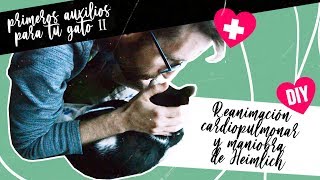
This is a YouTube video titled "¿Qué hacer si tu gato no respira o se está ahogando? | Primeros auxilios: RCP y maniobra de Heimlich" created on January 29, 2020. The content features Carlos, a clinical veterinarian, providing a detailed instructional talk on how to perform a physical exam on cats, including emergency procedures such as CPR and the Heimlich maneuver for cats that are not breathing or choking. The video also includes demonstrations using a dog as a stand-in and shares pet introductions at the end. The video is educational and aimed at cat owners to equip them with life-saving knowledge.
We already know how to do a physical exam. We saw it in last week's video. Although not many people have watched it yet, many of you have asked me how to do it if your cat has no pulse or is choking. And that was what I had up my sleeve for today's video. Hello, I'm Carlos, a clinical veterinarian at Small Animals. Welcome to the Happy Pets and Families channel. Today, from my home. Previously on Happy Pets and Families. Today I bring you one of those basic things that everyone needs to know when living with a cat. I'm going to teach you how to do a general physical exam on your cat. The first thing is to check whether or not your cat is breathing. What's the next thing you're going to check? The heart. Another place you should stop is to look at the color of its gums. If everything is fine so far, you need to check the cat's temperature. Okay. And so far, we've gone through the stages of a cat's physical exam. If you see that everything is normal, if your cat is breathing normally, then you check its pulse. If its pulse is normal, then you check its gums. Then you check its temperature. But what happens if you suddenly find that it is not breathing or its heart is not beating? In these cases, and very, very exceptionally, we perform cpr. It is important that you know how to perform these types of maneuvers because they can save your cat's life, although these are actions that we practically do out of desperation because it means that your cat is in cardio respiratory arrest and that its condition is very, very unstable. Even if you perform cpr, you will have to rush to the vet, but this can help keep it alive until you get to the clinic, where obviously the vet will be much better equipped and will also have more knowledge to stabilize your cat's vital signs. This is not easy, and you may not be able to do it, but it is good that you have the knowledge, because if you do, it could save your cat's life. Obviously, before doing nothing, at least try. This is something that should only be done in absolutely urgent situations. And when you have made sure that the cat has no pulse, is not breathing, and is not responding to any type of stimulus. Well, let's get started. Today I've brought Tatu as my assistant because Totoro won't be of any use to us for this. Goodbye, Totoro. These types of maneuvers are usually performed with Dumas. I'm not going to perform cardiac massage on Milou because he doesn't need it. I know that Tatu is a dog. But anyway, he'll be perfect for explaining how to perform cardiac massage on your cat. And I hope you never have to do it. And what's the first thing we're going to do? The first step is to press on your cat's chest a couple of times to expel some of the stale air in its lungs, which is kind of stale, not fresh air. Once this is done, you will need to begin mouth to nose breathing. You should not breathe into your cat's mouth, but rather through its nose. To do this, you must remove any type of collar or any type of obstruction that your cat has around its neck so that the air can flow without any type of barrier. For mouth to nose breathing, you must hold its mouth so that it does not open, because otherwise when you blow air in through its nose, all of it will come out through its mouth. Then you will need to hold its mouth up and in that case, blow air in through its nose. If your cat is lying on its side, you will need to rest it slightly on its front legs, stretch its head a little so that the airway is as open as possible, and blow a little air into its nose with your lips. If the chest inflates when you breathe, it means that you are doing it correctly. Here with my Liu, I show you the position, but obviously I did not do mouth to nose breathing because my cat did not need it. Inflate the air a couple of times and then lay the cat down again with its left side facing up. At this point, you will begin cardiac massage. It is not necessary to do cardiac massage on cats with both hands because they have a very, very small chest. You can simply use one hand to stimulate the heart. You will need to do approximately 100 to 120 compressions per minute so that the chest goes down approximately 1.5 or 2 centimeters with each compression to make sure that you are not applying excessive force that could fracture a rib. For example, for every five or ten compressions you do, you will need to insufflate a little air, as I mentioned before with mouth or throat breathing. At this point, you do not need to be stimulating the heart because otherwise you will not allow the lungs to inflate. At this point, stop stimulating the heart, put the cat in the position I mentioned, insufflate air and then continue. If you see that his heart is beating again or that he starts breathing on his own, so stop pacing him, you don't have to keep doing it, but you will have to go to the vet right away. As I've already told you, and if he's not breathing or reacting, you can continue for about 15 minutes. If you haven't managed to get the cat to react after 15 minutes, it means that the maneuver is most likely not being successful and that you won't be able to revive your cat. Also, should you take him to the vet? Yes, yes, always take him to the vet, just in case. And at that moment, even if you're performing cpr, you should already be heading to the vet and watch them do it in the car, because the sooner you get there, the better chance your cat will have of surviving. But it's also possible that your cat, for whatever reason, is choking on something. In that case, you have to do what I told you in the other video. The first thing you need to do is see if you can reach the object inside the mouth, because that is what is choking the cat. Then you will have to open the cat's mouth, look inside, and if you can, put your hand in and take it out. If we have not been able to extract it, we will have to hold it down and try to shake it so that the object can fall out if it is very close to the mouth. If not, what you will have to do is practice a daik g maneuver. What is the maneuver? Well, what we often see in movies where you squeeze people here so that they end up removing the object they are choking on. You can also do it with your cat, and it is very simple. You just have to know the exact place to apply pressure. But first of all, another disclaimer. We are doing this with a doomie because we are not going to do it with a real cat. We are not going to do it with a live cat because it does not need it, and therefore we should not practice it with our cats at home. On the other hand, it is a complicated maneuver. You might try to do it at home if your cat is choking, which I hope never happens, but it could happen, and you won't be able to remove the object that is choking it. In any case, whenever you see that your cat is in this situation, you will have to go to the vet's office because you might remove some of the fragments of what is choking it and there might be another one left inside. Or even doing all the movements in the himlish maneuver, you won't even be able to remove the object that is choking it. But whether it works or not, it is at least better to try and have the knowledge. That is why I am making the video to do this in cats, where their ribs end in the abdomen, down here you will find a softer, more sunken part. That is exactly the point where you have to apply pressure. To apply pressure, you will have to use one of your fists, place it and hold that fist with your other hand. This way you'll be able to apply the force of both arms to try to make the object move towards the mouth, and from there you can remove it or your cat can expel it. It's important that each time you press on the area of the abdomen inside the mouth, because you may see the object at that moment and end up removing it. If you don't see it, you'll have to press again to see if the object ends up coming out. If after you've done it three or four times, you're still unable to get your cat to expel it, you'll have to run to the vet's office so they can extract it. And that's it. That's it for the video. I think it was short and quite useful. Well, let me know in the comments if you found it useful or not. Today we've had Tatu here, who's been a bit incognito in this video about cats, even though he's a dog, but the truth is that he's behaved quite well. And that's it for today's video. If you liked it, give it a like and share it with everyone. I really think this is information that everyone should know when living with a cat. Also, remember to subscribe to our channel if you haven't already. And hit the bell so that YouTube will notify you every time we upload a new video. Thank you very much for following the Happy Pets and Families channel, and we'll see you in the next video. And as always, we're going to introduce your pets in this section of the channel, but not without first telling you that we have a secondary channel on YouTube called Questions and Answers from a Veterinarian, where we answer very, very short questions that you have when living with your cats and dogs. Stop by and subscribe so you don't miss anything. Well, let's get started. Oh, the odd couple. They tell me this is Truoneto and he sleeps on top of his cage. Here he is with Zeus. They have all been rescued from the street, except Truoneto, who is adopted. I hope Truonito is the rat, because if he is a rat caught from the street. And here we have my Nino, who look at his bearing, a practically imperial bearing. He tells me that he greets me from the Canary Islands and asks me to please take our next video. He says, meow, meow. Please, man. If you act like that kitty, I'm sure I'll take you out. How handsome he is. And look at all the little things I have here. They introduce me to Catchy, who is a kitten that they adopted from a shelter where he was a little shy and quite quiet, but who in the end ended up being an explosion of joy and mischief according to his family. The truth is that you can see from his face that he is a very mischievous cat. Thank you very much, Joanna, for introducing us to your kitten. And congratulations on having adopted him. And if you want, let's meet your pet. What you have to do is introduce them to us in the Facebook group. But if you've already introduced them to us in the Facebook group, please be patient. We're releasing them little by little so you might find your animal family at the end of our videos. One of the least expected weeks. See you next week, crazy face. Oh, wait, I'm crying now. There's already a super plane above us. You're giving off a bit of a bad vibe in this shot. Keep a cool head veil. I like this more than anything you've recorded. Well, that's it. Well, I'll save it there. Right, because you can't see your sleeve. People know what a sleeve is. It's just that if I repeat it now, it might not come out. Okay. But anyway, should I really do it then or not? Well, I'm going to change it because as I said, the other thing. Okay. And if you do it like this, downwards, you have a bit of a dark light. Okay. No, wait. Wait for them to focus on you, like everything else. Oh, this doesn't need to be done anymore. Read it, Virgin Mary. Sure. And that's it. I hope this video has satisfied your desires, your needs, your curiosity. Previously on Pets and Happy Families. I say this with less drama. What? Nothing. We're going to get the chickpeas stuck at the end, you'll see. Amen.
More from Javier

Cuando nadie reconoce tu dolor por la pérdida de una mascota: así es el duelo desautorizado 💔




¿Tu perro hace suficiente ejercicio? Mantenerlo activo es clave para que viva mejor 🐶💪

GATIFICANDO UNA PARED PARA MI GATO 😻🧗♂️ Ideas para aprovechar el espacio vertical en casas pequeñas



Por qué duele tanto perder a un perro o un gato: el vínculo que explica nuestro duelo 💔🐾

