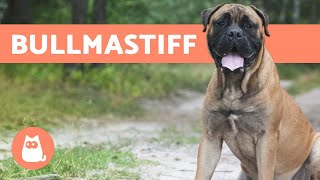
This is a YouTube video titled "Raza de perros BULLMASTIF - Origen, Características y Temperamento" created on September 19, 2019. The content is a detailed monologue describing the Bullmastiff dog breed, covering its origin, physical characteristics, temperament, care, training, health issues, and legal considerations. The video is presented in Spanish and aims to inform viewers about the breed's history and proper care.
The Bullmastiff dog breed was created by crossing an English bulldog with an English mastiff. The result is a strong, muscular dog with a noble character. Interested in learning more about it? We'll tell you all about it in this new video from animal Expert. Don't miss it. The history of the Bullmastiff begins in Great Britain at the end of the 19th century. At that time, gamekeepers used bulldogs or mastiffs to protect themselves from poachers and other criminals. However, they wanted to develop a much more effective breed of dog with specific attributes. The cross between these two dogs produced a strong dog with an excellent sense of smell. In fact, its mere presence was enough to keep criminals at bay. Later, the breed became popular and began to be kept on farms and estates in Great Britain. It is a large and imposing dog with a broad square head and a powerful symmetrical body. Males usually measure between 64 and 69 centimeters at the withers and weigh between 50 and 60 kilograms. Females, on the other hand, are slightly smaller, measuring between 61 and 66 cm at the withers and weighing between 41 and 50 kg. They have a short, hard and smooth coat to the touch, well attached to the body, generally red, fawn or brindle in color. The black mask on the face is also noteworthy. Although the Bullmastiff has been developed over generations as a guard and defense dog, the truth is that we are talking about an affectionate and loyal dog. Properly socialized, it will be patient, tolerant and friendly with all types of people, dogs and other pets. Although due to its large size, it can be somewhat rough when playing or hand in its puppy stages. We will observe a happy, fun and playful dog and later on its temperament will relax until it becomes a calm and kind dog. In any case, we are also talking about a dog that is very protective of its own, so we should not encourage aggressive behavior towards third parties. The Bullmastiff's education should begin early. When it is still a puppy, it should remain with its mother and siblings until it is approximately two and a half months old and then socialize it with other dogs or people, environments and animals. It is essential to offer it varied and positive experiences. To do this, we can attend puppy classes. Once its vaccinations are complete, we can take it out on the street where we will teach it to walk, to urinate and to socialize with other individuals. An important aspect will be to practice basic obedience commands which are essential for good communication between dog and owner, but also for the safety of the dog and other individuals. It may be advisable to go to a dog training center that works in a positive way. Remember that the bullmastiff dog is considered a potentially dangerous breed in many countries, for example in Spain, so it will be essential to obtain civil liability insurance and the relevant license. The bullmastiff will need between three and five daily walks, depending on its age and needs, which can also be combined with moderate sessions of physical exercise or games. We will provide it with quality food and due to its skin, we will ensure that it has a comfortable, soft and wide bed so that it can rest. The coat does not require much care. It will be enough to brush it weekly with a rubber brush and bathe it every two or three months, depending on the level of dirt. Finally, we must not forget that these dogs greatly enjoy mental stimulation exercises or toys, which of course must be durable and adapted to their size. Bullmastiff dogs frequently develop hip dysplasia and entropion, an eye problem. Less frequently, they may experience ataxia, wobbler syndrome, elbow dysplasia or retinal dysplasia. For all these reasons, it is advisable to have frequent Veterinary visits every six to 12 months, follow the vaccination schedule and carry out regular deworming both internally and externally. With all this, this dog can be with us for between eight and 10 years. What do you think of this breed? Would you adopt a bull mastiff? Leave us your comments and don't forget to like and subscribe if you enjoyed this content and want to stay up to date with everything we share. Until next time, experiment.