¿Son malos los HUESOS PRENSADOS o CARNAZAS para PERROS? | ¿Son peligrosos para tu mascota?
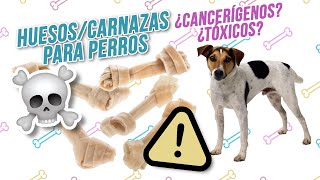
This is a YouTube video titled "¿Son malos los HUESOS PRENSADOS o CARNAZAS para PERROS? | ¿Son peligrosos para tu mascota?" created on October 28, 2020. The content features Carlos, a clinical veterinarian, discussing the safety and health concerns related to pressed bones and rawhide treats for dogs. He addresses common internet claims, explains the manufacturing process, regulatory standards, and potential risks such as choking. The video aims to provide a balanced, evidence-based perspective to help pet owners make informed decisions about these dog treats.
How many times have you seen on the Internet that these types of bones are carcinogenic or toxic for your dog? Well, that's exactly what we're going to talk about today. Hello, I'm Carlos, a clinical veterinarian at Small Animals. Welcome to the Happy Pets and Families Channel. The truth is that we've come across this type of post on the Internet a lot. In fact, we're making this video because a follower asked us about it in our Facebook group. He posted a post about bones, what was wrong with these types of pressed bones for dogs? And asked us what was true about it. Well, it's taken us a while, but here we are answering. You really don't find much information on the Internet. And the one you do find is always quite biased. There are those who tell you that bones are wonderful, which is usually the industry that makes them, and those who tell you that bones are terrible, that they will cause some kind of harm to your dog that is completely irreparable, but they also do not provide you with any information. Are they good? Are they bad? Do they have any side effects for your dog? Well, to find out, we are going to gradually break down the post that was shared with me on Facebook. What are they? Because you may have seen them in the store where you buy your dog's food and you do not know exactly where those bones come from. And they, in the past, they refer to them as buffalo bones. I tell you this because, as I read on, the word will come up and it is specifically referring to this type of bone. According to the post, it says buffalo bones for dogs are a derivative of the leather industry, the same type of factory that produces leather for clothing, bags and shoes. Okay, this isn't a complete lie. They're made of collagen. Collagen is generally obtained from the skin of animals. In this case, it's usually from cattle. What happens is that the skin is treated and part of it goes to make collagen for other things, including the collagen supplements that we take in certain circumstances. And the other part, the outer part, does go to be tanned, does go to make leather. Just because it all comes from the skin doesn't mean it's all made together. Each part is separated and goes to different industries. And how do they make them? Well, according to the post, they say, in fact, buffalo bone for dogs is really dangerous. To make it, it has to undergo a series of industrial processes that are extremely harmful to health. Then he tells you a little about the procedures and says, first, the cattle skins are sent to the tanneries to be treated with a chemical bath to prevent deterioration and putrefaction. Then they are treated with an ash solution, a recipe of calcined sodium sulfide that has an action to eliminate hair, the fat that covers the skin. The skins are treated with some chemical substance to make them flexible and can be rolled. The exterior is used for clothing, shoes, sofas, bags, while the interior is used to produce dog bones, including cosmetics, glue and gelatin. Once they are divided into two parts, the interior is treated with a hydrogen peroxide solution or bleach to eliminate the smell of the skin. Well, let's see. It is true that the skins from which collagen is obtained to make the bones that your dog eats are the same skins, or they may be the same skins that end up being tanned and that end up being made into bags or shoes or sofas. But that does not mean that all the skins were subjected to chemical processing or skins undergo a chemical process to obtain collagen. But the fact that something undergoes a chemical process does not necessarily mean that it is bad. As long as the substances used in the chemical process do not end up in the food in toxic levels, this does not necessarily have a negative impact on the dog's health. For example, some olives are pickled with soda, and this does not mean that you are eating the soda directly. Rather, a small amount of soda has been used to pickle the olives, which in the end are safe, and that you can end up eating them, in fact, and returning to collagen and skin. And also gelatin, which also comes from the skin. We often eat gelatin. And this has also had to undergo a chemical process to obtain this substance from animal skins, which does not mean that they are dangerous to our health. But the post also asks how it is possible that they are not expire. Has anyone noticed that these bones do not expire? But how is this possible? They are full of products, of course, toxic ones that help keep the product unchanged. The presence of lead, arsenic, mercury, chromium salts, formaldehyde and other toxic chemicals has been detected in rawhides and helps keep them unchanged. Oh my goodness. Sure, I understand that if right now they were telling you that in your dog's bones you could find arsenic, cosamine, formaldehyde and all kinds of chemicals, you would practically be having a fit. But is that true? The truth is that it is possible that raw cattle hide, which they are telling you is raw, can contain these types of substances, but chemical substances and heavy metals can be found in practically Any food. Everyone has heard about the mercury found in tuna. The thing is that the foods that are on the market have levels of heavy metals below a certain level limits that have been shown to be safe. And I'm not telling you with. With this argument that there's a little bit of castor oil or that there's a little bit of lead, or that. Well, I'm not saying that nothing happens here, but simply that there is legislation that helps ensure that the bones your dog is eating have limits that are considered safe for their health. In addition, dog bones and dog treats do expire. All the packaging has the expiration date on the packaging. What prevents them from deteriorating over time is that they have a small amount of water. But like when you give your dog dry food, since there's little water, bacteria can't grow and can't degrade the food. Of course, this is different. If, for example, you open a can of food for your dog, bacteria can grow in this type of food that has a lot more water, which is why you have to put it in the refrigerator. It's that small amount of water that prevents these types of bones from deteriorating over time, get bad over time. Okay, and having said all this, now you're probably saying, well, here you want to sell me the biggest bone for my dog, because it seems like you're super in favor. I want to make it clear that I'm not for or against it. At the moment, I'm simply presenting you with data and I'm seeing which parts of the discourse they've put in the Facebook post fit and which other parts are done a bit too broadly. These types of posts are usually written in a very special way. There are some parts that they think are true. So you go online, look it up, and say, oh, yeah, obviously it's true, and you already believe that everything else that is written is true. But they usually mix it up with other parts that are a bit ambiguous. These are the more alarmist parts where they say some vague, very, very serious things, such as the issue of heavy metals, which I have already told you, can be present in any other food, even in fruits, vegetables and greens. And they mix all that together, put it in a publication, and present it to you so that you believe everything as you are reading. As I always tell you, you do not have to believe 100% anything you find on the Internet. You do not really know what the intention of that person is giving it and what is behind that person. Having written the post or publication, they tell you a lot of things. That say, well, of course the this has been proven, but they do not tell you where it has been proven, which would be the important thing. If you were given that source and you were able to go and see it, you could form a more informed opinion on the matter. To ensure that the food your animal companions, canines, felines or any other type of animal that lives with you eat is safe, there are regulations that companies must comply with in order to market their food. In this case we are referring to a series of regulations in the European Union that include the maximum limits for certain substances that raw materials used to make animal feed may contain. This type of regulation defines what can and cannot be used to feed your dog. If it does not comply with the standards or limits, it cannot be marketed. And if any analysis or control is carried out and it is detected that it is above the limits, it is withdrawn from the market. For example, look, this image is of a dog treat that was intended to be imported into the European Union, which had a high amount of salmonella. It was detected and withdrawn. Of course the system is not perfect, but lets not fool ourselves either. It is possible that some food escapes this system. For example, it happened recently here in Spain with food for people that was infected with a bacteria called Listeria. It had bypassed the controls and in the end it had reached the consumer. If that happens, and if there is a company that does not comply, that will be the only company that does not comply. The rest should be complying. Another aspect would be how they are manufactured, what the manufacturing process is. And that unfortunately is quite opaque because companies do not publish it, nor do they for people, because the food that people eat is available to everyone. You can buy a pre cooked pizza. You assume that this pizza is safe for you, but you have not been in the factory to find out how it was made. Here with the issue of animal feed products, it is exactly the same. It is true that there is a part in the post where it talks about the possibility of choking and that is a very, very significant risk with this type of treat. Because they are quite hard, they have flavors that animals like and so they try to eat them quite quickly. It is possible that a dog will try to swallow a bone that is too big and that could cause them to choke. Therefore, if in the end, after all the information I have just given you in the video, you decide to buy this type of treat for your dog, you have to make sure that they are the right size for their mouth and this means large, because then they will not be able to Swallow it in one piece and two, when you give it to them, always be in front of them. Always be aware they may try to swallow it all at once. And if you are in front of them, you can take it away. In addition to all this, even if you buy them in an appropriate size and always have them in front of you, if you see that the bone is getting eaten away when it reaches a size where they could try to swallow it all at once, I would recommend that you remove it. Also if splinters or chips form, because that can be dangerous when they try to swallow it, it can scrape the esophagus and cause a fairly serious wound. Having said all this, what do I think about these treats? Well, as I always say, the smaller the amount of treats you give your dog, the better. And with this type of treat, even more so because they are highly processed products. That's why I'm not very, very much in favor of it. Needless to say, if you suddenly read the label and find that it has a lot of additives, a lot of colorings, a lot of flavorings, well, that makes me say, look, it's better to skip that treat for your dog and give him another one that may help him a little more or that has much better nutrit that is made with quality raw materials. And that's it. Finally, we've talked about pressed bones for dogs. It's a topic that has taken me a while to get through because as you can see, you have to find out about the regulations. But anyway, I hope I've helped you and resolved any doubts you may have at this time. That's it for today's video. If you liked it, give it a like and share it with everyone. Remember to subscribe to our channel if you haven't already, and hit the bell so that YouTube will notify you every time we upload new content. We also have a secondary channel here on YouTube called Questions and Answers from a Veterinarian. Check it out and subscribe too. And today we meet Kia, who is introduced to us by Jorge Fernandez, and he says he adopted her from a park near his house. And Basenis introduces us to Cora and Neo. These are crispies. Lucy Rodriguez introduced him to us. Thank you very much for following the Happy Pets and Families channel. And I'll see you in the next video. Let's see what I can find. I mean, what I want to tell you is that, for example, parts where they say things, well, in whatever way you think. Oh my goodness, of course. And what is behind that person not wanting them to do, like 1069 from 2009, like 142 from 2011 to help keep it unchanged. Right. Which is regulation 183 from 2005, community directive 200,232 that was affected by a basteria. Well, I mean, that makes me say that 1089, when they try to swallow it, they can also. When they try to swallow it, it's always better to try. Oh, I don't know. If I said the bell thing and that way avoid them trying to swallow it, then in the end. Jose, Jose M.
More from Javier

Cuando nadie reconoce tu dolor por la pérdida de una mascota: así es el duelo desautorizado 💔




¿Tu perro hace suficiente ejercicio? Mantenerlo activo es clave para que viva mejor 🐶💪

GATIFICANDO UNA PARED PARA MI GATO 😻🧗♂️ Ideas para aprovechar el espacio vertical en casas pequeñas



Por qué duele tanto perder a un perro o un gato: el vínculo que explica nuestro duelo 💔🐾

