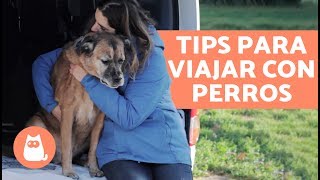
Patricia Herrero and Carina share how to prepare dogs for travel, from socializing them to teaching them to stay in a designated spot. They explain how to match trips to your dog's personality and build the mental skills they need before you go.
Hi, we're Bongo Vespa and myself. I'm Patricia Herrero from Patadora Canina. And today, together with an animal expert, I'm going to explain how to mentally prepare your dog. Before a long trip. I hope you've planned a canine adventure. But first you need to know that you have to mentally prepare your dog. It needs to be a few months in advance. Don't wait until you leave tomorrow, because at that point there won't be time. The most important thing is that your dog is well socialized. What does that mean? That he's used to everything he's going to encounter. I'm not just talking about dogs and people, but also about noises, new places, cramped spaces and transportation. During a trip there are so many situations that our dog has to deal with and he has to be okay with. How do you do that? Well, by gradually getting him used to all of that. I always say that socializing isn't about bullying. Just because I want to get my dog used to being with children doesn't mean we have to go to a school during rush hour with 10 kids touching him. That's it. Well, we do the exact opposite, but gradually get them used to it. It's a day to day thing. What we also have to do is identify if our dog is afraid of something and help them overcome it. Each dog is different and as I always say, even though I have dance classes and I want to dance, I will never dance like Shakira because I have my limitations. Well, dogs go through the same thing. What I want is for you to always be the best versions of yourselves, including your dogs. And for that we have to get them used to everything that happens. Although we help our dog to be more sociable, you also have to keep in mind that each dog has its own personality. So adapt the trip completely to your dog. What do I mean by that? Don't go to a super tastic place with a lot of people instead of going to the mountains. In other words, adapt each of the destinations a little during the trip. Also try to create moments for everything. That is moments of nature, moments of city life, moments of rest that we often forget. We think that since our dog is active and likes to discover things, he has to be active all day long. But that is not the case. Rest is very necessary. When I say rest, I do not mean just being as they are, which is right now relaxed, but sleeping soundly. And for that they need a safe place. What do you mean? They need to be used to being able to rest. Anywhere. The carrier, for example, is. It is a very good tool to be able to take your room with you anywhere. And so they can rest from a hotel room, in a van, in a restaurant, anywhere, because they have their room with them for them. It would be ideal if you got them used to sleeping in different places from the time they are puppies, not just at home. In other words, get out your planner, call your friends, and go to sleep in different places with your puppy. In this way, they will get used to resting in different places, not just at home. Now, we are going to explain a couple of very useful exercises for traveling with our dogs. One is to go to your place anywhere, and the other, of course, is the call. For this exercise, we're going to need a surface. It doesn't matter which one. For example, I've taken my blanket. I say this because it could be anything from a towel. There are also portable mats for dogs, their crib, their carrier, anything. What we're going to do is teach them to go to their place. And in this case, it's going to be this blanket. Okay? We'll put it here first. We're going to make it a little big. Okay? We're going to have enough surface because what we want is to go little by little. You see, they already know what the exercise is about, and they already get on top there. Let's see. Okay, so what we're going to need are edible treats that are big enough for them to chew on, but not so big that they have to be there for a while eating them and that are a little soft. So what we're going to do is the following here in your place, and we'll reward them inside. We could also do it with a clicker, but now we're going to do it this way. To your place.
Very good.
Come on out. Go out.
Very good.
Ideally, you should train one dog at a time, okay. Because it's hard to know what to reward when they're both inside, but, well, since they're behaving very well here, we'll let them both be outside. And it's also important that you say a word, just like we did with the car in another video. We'll also do it with the blanket. That is the when we want them to leave, we'll say a word. Come on to your place.
Very good.
Go out to your place. In this case, they've stayed outside. Since we're learning the exercise from scratch, we can reward and accept the octopus. But as we advance in the exercise, what we're Going to want is for them to be completely inside the blanket outside. Okay. To your place.
Very good.
To your place.
Very good.
Out. I'll put it outside. To your place.
Very good. Very good.
Out. To your place. That's also called a target. I've seen that you have a video on animal expert by Albera and Ala. Okay. Where it explains very well what targets are. This would be a floor target in this case, right? In this case, we can use a blanket, but it could be anything. What we teach the dog is to go to that spot outside. In fact, in competitions, it's often used to do what's called the box test, which is when they put out four cones and the dog has to go inside. Okay. That's done with these types of things. To your spot. And we could train it with many techniques. Right now, we're doing it simply with the very good, but we could also do it with a clicker. But anyway, now we're doing it a little bit. Look. And also, if our dog shows the behavior, in this case being inside by going alone, we can also reward it once we've developed the exercise of going to your spot a little bit. In this case, going to the ribbon blanket, we can put it anywhere. In this case, I've put it inside the van because it can also be a great way to teach them to get into the van. Vespa, to your place. To your place. Come on.
Very good.
To your place.
Very good.
Vespa, your place. Right there. To your place. Vespa.
Very good, very good.
Bongo Bongo, for example, doesn't do well getting up and down. So we're going to leave him up here. Vespa, get down to your place.
Very good, very good.
Go. I hope that after this video, you take the time to plan your canine adventure and also prepare your dog for it. If you want to follow ours, you have the channel paid Educadora Carina, where we will meet and you will be able to see everything we do. Ram.